

56
4 Life Evolves
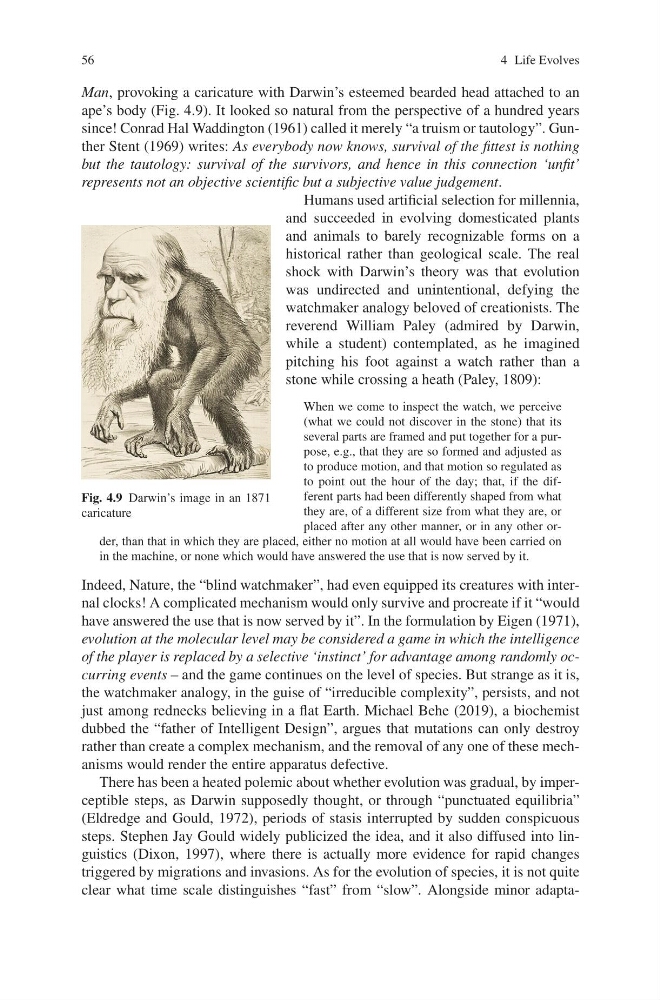
Man, provoking a caricature with Darwin’s esteemed bearded head attached to an
ape’s body (Fig. 4.9). It looked so natural from the perspective of a hundred years
since! Conrad Hal Waddington (1961) called it merely “a truism or tautology”. Gunther Stent (1969) writes: As everybody now knows, survival of the fittest is nothing
but the tautology: survival of the survivors, and hence in this connection ‘unfit’
represents not an objective scientific but a subjective value judgement.
Fig. 4.9 Darwin’s image in an 1871
caricature
Humans used artificial selection for millennia,
and succeeded in evolving domesticated plants
and animals to barely recognizable forms on a
historical rather than geological scale. The real
shock with Darwin’s theory was that evolution
was undirected and unintentional, defying the
watchmaker analogy beloved of creationists. The
reverend William Paley (admired by Darwin,
while a student) contemplated, as he imagined
pitching his foot against a watch rather than a
stone while crossing a heath (Paley, 1809):
When we come to inspect the watch, we perceive
(what we could not discover in the stone) that its
several parts are framed and put together for a purpose, e.g., that they are so formed and adjusted as
to produce motion, and that motion so regulated as
to point out the hour of the day; that, if the different parts had been differently shaped from what
they are, of a different size from what they are, or
placed after any other manner, or in any other order, than that in which they are placed, either no motion at all would have been carried on
in the machine, or none which would have answered the use that is now served by it.
Indeed, Nature, the “blind watchmaker”, had even equipped its creatures with internal clocks! A complicated mechanism would only survive and procreate if it “would
have answered the use that is now served by it”. In the formulation by Eigen (1971),
evolution at the molecular level may be considered a game in which the intelligence
of the player is replaced by a selective ‘instinct’ for advantage among randomly occurring events – and the game continues on the level of species. But strange as it is,
the watchmaker analogy, in the guise of “irreducible complexity”, persists, and not
just among rednecks believing in a flat Earth. Michael Behe (2019), a biochemist
dubbed the “father of Intelligent Design”, argues that mutations can only destroy
rather than create a complex mechanism, and the removal of any one of these mechanisms would render the entire apparatus defective.
There has been a heated polemic about whether evolution was gradual, by imperceptible steps, as Darwin supposedly thought, or through “punctuated equilibria”
(Eldredge and Gould, 1972), periods of stasis interrupted by sudden conspicuous
steps. Stephen Jay Gould widely publicized the idea, and it also diffused into linguistics (Dixon, 1997), where there is actually more evidence for rapid changes
triggered by migrations and invasions. As for the evolution of species, it is not quite
clear what time scale distinguishes “fast” from “slow”. Alongside minor adapta-
4 Life Evolves
Man, provoking a caricature with Darwin’s esteemed bearded head attached to an
ape’s body (Fig. 4.9). It looked so natural from the perspective of a hundred years
since! Conrad Hal Waddington (1961) called it merely “a truism or tautology”. Gunther Stent (1969) writes: As everybody now knows, survival of the fittest is nothing
but the tautology: survival of the survivors, and hence in this connection ‘unfit’
represents not an objective scientific but a subjective value judgement.
Fig. 4.9 Darwin’s image in an 1871
caricature
Humans used artificial selection for millennia,
and succeeded in evolving domesticated plants
and animals to barely recognizable forms on a
historical rather than geological scale. The real
shock with Darwin’s theory was that evolution
was undirected and unintentional, defying the
watchmaker analogy beloved of creationists. The
reverend William Paley (admired by Darwin,
while a student) contemplated, as he imagined
pitching his foot against a watch rather than a
stone while crossing a heath (Paley, 1809):
When we come to inspect the watch, we perceive
(what we could not discover in the stone) that its
several parts are framed and put together for a purpose, e.g., that they are so formed and adjusted as
to produce motion, and that motion so regulated as
to point out the hour of the day; that, if the different parts had been differently shaped from what
they are, of a different size from what they are, or
placed after any other manner, or in any other order, than that in which they are placed, either no motion at all would have been carried on
in the machine, or none which would have answered the use that is now served by it.
Indeed, Nature, the “blind watchmaker”, had even equipped its creatures with internal clocks! A complicated mechanism would only survive and procreate if it “would
have answered the use that is now served by it”. In the formulation by Eigen (1971),
evolution at the molecular level may be considered a game in which the intelligence
of the player is replaced by a selective ‘instinct’ for advantage among randomly occurring events – and the game continues on the level of species. But strange as it is,
the watchmaker analogy, in the guise of “irreducible complexity”, persists, and not
just among rednecks believing in a flat Earth. Michael Behe (2019), a biochemist
dubbed the “father of Intelligent Design”, argues that mutations can only destroy
rather than create a complex mechanism, and the removal of any one of these mechanisms would render the entire apparatus defective.
There has been a heated polemic about whether evolution was gradual, by imperceptible steps, as Darwin supposedly thought, or through “punctuated equilibria”
(Eldredge and Gould, 1972), periods of stasis interrupted by sudden conspicuous
steps. Stephen Jay Gould widely publicized the idea, and it also diffused into linguistics (Dixon, 1997), where there is actually more evidence for rapid changes
triggered by migrations and invasions. As for the evolution of species, it is not quite
clear what time scale distinguishes “fast” from “slow”. Alongside minor adapta-