

36
3 Broken Symmetry
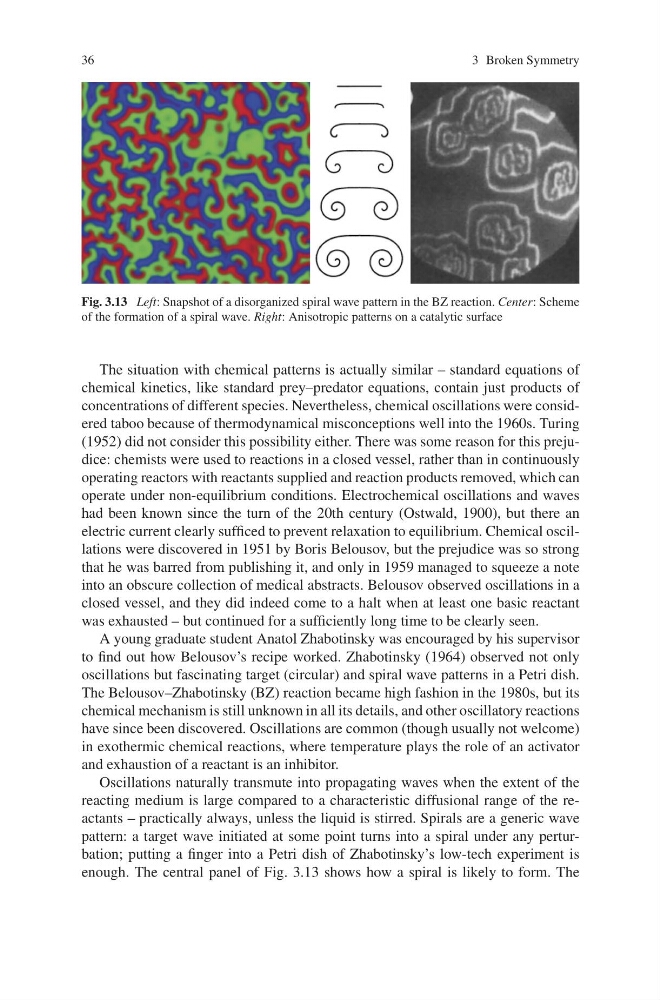
Fig. 3.13 Left: Snapshot of a disorganized spiral wave pattern in the BZ reaction. Center: Scheme
of the formation of a spiral wave. Right: Anisotropic patterns on a catalytic surface
The situation with chemical patterns is actually similar – standard equations of
chemical kinetics, like standard prey–predator equations, contain just products of
concentrations of different species. Nevertheless, chemical oscillations were considered taboo because of thermodynamical misconceptions well into the 1960s. Turing
(1952) did not consider this possibility either. There was some reason for this prejudice: chemists were used to reactions in a closed vessel, rather than in continuously
operating reactors with reactants supplied and reaction products removed, which can
operate under non-equilibrium conditions. Electrochemical oscillations and waves
had been known since the turn of the 20th century (Ostwald, 1900), but there an
electric current clearly sufficed to prevent relaxation to equilibrium. Chemical oscillations were discovered in 1951 by Boris Belousov, but the prejudice was so strong
that he was barred from publishing it, and only in 1959 managed to squeeze a note
into an obscure collection of medical abstracts. Belousov observed oscillations in a
closed vessel, and they did indeed come to a halt when at least one basic reactant
was exhausted – but continued for a sufficiently long time to be clearly seen.
A young graduate student Anatol Zhabotinsky was encouraged by his supervisor
to find out how Belousov’s recipe worked. Zhabotinsky (1964) observed not only
oscillations but fascinating target (circular) and spiral wave patterns in a Petri dish.
The Belousov–Zhabotinsky (BZ) reaction became high fashion in the 1980s, but its
chemical mechanism is still unknown in all its details, and other oscillatory reactions
have since been discovered. Oscillations are common (though usually not welcome)
in exothermic chemical reactions, where temperature plays the role of an activator
and exhaustion of a reactant is an inhibitor.
Oscillations naturally transmute into propagating waves when the extent of the
reacting medium is large compared to a characteristic diffusional range of the reactants – practically always, unless the liquid is stirred. Spirals are a generic wave
pattern: a target wave initiated at some point turns into a spiral under any perturbation; putting a finger into a Petri dish of Zhabotinsky’s low-tech experiment is
enough. The central panel of Fig. 3.13 shows how a spiral is likely to form. The
3 Broken Symmetry
Fig. 3.13 Left: Snapshot of a disorganized spiral wave pattern in the BZ reaction. Center: Scheme
of the formation of a spiral wave. Right: Anisotropic patterns on a catalytic surface
The situation with chemical patterns is actually similar – standard equations of
chemical kinetics, like standard prey–predator equations, contain just products of
concentrations of different species. Nevertheless, chemical oscillations were considered taboo because of thermodynamical misconceptions well into the 1960s. Turing
(1952) did not consider this possibility either. There was some reason for this prejudice: chemists were used to reactions in a closed vessel, rather than in continuously
operating reactors with reactants supplied and reaction products removed, which can
operate under non-equilibrium conditions. Electrochemical oscillations and waves
had been known since the turn of the 20th century (Ostwald, 1900), but there an
electric current clearly sufficed to prevent relaxation to equilibrium. Chemical oscillations were discovered in 1951 by Boris Belousov, but the prejudice was so strong
that he was barred from publishing it, and only in 1959 managed to squeeze a note
into an obscure collection of medical abstracts. Belousov observed oscillations in a
closed vessel, and they did indeed come to a halt when at least one basic reactant
was exhausted – but continued for a sufficiently long time to be clearly seen.
A young graduate student Anatol Zhabotinsky was encouraged by his supervisor
to find out how Belousov’s recipe worked. Zhabotinsky (1964) observed not only
oscillations but fascinating target (circular) and spiral wave patterns in a Petri dish.
The Belousov–Zhabotinsky (BZ) reaction became high fashion in the 1980s, but its
chemical mechanism is still unknown in all its details, and other oscillatory reactions
have since been discovered. Oscillations are common (though usually not welcome)
in exothermic chemical reactions, where temperature plays the role of an activator
and exhaustion of a reactant is an inhibitor.
Oscillations naturally transmute into propagating waves when the extent of the
reacting medium is large compared to a characteristic diffusional range of the reactants – practically always, unless the liquid is stirred. Spirals are a generic wave
pattern: a target wave initiated at some point turns into a spiral under any perturbation; putting a finger into a Petri dish of Zhabotinsky’s low-tech experiment is
enough. The central panel of Fig. 3.13 shows how a spiral is likely to form. The