

34
3 Broken Symmetry
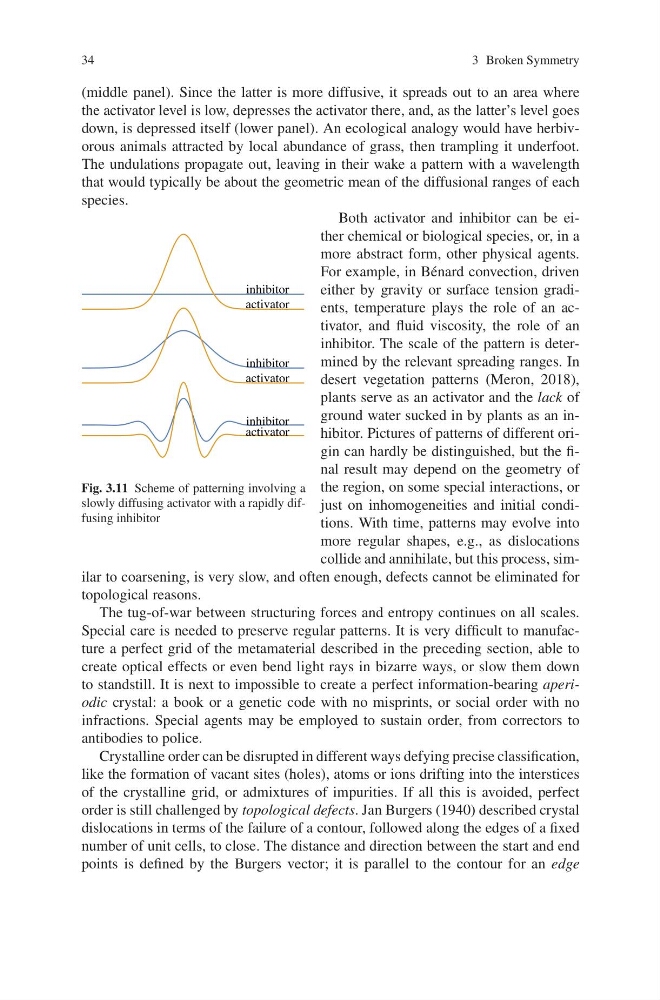
(middle panel). Since the latter is more diffusive, it spreads out to an area where
the activator level is low, depresses the activator there, and, as the latter’s level goes
down, is depressed itself (lower panel). An ecological analogy would have herbivorous animals attracted by local abundance of grass, then trampling it underfoot.
The undulations propagate out, leaving in their wake a pattern with a wavelength
that would typically be about the geometric mean of the diffusional ranges of each
species.
Fig. 3.11 Scheme of patterning involving a
slowly diffusing activator with a rapidly diffusing inhibitor
Both activator and inhibitor can be either chemical or biological species, or, in a
more abstract form, other physical agents.
For example, in B´ enard convection, driven
either by gravity or surface tension gradients, temperature plays the role of an activator, and fluid viscosity, the role of an
inhibitor. The scale of the pattern is determined by the relevant spreading ranges. In
desert vegetation patterns (Meron, 2018),
plants serve as an activator and the lack of
ground water sucked in by plants as an inhibitor. Pictures of patterns of different origin can hardly be distinguished, but the final result may depend on the geometry of
the region, on some special interactions, or
just on inhomogeneities and initial conditions. With time, patterns may evolve into
more regular shapes, e.g., as dislocations
collide and annihilate, but this process, similar to coarsening, is very slow, and often enough, defects cannot be eliminated for
topological reasons.
The tug-of-war between structuring forces and entropy continues on all scales.
Special care is needed to preserve regular patterns. It is very difficult to manufacture a perfect grid of the metamaterial described in the preceding section, able to
create optical effects or even bend light rays in bizarre ways, or slow them down
to standstill. It is next to impossible to create a perfect information-bearing aperiodic crystal: a book or a genetic code with no misprints, or social order with no
infractions. Special agents may be employed to sustain order, from correctors to
antibodies to police.
Crystalline order can be disrupted in different ways defying precise classification,
like the formation of vacant sites (holes), atoms or ions drifting into the interstices
of the crystalline grid, or admixtures of impurities. If all this is avoided, perfect
order is still challenged by topological defects. Jan Burgers (1940) described crystal
dislocations in terms of the failure of a contour, followed along the edges of a fixed
number of unit cells, to close. The distance and direction between the start and end
points is defined by the Burgers vector; it is parallel to the contour for an edge
3 Broken Symmetry
(middle panel). Since the latter is more diffusive, it spreads out to an area where
the activator level is low, depresses the activator there, and, as the latter’s level goes
down, is depressed itself (lower panel). An ecological analogy would have herbivorous animals attracted by local abundance of grass, then trampling it underfoot.
The undulations propagate out, leaving in their wake a pattern with a wavelength
that would typically be about the geometric mean of the diffusional ranges of each
species.
Fig. 3.11 Scheme of patterning involving a
slowly diffusing activator with a rapidly diffusing inhibitor
Both activator and inhibitor can be either chemical or biological species, or, in a
more abstract form, other physical agents.
For example, in B´ enard convection, driven
either by gravity or surface tension gradients, temperature plays the role of an activator, and fluid viscosity, the role of an
inhibitor. The scale of the pattern is determined by the relevant spreading ranges. In
desert vegetation patterns (Meron, 2018),
plants serve as an activator and the lack of
ground water sucked in by plants as an inhibitor. Pictures of patterns of different origin can hardly be distinguished, but the final result may depend on the geometry of
the region, on some special interactions, or
just on inhomogeneities and initial conditions. With time, patterns may evolve into
more regular shapes, e.g., as dislocations
collide and annihilate, but this process, similar to coarsening, is very slow, and often enough, defects cannot be eliminated for
topological reasons.
The tug-of-war between structuring forces and entropy continues on all scales.
Special care is needed to preserve regular patterns. It is very difficult to manufacture a perfect grid of the metamaterial described in the preceding section, able to
create optical effects or even bend light rays in bizarre ways, or slow them down
to standstill. It is next to impossible to create a perfect information-bearing aperiodic crystal: a book or a genetic code with no misprints, or social order with no
infractions. Special agents may be employed to sustain order, from correctors to
antibodies to police.
Crystalline order can be disrupted in different ways defying precise classification,
like the formation of vacant sites (holes), atoms or ions drifting into the interstices
of the crystalline grid, or admixtures of impurities. If all this is avoided, perfect
order is still challenged by topological defects. Jan Burgers (1940) described crystal
dislocations in terms of the failure of a contour, followed along the edges of a fixed
number of unit cells, to close. The distance and direction between the start and end
points is defined by the Burgers vector; it is parallel to the contour for an edge