

3.4 Non-Equilibrium Patterns
33
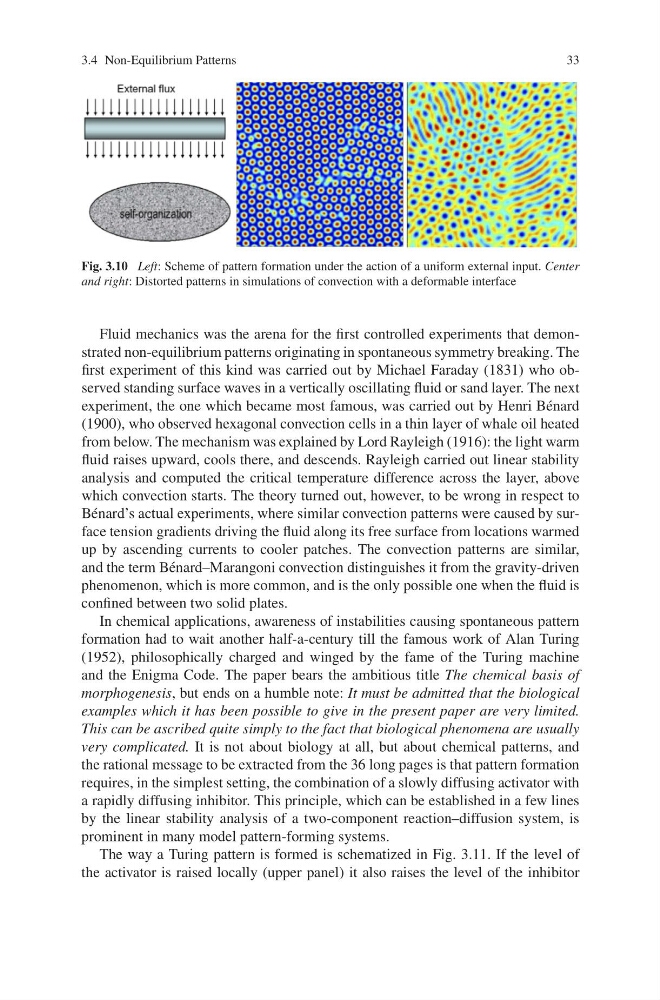
Fig. 3.10 Left: Scheme of pattern formation under the action of a uniform external input. Center
and right: Distorted patterns in simulations of convection with a deformable interface
Fluid mechanics was the arena for the first controlled experiments that demonstrated non-equilibrium patterns originating in spontaneous symmetry breaking. The
first experiment of this kind was carried out by Michael Faraday (1831) who observed standing surface waves in a vertically oscillating fluid or sand layer. The next
experiment, the one which became most famous, was carried out by Henri B´ enard
(1900), who observed hexagonal convection cells in a thin layer of whale oil heated
from below. The mechanism was explained by Lord Rayleigh (1916): the light warm
fluid raises upward, cools there, and descends. Rayleigh carried out linear stability
analysis and computed the critical temperature difference across the layer, above
which convection starts. The theory turned out, however, to be wrong in respect to
B´ enard’s actual experiments, where similar convection patterns were caused by surface tension gradients driving the fluid along its free surface from locations warmed
up by ascending currents to cooler patches. The convection patterns are similar,
and the term B´ enard–Marangoni convection distinguishes it from the gravity-driven
phenomenon, which is more common, and is the only possible one when the fluid is
confined between two solid plates.
In chemical applications, awareness of instabilities causing spontaneous pattern
formation had to wait another half-a-century till the famous work of Alan Turing
(1952), philosophically charged and winged by the fame of the Turing machine
and the Enigma Code. The paper bears the ambitious title The chemical basis of
morphogenesis, but ends on a humble note: It must be admitted that the biological
examples which it has been possible to give in the present paper are very limited.
This can be ascribed quite simply to the fact that biological phenomena are usually
very complicated. It is not about biology at all, but about chemical patterns, and
the rational message to be extracted from the 36 long pages is that pattern formation
requires, in the simplest setting, the combination of a slowly diffusing activator with
a rapidly diffusing inhibitor. This principle, which can be established in a few lines
by the linear stability analysis of a two-component reaction–diffusion system, is
prominent in many model pattern-forming systems.
The way a Turing pattern is formed is schematized in Fig. 3.11. If the level of
the activator is raised locally (upper panel) it also raises the level of the inhibitor
33
Fig. 3.10 Left: Scheme of pattern formation under the action of a uniform external input. Center
and right: Distorted patterns in simulations of convection with a deformable interface
Fluid mechanics was the arena for the first controlled experiments that demonstrated non-equilibrium patterns originating in spontaneous symmetry breaking. The
first experiment of this kind was carried out by Michael Faraday (1831) who observed standing surface waves in a vertically oscillating fluid or sand layer. The next
experiment, the one which became most famous, was carried out by Henri B´ enard
(1900), who observed hexagonal convection cells in a thin layer of whale oil heated
from below. The mechanism was explained by Lord Rayleigh (1916): the light warm
fluid raises upward, cools there, and descends. Rayleigh carried out linear stability
analysis and computed the critical temperature difference across the layer, above
which convection starts. The theory turned out, however, to be wrong in respect to
B´ enard’s actual experiments, where similar convection patterns were caused by surface tension gradients driving the fluid along its free surface from locations warmed
up by ascending currents to cooler patches. The convection patterns are similar,
and the term B´ enard–Marangoni convection distinguishes it from the gravity-driven
phenomenon, which is more common, and is the only possible one when the fluid is
confined between two solid plates.
In chemical applications, awareness of instabilities causing spontaneous pattern
formation had to wait another half-a-century till the famous work of Alan Turing
(1952), philosophically charged and winged by the fame of the Turing machine
and the Enigma Code. The paper bears the ambitious title The chemical basis of
morphogenesis, but ends on a humble note: It must be admitted that the biological
examples which it has been possible to give in the present paper are very limited.
This can be ascribed quite simply to the fact that biological phenomena are usually
very complicated. It is not about biology at all, but about chemical patterns, and
the rational message to be extracted from the 36 long pages is that pattern formation
requires, in the simplest setting, the combination of a slowly diffusing activator with
a rapidly diffusing inhibitor. This principle, which can be established in a few lines
by the linear stability analysis of a two-component reaction–diffusion system, is
prominent in many model pattern-forming systems.
The way a Turing pattern is formed is schematized in Fig. 3.11. If the level of
the activator is raised locally (upper panel) it also raises the level of the inhibitor