

26
3 Broken Symmetry
the Platonic bodies with triangular faces: a tetrahedron, octahedron, or icosahedron.
The former two correspond to the face-centered and body-centered cubic crystal
lattices, but the latter is something special, as we shall see presently.
Of course, other resonances are possible, including more than three waves and
waves of different wavelengths leading to other crystal structures, but the abovementioned lattices are the densest and most common, in both two and three dimensions. By classical theory, periodic crystals may possess an n-fold rotation axis with
n equal to 2, 3, 4, or 6. When Dan Shechtman (1984) found the forbidden 5-fold
symmetry in a diffraction pattern, he hesitated to publish. His hesitation was superfluous, and the discovery eventually led to his 2011 Nobel Prize in Chemistry.
Before Shechtman’s experiments, quasiperiodic structures had been predicted by
Harald Bohr (1925) 1 as projections of regular crystals in higher dimensions, and
in the 1970s Roger Penrose invented a quasiperiodic tiling of the plane bearing his
name. This pattern, shown in the left-hand panel of Fig. 3.3, never repeats itself but
has a simple structure built up of just two types of rhombic tiles. A quasiperiodic
structure in the plane obtained by superposition of six waves forming two resonant
triangles shifted by 30 ◦ looks similar to the diffraction pattern of a quasicrystalline
material (Fig. 3.3). A three-dimensional quasicrystal is generated by the icosahedral
resonant structure.
The crystalline structure shows up in the shape of slowly growing crystals, as we
see in the shapes of snowflakes (Fig. 3.4, center) retaining the hexagonal symmetry
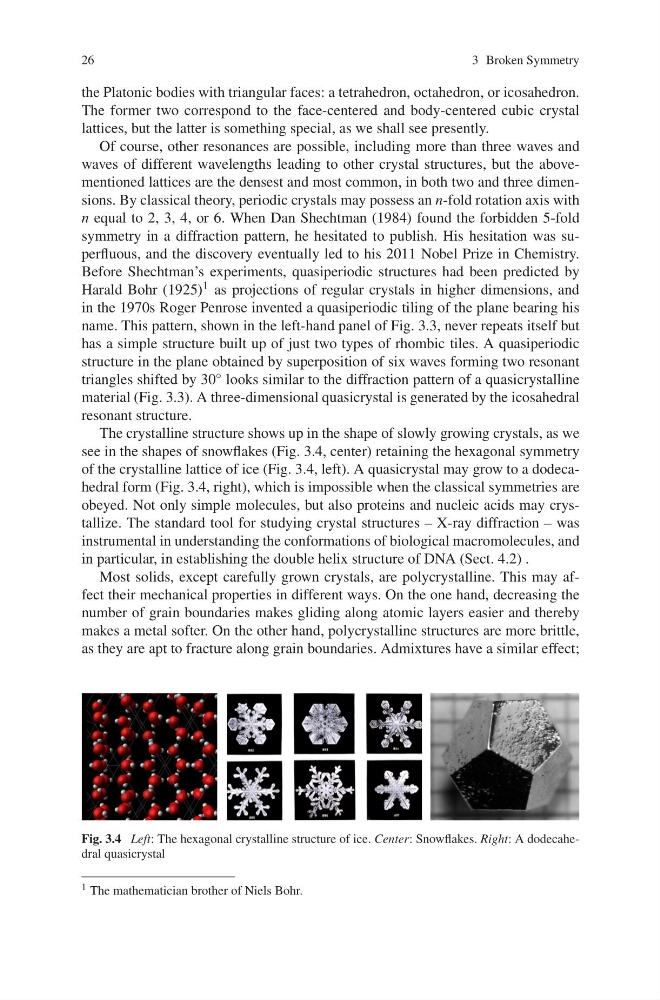
of the crystalline lattice of ice (Fig. 3.4, left). A quasicrystal may grow to a dodecahedral form (Fig. 3.4, right), which is impossible when the classical symmetries are
obeyed. Not only simple molecules, but also proteins and nucleic acids may crystallize. The standard tool for studying crystal structures – X-ray diffraction – was
instrumental in understanding the conformations of biological macromolecules, and
in particular, in establishing the double helix structure of DNA (Sect. 4.2) .
Most solids, except carefully grown crystals, are polycrystalline. This may affect their mechanical properties in different ways. On the one hand, decreasing the
number of grain boundaries makes gliding along atomic layers easier and thereby
makes a metal softer. On the other hand, polycrystalline structures are more brittle,
as they are apt to fracture along grain boundaries. Admixtures have a similar effect;
Fig. 3.4 Left: The hexagonal crystalline structure of ice. Center: Snowflakes. Right: A dodecahedral quasicrystal
1 The mathematician brother of Niels Bohr.
3 Broken Symmetry
the Platonic bodies with triangular faces: a tetrahedron, octahedron, or icosahedron.
The former two correspond to the face-centered and body-centered cubic crystal
lattices, but the latter is something special, as we shall see presently.
Of course, other resonances are possible, including more than three waves and
waves of different wavelengths leading to other crystal structures, but the abovementioned lattices are the densest and most common, in both two and three dimensions. By classical theory, periodic crystals may possess an n-fold rotation axis with
n equal to 2, 3, 4, or 6. When Dan Shechtman (1984) found the forbidden 5-fold
symmetry in a diffraction pattern, he hesitated to publish. His hesitation was superfluous, and the discovery eventually led to his 2011 Nobel Prize in Chemistry.
Before Shechtman’s experiments, quasiperiodic structures had been predicted by
Harald Bohr (1925) 1 as projections of regular crystals in higher dimensions, and
in the 1970s Roger Penrose invented a quasiperiodic tiling of the plane bearing his
name. This pattern, shown in the left-hand panel of Fig. 3.3, never repeats itself but
has a simple structure built up of just two types of rhombic tiles. A quasiperiodic
structure in the plane obtained by superposition of six waves forming two resonant
triangles shifted by 30 ◦ looks similar to the diffraction pattern of a quasicrystalline
material (Fig. 3.3). A three-dimensional quasicrystal is generated by the icosahedral
resonant structure.
The crystalline structure shows up in the shape of slowly growing crystals, as we
see in the shapes of snowflakes (Fig. 3.4, center) retaining the hexagonal symmetry
of the crystalline lattice of ice (Fig. 3.4, left). A quasicrystal may grow to a dodecahedral form (Fig. 3.4, right), which is impossible when the classical symmetries are
obeyed. Not only simple molecules, but also proteins and nucleic acids may crystallize. The standard tool for studying crystal structures – X-ray diffraction – was
instrumental in understanding the conformations of biological macromolecules, and
in particular, in establishing the double helix structure of DNA (Sect. 4.2) .
Most solids, except carefully grown crystals, are polycrystalline. This may affect their mechanical properties in different ways. On the one hand, decreasing the
number of grain boundaries makes gliding along atomic layers easier and thereby
makes a metal softer. On the other hand, polycrystalline structures are more brittle,
as they are apt to fracture along grain boundaries. Admixtures have a similar effect;
Fig. 3.4 Left: The hexagonal crystalline structure of ice. Center: Snowflakes. Right: A dodecahedral quasicrystal
1 The mathematician brother of Niels Bohr.