

3.1 Crystals
25
Within graphite layers, chemical bonds are similar to those in a benzene ring, already somewhat weaker, forming a flat hexagonal lattice (Fig. 3.2, center), but layers
are bound only by van der Waals bonds, the weakest of all. Water molecules in an ice
crystal are held together by weaker hydrogen bonds due to a hydrogen atom shared
by two oxygen atoms. The configuration of the ice crystal (Fig. 3.2, right) depends
on the shape of the water molecule, and this is the reason why ice is, rather uniquely,
lighter than water, to our (and marine life’s) benefit; denser crystalline structures of
ice do exist at lower temperatures and higher pressures, thankfully under conditions
far removed from our (and marine life’s) everyday experience.
Clearly, the strength of bonds determines the melting point of a crystal, as we
already noted at the beginning of this section, and ice held by hydrogen bonds melts
at a far lower temperature than most salts and metals. Diamond and graphite melt
or sublimate at a temperature above 4000 K. Far higher melting temperatures are
possible beyond common earthly conditions. Van Horn (1968) predicted the crystallization of ions at temperatures of millions of degrees kelvin at enormous densities
and pressures in the interior of white dwarfs, and this has recently been confirmed
by observing the decrease in their cooling rate due to the release of the crystallization heat. Crystals at still higher densities and temperatures are sustained by nuclear
forces in the core or in neutron stars (Glendenning, 2001).
Crystalline structures can be obtained by superposition of standing waves of the
form a k cos k · x, where x is the vector defining the location and k is a wave vector
of a suitable magnitude and direction. The wave vectors characterizing a particular structure are revealed by the Fourier transform of the spatial density and/or the
charge distribution. This is the basis of standard tools for studying crystal structure:
diffraction of X-rays or electrons with a wavelength of the same order of magnitude as the interatomic distances. The energy of a crystal can be presented as a sum
of resonant combinations of waves, such that their wave vectors sum up to zero.
The simplest resonant combination includes triplets of waves with the same wavelength. In two dimensions, there is only one such combination with wave vectors
forming a regular (equilateral) triangle, which corresponds to the hexagonal pattern
filling a plane. In three dimensions, such resonant combinations may form one of
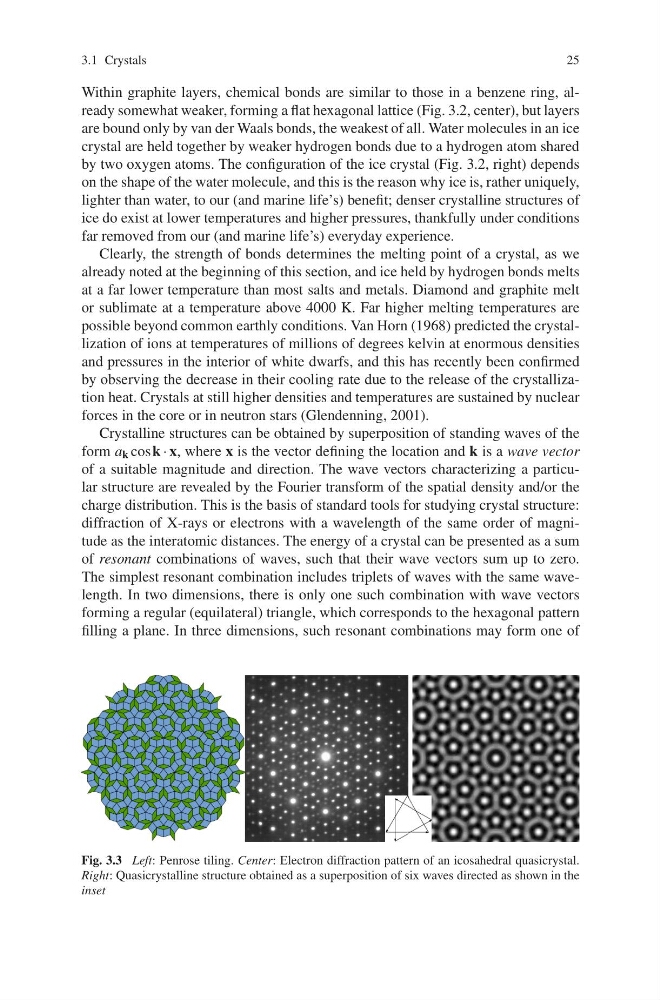
Fig. 3.3 Left: Penrose tiling. Center: Electron diffraction pattern of an icosahedral quasicrystal.
Right: Quasicrystalline structure obtained as a superposition of six waves directed as shown in the
inset
25
Within graphite layers, chemical bonds are similar to those in a benzene ring, already somewhat weaker, forming a flat hexagonal lattice (Fig. 3.2, center), but layers
are bound only by van der Waals bonds, the weakest of all. Water molecules in an ice
crystal are held together by weaker hydrogen bonds due to a hydrogen atom shared
by two oxygen atoms. The configuration of the ice crystal (Fig. 3.2, right) depends
on the shape of the water molecule, and this is the reason why ice is, rather uniquely,
lighter than water, to our (and marine life’s) benefit; denser crystalline structures of
ice do exist at lower temperatures and higher pressures, thankfully under conditions
far removed from our (and marine life’s) everyday experience.
Clearly, the strength of bonds determines the melting point of a crystal, as we
already noted at the beginning of this section, and ice held by hydrogen bonds melts
at a far lower temperature than most salts and metals. Diamond and graphite melt
or sublimate at a temperature above 4000 K. Far higher melting temperatures are
possible beyond common earthly conditions. Van Horn (1968) predicted the crystallization of ions at temperatures of millions of degrees kelvin at enormous densities
and pressures in the interior of white dwarfs, and this has recently been confirmed
by observing the decrease in their cooling rate due to the release of the crystallization heat. Crystals at still higher densities and temperatures are sustained by nuclear
forces in the core or in neutron stars (Glendenning, 2001).
Crystalline structures can be obtained by superposition of standing waves of the
form a k cos k · x, where x is the vector defining the location and k is a wave vector
of a suitable magnitude and direction. The wave vectors characterizing a particular structure are revealed by the Fourier transform of the spatial density and/or the
charge distribution. This is the basis of standard tools for studying crystal structure:
diffraction of X-rays or electrons with a wavelength of the same order of magnitude as the interatomic distances. The energy of a crystal can be presented as a sum
of resonant combinations of waves, such that their wave vectors sum up to zero.
The simplest resonant combination includes triplets of waves with the same wavelength. In two dimensions, there is only one such combination with wave vectors
forming a regular (equilateral) triangle, which corresponds to the hexagonal pattern
filling a plane. In three dimensions, such resonant combinations may form one of
Fig. 3.3 Left: Penrose tiling. Center: Electron diffraction pattern of an icosahedral quasicrystal.
Right: Quasicrystalline structure obtained as a superposition of six waves directed as shown in the
inset