

8.3 Digital Morphogenesis
121
that it is by modifying the internal structure, in particular, by creating and breaking
crosslinks in the cytoskeleton, that cells deform and move (Sect. 5.6).
More natural ways to change internal structure than UV illumination can be implemented in hydrogels, networks of hydrophilic polymer chains imbibed with aqueous solutions. This material mimics the humidity-induced swelling and shrinking of
plant cells (Sect. 6.6), and is also responsive to other environmental factors, like
temperature and ionic strength. These capabilities have found a variety of applications (Ionov, 2013). One of them is the smart release of drugs. A microscopic
hydrogel particle imbibed with a water-soluble drug is swollen at normal body temperature but shrinks at the higher temperature of an inflammation site and releases
the drug. Deformation of hydrogels can also be graded at different locations, causing the material to bend. A variety of shapes can be created in layered or anisotropic
hydrogels. Plants also make use of this feature, as we have seen in Sect. 6.6. Once
again, none of this yet amounts to shape memory, but different temporary shapes
can be created in the same way as sketched in the right-hand panel of Fig. 8.2, but
creating temporary crosslinks using milder chemical interactions involving crystallizable or complex-forming side-chains and actuated by temperature or chemical
reactions (Lowenberg et al, 2017).
8.3 Digital Morphogenesis
In our age, when computers control all kinds of manufacturing, it is quite natural to
ask for their help in shaping malleable materials. The ancient fabrication method by
removal of excess material reigned supreme from Homo habilis sharpening a stone
flake, to a sculptor envisaging the future statue in a piece of marble, to an advanced
photolithographic machine carving integrated circuits from silicon wafers. A new
way of additive manufacturing emerged in the late 20th century and matured as
3D printing in the early 21st. Since deposition is invariably computer controlled, it
might just as well be called digital morphogenesis.
If you search for this term on the Web of Science, two unrelated themes come
into view. First, is the formation of fingers in animal development. This reminds us
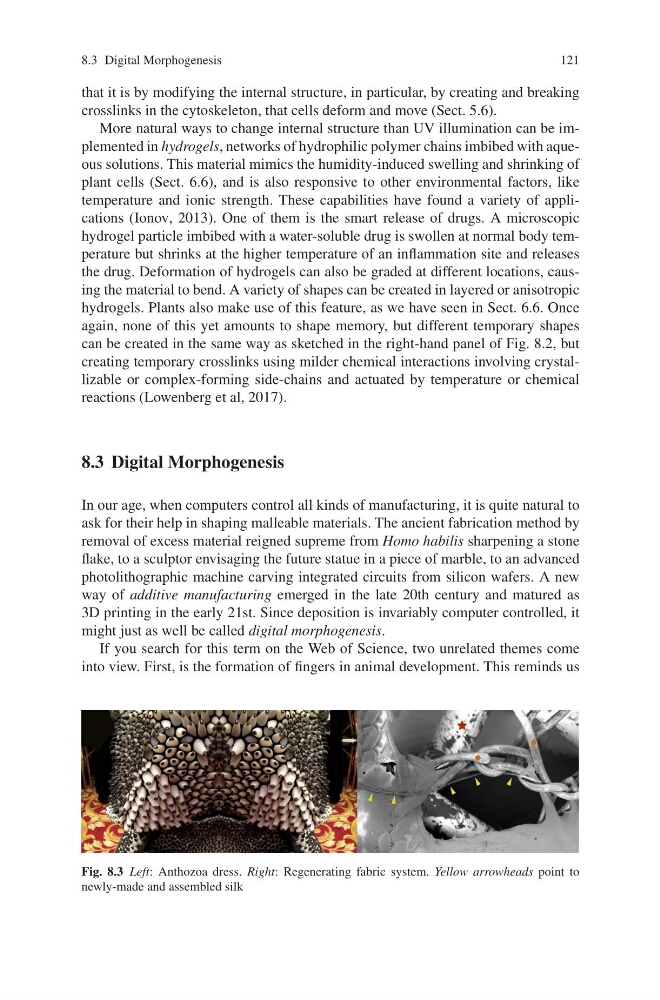
Fig. 8.3 Left: Anthozoa dress. Right: Regenerating fabric system. Yellow arrowheads point to
newly-made and assembled silk
121
that it is by modifying the internal structure, in particular, by creating and breaking
crosslinks in the cytoskeleton, that cells deform and move (Sect. 5.6).
More natural ways to change internal structure than UV illumination can be implemented in hydrogels, networks of hydrophilic polymer chains imbibed with aqueous solutions. This material mimics the humidity-induced swelling and shrinking of
plant cells (Sect. 6.6), and is also responsive to other environmental factors, like
temperature and ionic strength. These capabilities have found a variety of applications (Ionov, 2013). One of them is the smart release of drugs. A microscopic
hydrogel particle imbibed with a water-soluble drug is swollen at normal body temperature but shrinks at the higher temperature of an inflammation site and releases
the drug. Deformation of hydrogels can also be graded at different locations, causing the material to bend. A variety of shapes can be created in layered or anisotropic
hydrogels. Plants also make use of this feature, as we have seen in Sect. 6.6. Once
again, none of this yet amounts to shape memory, but different temporary shapes
can be created in the same way as sketched in the right-hand panel of Fig. 8.2, but
creating temporary crosslinks using milder chemical interactions involving crystallizable or complex-forming side-chains and actuated by temperature or chemical
reactions (Lowenberg et al, 2017).
8.3 Digital Morphogenesis
In our age, when computers control all kinds of manufacturing, it is quite natural to
ask for their help in shaping malleable materials. The ancient fabrication method by
removal of excess material reigned supreme from Homo habilis sharpening a stone
flake, to a sculptor envisaging the future statue in a piece of marble, to an advanced
photolithographic machine carving integrated circuits from silicon wafers. A new
way of additive manufacturing emerged in the late 20th century and matured as
3D printing in the early 21st. Since deposition is invariably computer controlled, it
might just as well be called digital morphogenesis.
If you search for this term on the Web of Science, two unrelated themes come
into view. First, is the formation of fingers in animal development. This reminds us
Fig. 8.3 Left: Anthozoa dress. Right: Regenerating fabric system. Yellow arrowheads point to
newly-made and assembled silk