

120
8 Biomorphic Technologies
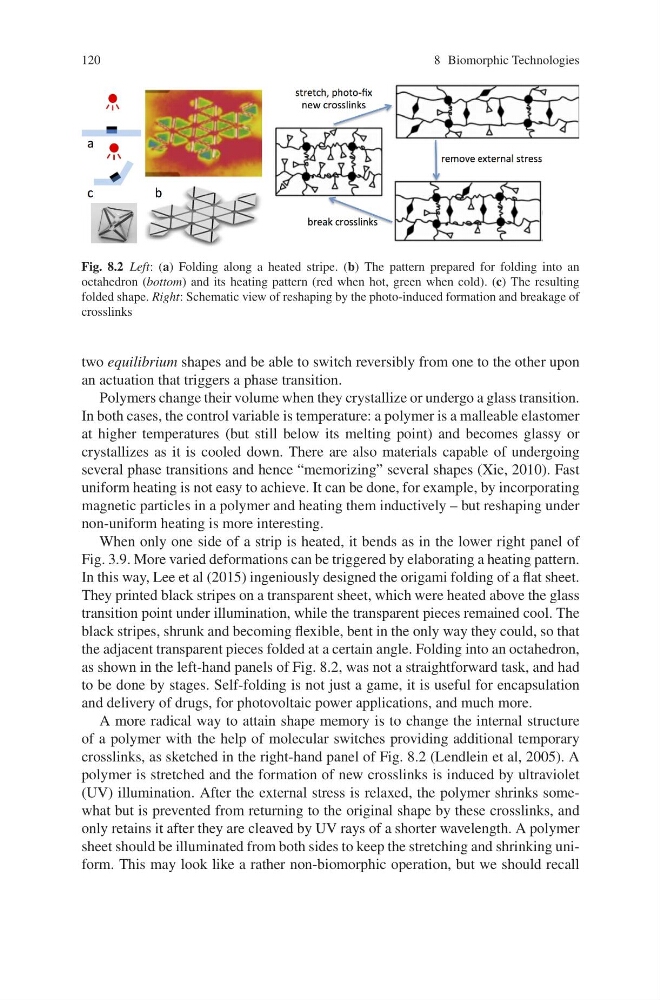
Fig. 8.2 Left: (a) Folding along a heated stripe. (b) The pattern prepared for folding into an
octahedron (bottom) and its heating pattern (red when hot, green when cold). (c) The resulting
folded shape. Right: Schematic view of reshaping by the photo-induced formation and breakage of
crosslinks
two equilibrium shapes and be able to switch reversibly from one to the other upon
an actuation that triggers a phase transition.
Polymers change their volume when they crystallize or undergo a glass transition.
In both cases, the control variable is temperature: a polymer is a malleable elastomer
at higher temperatures (but still below its melting point) and becomes glassy or
crystallizes as it is cooled down. There are also materials capable of undergoing
several phase transitions and hence “memorizing” several shapes (Xie, 2010). Fast
uniform heating is not easy to achieve. It can be done, for example, by incorporating
magnetic particles in a polymer and heating them inductively – but reshaping under
non-uniform heating is more interesting.
When only one side of a strip is heated, it bends as in the lower right panel of
Fig. 3.9. More varied deformations can be triggered by elaborating a heating pattern.
In this way, Lee et al (2015) ingeniously designed the origami folding of a flat sheet.
They printed black stripes on a transparent sheet, which were heated above the glass
transition point under illumination, while the transparent pieces remained cool. The
black stripes, shrunk and becoming flexible, bent in the only way they could, so that
the adjacent transparent pieces folded at a certain angle. Folding into an octahedron,
as shown in the left-hand panels of Fig. 8.2, was not a straightforward task, and had
to be done by stages. Self-folding is not just a game, it is useful for encapsulation
and delivery of drugs, for photovoltaic power applications, and much more.
A more radical way to attain shape memory is to change the internal structure
of a polymer with the help of molecular switches providing additional temporary
crosslinks, as sketched in the right-hand panel of Fig. 8.2 (Lendlein et al, 2005). A
polymer is stretched and the formation of new crosslinks is induced by ultraviolet
(UV) illumination. After the external stress is relaxed, the polymer shrinks somewhat but is prevented from returning to the original shape by these crosslinks, and
only retains it after they are cleaved by UV rays of a shorter wavelength. A polymer
sheet should be illuminated from both sides to keep the stretching and shrinking uniform. This may look like a rather non-biomorphic operation, but we should recall
8 Biomorphic Technologies
Fig. 8.2 Left: (a) Folding along a heated stripe. (b) The pattern prepared for folding into an
octahedron (bottom) and its heating pattern (red when hot, green when cold). (c) The resulting
folded shape. Right: Schematic view of reshaping by the photo-induced formation and breakage of
crosslinks
two equilibrium shapes and be able to switch reversibly from one to the other upon
an actuation that triggers a phase transition.
Polymers change their volume when they crystallize or undergo a glass transition.
In both cases, the control variable is temperature: a polymer is a malleable elastomer
at higher temperatures (but still below its melting point) and becomes glassy or
crystallizes as it is cooled down. There are also materials capable of undergoing
several phase transitions and hence “memorizing” several shapes (Xie, 2010). Fast
uniform heating is not easy to achieve. It can be done, for example, by incorporating
magnetic particles in a polymer and heating them inductively – but reshaping under
non-uniform heating is more interesting.
When only one side of a strip is heated, it bends as in the lower right panel of
Fig. 3.9. More varied deformations can be triggered by elaborating a heating pattern.
In this way, Lee et al (2015) ingeniously designed the origami folding of a flat sheet.
They printed black stripes on a transparent sheet, which were heated above the glass
transition point under illumination, while the transparent pieces remained cool. The
black stripes, shrunk and becoming flexible, bent in the only way they could, so that
the adjacent transparent pieces folded at a certain angle. Folding into an octahedron,
as shown in the left-hand panels of Fig. 8.2, was not a straightforward task, and had
to be done by stages. Self-folding is not just a game, it is useful for encapsulation
and delivery of drugs, for photovoltaic power applications, and much more.
A more radical way to attain shape memory is to change the internal structure
of a polymer with the help of molecular switches providing additional temporary
crosslinks, as sketched in the right-hand panel of Fig. 8.2 (Lendlein et al, 2005). A
polymer is stretched and the formation of new crosslinks is induced by ultraviolet
(UV) illumination. After the external stress is relaxed, the polymer shrinks somewhat but is prevented from returning to the original shape by these crosslinks, and
only retains it after they are cleaved by UV rays of a shorter wavelength. A polymer
sheet should be illuminated from both sides to keep the stretching and shrinking uniform. This may look like a rather non-biomorphic operation, but we should recall