

106
7 Communication
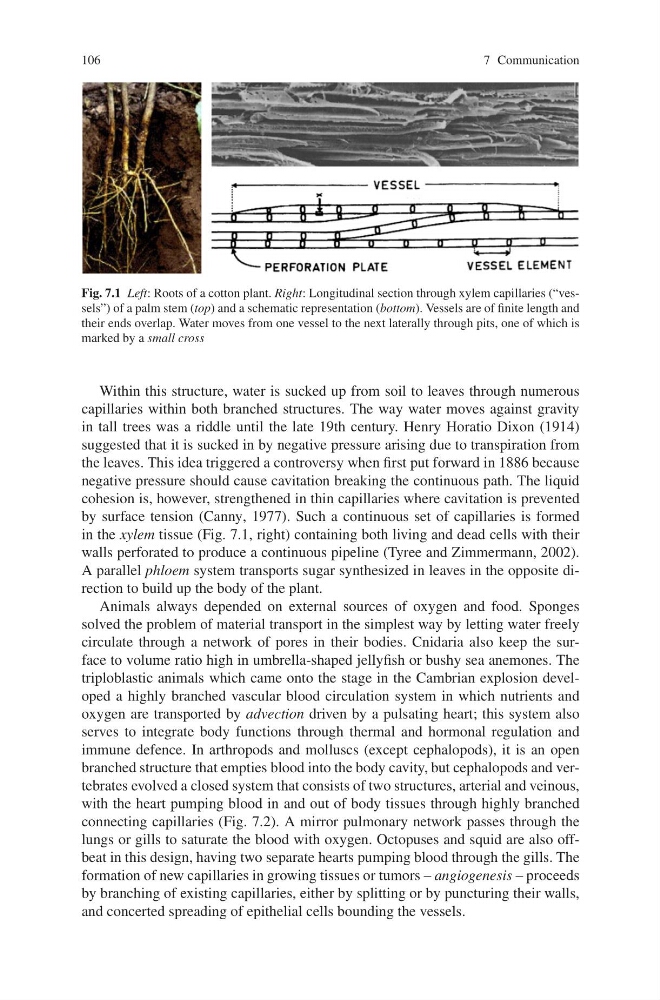
Fig. 7.1 Left: Roots of a cotton plant. Right: Longitudinal section through xylem capillaries (“vessels”) of a palm stem (top) and a schematic representation (bottom). Vessels are of finite length and
their ends overlap. Water moves from one vessel to the next laterally through pits, one of which is
marked by a small cross
Within this structure, water is sucked up from soil to leaves through numerous
capillaries within both branched structures. The way water moves against gravity
in tall trees was a riddle until the late 19th century. Henry Horatio Dixon (1914)
suggested that it is sucked in by negative pressure arising due to transpiration from
the leaves. This idea triggered a controversy when first put forward in 1886 because
negative pressure should cause cavitation breaking the continuous path. The liquid
cohesion is, however, strengthened in thin capillaries where cavitation is prevented
by surface tension (Canny, 1977). Such a continuous set of capillaries is formed
in the xylem tissue (Fig. 7.1, right) containing both living and dead cells with their
walls perforated to produce a continuous pipeline (Tyree and Zimmermann, 2002).
A parallel phloem system transports sugar synthesized in leaves in the opposite direction to build up the body of the plant.
Animals always depended on external sources of oxygen and food. Sponges
solved the problem of material transport in the simplest way by letting water freely
circulate through a network of pores in their bodies. Cnidaria also keep the surface to volume ratio high in umbrella-shaped jellyfish or bushy sea anemones. The
triploblastic animals which came onto the stage in the Cambrian explosion developed a highly branched vascular blood circulation system in which nutrients and
oxygen are transported by advection driven by a pulsating heart; this system also
serves to integrate body functions through thermal and hormonal regulation and
immune defence. In arthropods and molluscs (except cephalopods), it is an open
branched structure that empties blood into the body cavity, but cephalopods and vertebrates evolved a closed system that consists of two structures, arterial and veinous,
with the heart pumping blood in and out of body tissues through highly branched
connecting capillaries (Fig. 7.2). A mirror pulmonary network passes through the
lungs or gills to saturate the blood with oxygen. Octopuses and squid are also offbeat in this design, having two separate hearts pumping blood through the gills. The
formation of new capillaries in growing tissues or tumors – angiogenesis – proceeds
by branching of existing capillaries, either by splitting or by puncturing their walls,
and concerted spreading of epithelial cells bounding the vessels.
7 Communication
Fig. 7.1 Left: Roots of a cotton plant. Right: Longitudinal section through xylem capillaries (“vessels”) of a palm stem (top) and a schematic representation (bottom). Vessels are of finite length and
their ends overlap. Water moves from one vessel to the next laterally through pits, one of which is
marked by a small cross
Within this structure, water is sucked up from soil to leaves through numerous
capillaries within both branched structures. The way water moves against gravity
in tall trees was a riddle until the late 19th century. Henry Horatio Dixon (1914)
suggested that it is sucked in by negative pressure arising due to transpiration from
the leaves. This idea triggered a controversy when first put forward in 1886 because
negative pressure should cause cavitation breaking the continuous path. The liquid
cohesion is, however, strengthened in thin capillaries where cavitation is prevented
by surface tension (Canny, 1977). Such a continuous set of capillaries is formed
in the xylem tissue (Fig. 7.1, right) containing both living and dead cells with their
walls perforated to produce a continuous pipeline (Tyree and Zimmermann, 2002).
A parallel phloem system transports sugar synthesized in leaves in the opposite direction to build up the body of the plant.
Animals always depended on external sources of oxygen and food. Sponges
solved the problem of material transport in the simplest way by letting water freely
circulate through a network of pores in their bodies. Cnidaria also keep the surface to volume ratio high in umbrella-shaped jellyfish or bushy sea anemones. The
triploblastic animals which came onto the stage in the Cambrian explosion developed a highly branched vascular blood circulation system in which nutrients and
oxygen are transported by advection driven by a pulsating heart; this system also
serves to integrate body functions through thermal and hormonal regulation and
immune defence. In arthropods and molluscs (except cephalopods), it is an open
branched structure that empties blood into the body cavity, but cephalopods and vertebrates evolved a closed system that consists of two structures, arterial and veinous,
with the heart pumping blood in and out of body tissues through highly branched
connecting capillaries (Fig. 7.2). A mirror pulmonary network passes through the
lungs or gills to saturate the blood with oxygen. Octopuses and squid are also offbeat in this design, having two separate hearts pumping blood through the gills. The
formation of new capillaries in growing tissues or tumors – angiogenesis – proceeds
by branching of existing capillaries, either by splitting or by puncturing their walls,
and concerted spreading of epithelial cells bounding the vessels.