

102
6 Cells United
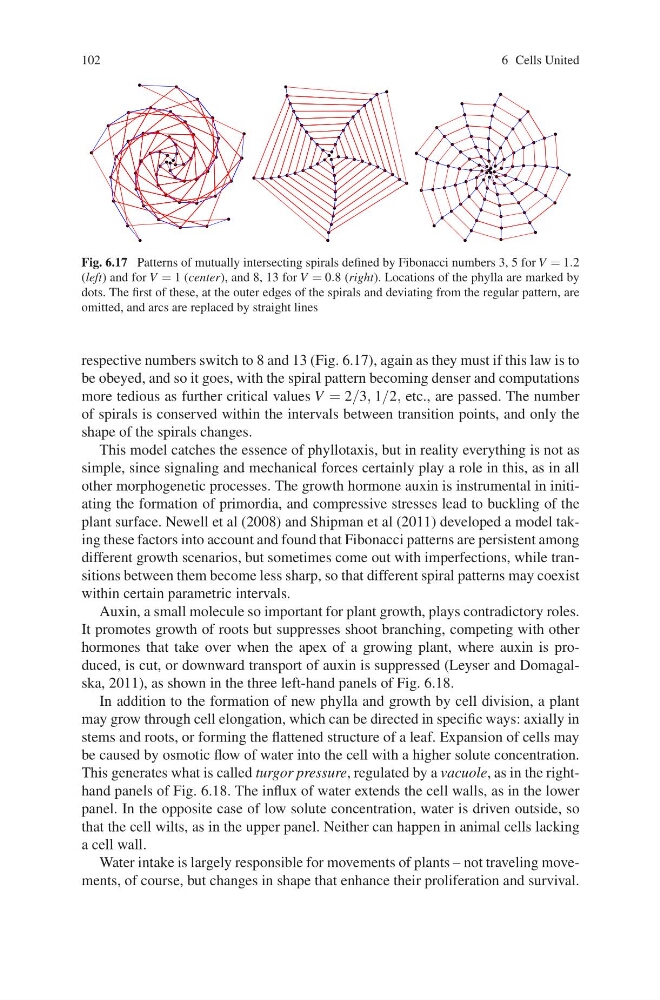
Fig. 6.17 Patterns of mutually intersecting spirals defined by Fibonacci numbers 3, 5 for V = 1.2
(left) and for V = 1 (center), and 8, 13 for V = 0.8 (right). Locations of the phylla are marked by
dots. The first of these, at the outer edges of the spirals and deviating from the regular pattern, are
omitted, and arcs are replaced by straight lines
respective numbers switch to 8 and 13 (Fig. 6.17), again as they must if this law is to
be obeyed, and so it goes, with the spiral pattern becoming denser and computations
more tedious as further critical values V = 2/3, 1/2, etc., are passed. The number
of spirals is conserved within the intervals between transition points, and only the
shape of the spirals changes.
This model catches the essence of phyllotaxis, but in reality everything is not as
simple, since signaling and mechanical forces certainly play a role in this, as in all
other morphogenetic processes. The growth hormone auxin is instrumental in initiating the formation of primordia, and compressive stresses lead to buckling of the
plant surface. Newell et al (2008) and Shipman et al (2011) developed a model taking these factors into account and found that Fibonacci patterns are persistent among
different growth scenarios, but sometimes come out with imperfections, while transitions between them become less sharp, so that different spiral patterns may coexist
within certain parametric intervals.
Auxin, a small molecule so important for plant growth, plays contradictory roles.
It promotes growth of roots but suppresses shoot branching, competing with other
hormones that take over when the apex of a growing plant, where auxin is produced, is cut, or downward transport of auxin is suppressed (Leyser and Domagalska, 2011), as shown in the three left-hand panels of Fig. 6.18.
In addition to the formation of new phylla and growth by cell division, a plant
may grow through cell elongation, which can be directed in specific ways: axially in
stems and roots, or forming the flattened structure of a leaf. Expansion of cells may
be caused by osmotic flow of water into the cell with a higher solute concentration.
This generates what is called turgor pressure, regulated by a vacuole, as in the righthand panels of Fig. 6.18. The influx of water extends the cell walls, as in the lower
panel. In the opposite case of low solute concentration, water is driven outside, so
that the cell wilts, as in the upper panel. Neither can happen in animal cells lacking
a cell wall.
Water intake is largely responsible for movements of plants – not traveling movements, of course, but changes in shape that enhance their proliferation and survival.
6 Cells United
Fig. 6.17 Patterns of mutually intersecting spirals defined by Fibonacci numbers 3, 5 for V = 1.2
(left) and for V = 1 (center), and 8, 13 for V = 0.8 (right). Locations of the phylla are marked by
dots. The first of these, at the outer edges of the spirals and deviating from the regular pattern, are
omitted, and arcs are replaced by straight lines
respective numbers switch to 8 and 13 (Fig. 6.17), again as they must if this law is to
be obeyed, and so it goes, with the spiral pattern becoming denser and computations
more tedious as further critical values V = 2/3, 1/2, etc., are passed. The number
of spirals is conserved within the intervals between transition points, and only the
shape of the spirals changes.
This model catches the essence of phyllotaxis, but in reality everything is not as
simple, since signaling and mechanical forces certainly play a role in this, as in all
other morphogenetic processes. The growth hormone auxin is instrumental in initiating the formation of primordia, and compressive stresses lead to buckling of the
plant surface. Newell et al (2008) and Shipman et al (2011) developed a model taking these factors into account and found that Fibonacci patterns are persistent among
different growth scenarios, but sometimes come out with imperfections, while transitions between them become less sharp, so that different spiral patterns may coexist
within certain parametric intervals.
Auxin, a small molecule so important for plant growth, plays contradictory roles.
It promotes growth of roots but suppresses shoot branching, competing with other
hormones that take over when the apex of a growing plant, where auxin is produced, is cut, or downward transport of auxin is suppressed (Leyser and Domagalska, 2011), as shown in the three left-hand panels of Fig. 6.18.
In addition to the formation of new phylla and growth by cell division, a plant
may grow through cell elongation, which can be directed in specific ways: axially in
stems and roots, or forming the flattened structure of a leaf. Expansion of cells may
be caused by osmotic flow of water into the cell with a higher solute concentration.
This generates what is called turgor pressure, regulated by a vacuole, as in the righthand panels of Fig. 6.18. The influx of water extends the cell walls, as in the lower
panel. In the opposite case of low solute concentration, water is driven outside, so
that the cell wilts, as in the upper panel. Neither can happen in animal cells lacking
a cell wall.
Water intake is largely responsible for movements of plants – not traveling movements, of course, but changes in shape that enhance their proliferation and survival.