

73
4
of the Grubbs I catalyst. The inverse reaction
of ethenolysis, the metathesis of two terminal
alkenes with separation of ethene, is also a popular reaction: Because the resulting gaseous ethene
can be separated in a slight vacuum during the
reaction, the equilibrium is completely shifted to
the product side and thus a 100% conversion is
achieved.
The cross-metathesis of MO with alkenes
can also be carried out with other symmetrical
alkenes instead of ethene. With 2-butene, methyl
9-undecenoate is obtained, with 3-hexene methyl
9-dodecenoate. With cyclohexene, the chain
is extended by six carbon atoms, however, also
various coproducts and derivatives are formed
(. Fig. 4.16).
Ethenolysis can also be performed directly
with unsaturated triglycerides. . Figure 4.17
shows the ethenolysis of a triolein as an example. In addition to the co-product 1-decene, a
triglyceride of ω-decenoic acid is formed, which
can be hydrogenated to tricaprin. With this
metathesis variant, it is thus possible to produce
a short-chain from a long-chain triglyceride.
The metathetic ethenolysis of jojoba oil is
also of interest (box in 7 Sect. 2.2.10). Jojoba oil
consists of monoesters of unsaturated carboxylic
acids having a C=C double bond at position 9
. Fig. 4.15 shows the ethenolysis of methyl
oleate with the formation of the two C10 products 1-decene and methyl 9-decenoate. Thus, two
terminal unsaturated compounds are formed
which are very reactive and can therefore be used
for many subsequent reactions:
5 Methyl 9-decenoate can be converted to
dimethyl undecanoate by alkoxycarbonylation, to methyl 10-aminodecanoate by
amination or to methyl 9,10-epoxydecanoate
by epoxidation. These compounds are in turn
excellent monomers for polyesters, polyamides or epoxy resins. Because of these properties, methyl 9-decenoate is also regarded as a
potential new “key oleochemical substance”.
5 Methyl 9-decenoate can also be dimerized to
a long-chain α,ω diester.
5 The coproduct of this metathesis, 1-decene,
can be used for the production of lubricants
or surfactants or copolymerized with ethene
and is therefore also a valuable product.
Ethenolysis of oleochemicals is advantageously
carried out at high ethene surpluses, e.g. in an
autoclave at 50 bar ethene pressure. According
to Le Chatelier’s principle, high conversion rates
of the oleochemical can thus be achieved. This
requires only low concentrations (0.01 mol%)
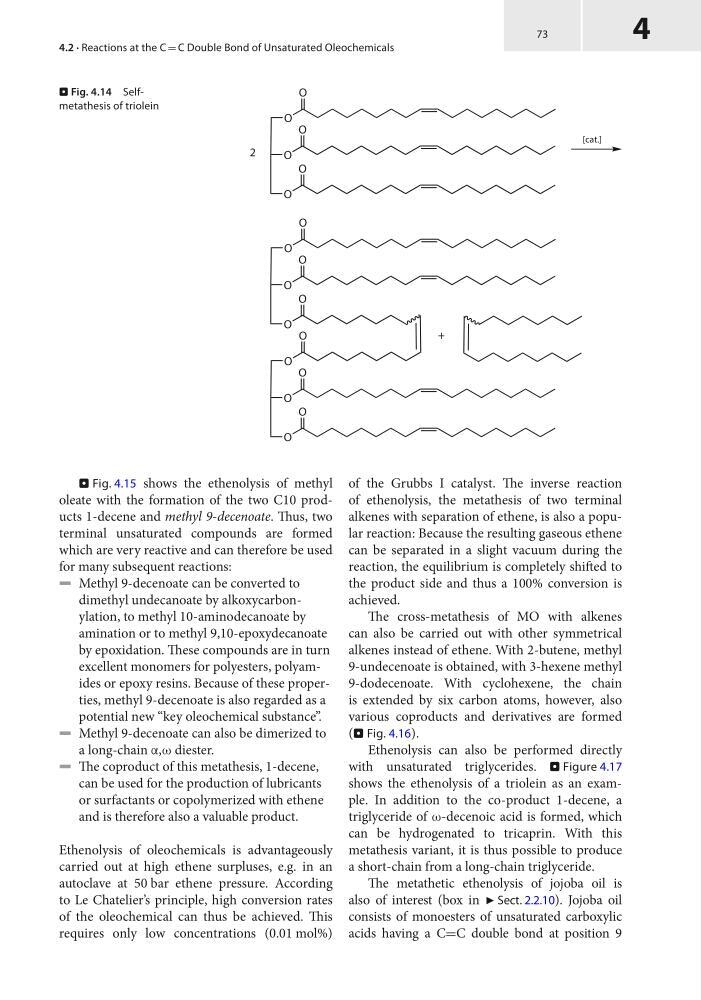
. Fig. 4.14 Selfmetathesis of triolein
O
O
O
O
O
O
2
[cat.]
O
O
O
O
O
O
O
O
O
O
O
O
+
4.2 · Reactions at the C = C Double Bond of Unsaturated Oleochemicals
4
of the Grubbs I catalyst. The inverse reaction
of ethenolysis, the metathesis of two terminal
alkenes with separation of ethene, is also a popular reaction: Because the resulting gaseous ethene
can be separated in a slight vacuum during the
reaction, the equilibrium is completely shifted to
the product side and thus a 100% conversion is
achieved.
The cross-metathesis of MO with alkenes
can also be carried out with other symmetrical
alkenes instead of ethene. With 2-butene, methyl
9-undecenoate is obtained, with 3-hexene methyl
9-dodecenoate. With cyclohexene, the chain
is extended by six carbon atoms, however, also
various coproducts and derivatives are formed
(. Fig. 4.16).
Ethenolysis can also be performed directly
with unsaturated triglycerides. . Figure 4.17
shows the ethenolysis of a triolein as an example. In addition to the co-product 1-decene, a
triglyceride of ω-decenoic acid is formed, which
can be hydrogenated to tricaprin. With this
metathesis variant, it is thus possible to produce
a short-chain from a long-chain triglyceride.
The metathetic ethenolysis of jojoba oil is
also of interest (box in 7 Sect. 2.2.10). Jojoba oil
consists of monoesters of unsaturated carboxylic
acids having a C=C double bond at position 9
. Fig. 4.15 shows the ethenolysis of methyl
oleate with the formation of the two C10 products 1-decene and methyl 9-decenoate. Thus, two
terminal unsaturated compounds are formed
which are very reactive and can therefore be used
for many subsequent reactions:
5 Methyl 9-decenoate can be converted to
dimethyl undecanoate by alkoxycarbonylation, to methyl 10-aminodecanoate by
amination or to methyl 9,10-epoxydecanoate
by epoxidation. These compounds are in turn
excellent monomers for polyesters, polyamides or epoxy resins. Because of these properties, methyl 9-decenoate is also regarded as a
potential new “key oleochemical substance”.
5 Methyl 9-decenoate can also be dimerized to
a long-chain α,ω diester.
5 The coproduct of this metathesis, 1-decene,
can be used for the production of lubricants
or surfactants or copolymerized with ethene
and is therefore also a valuable product.
Ethenolysis of oleochemicals is advantageously
carried out at high ethene surpluses, e.g. in an
autoclave at 50 bar ethene pressure. According
to Le Chatelier’s principle, high conversion rates
of the oleochemical can thus be achieved. This
requires only low concentrations (0.01 mol%)
. Fig. 4.14 Selfmetathesis of triolein
O
O
O
O
O
O
2
[cat.]
O
O
O
O
O
O
O
O
O
O
O
O
+
4.2 · Reactions at the C = C Double Bond of Unsaturated Oleochemicals