

72
Chapter 4 · There is More to Oleochemistry - Reactions at the Fatty Acid Alkyl Chain
4
Cross-metathesis is even more versatile than
self-metathesis because the molecule reacting with the unsaturated oleochemical can be
widely varied. However, this also poses a danger: In addition to the self-metathesis products of the two starting compounds, the use of
asymmetric metathesis partners can lead to the
formation of several unsaturated cross-products, which in turn can continue to react and
thus form a complex mixture of products that
cannot be used industrially. Therefore, in the
investigation of oleochemical cross-metatheses,
it is obvious to use very reactive symmetrical
alkenes.
Here, metathesis with the industrially well
available ethene is a good choice. Metatheses
with ethene are also referred to as ethenolyses.
Since the metathesis of ethylene with itself produces only ethene, no undesirable self-metathesis
products of ethene are produced. Since crossmetathesis takes place much more rapidly than
self-metathesis of the oleochemical in the presence of a large excess of ethene, this reaction can
be carried out very selectively.
decene, is an excellent starting material for the
synthesis of lubricants and surfactants.
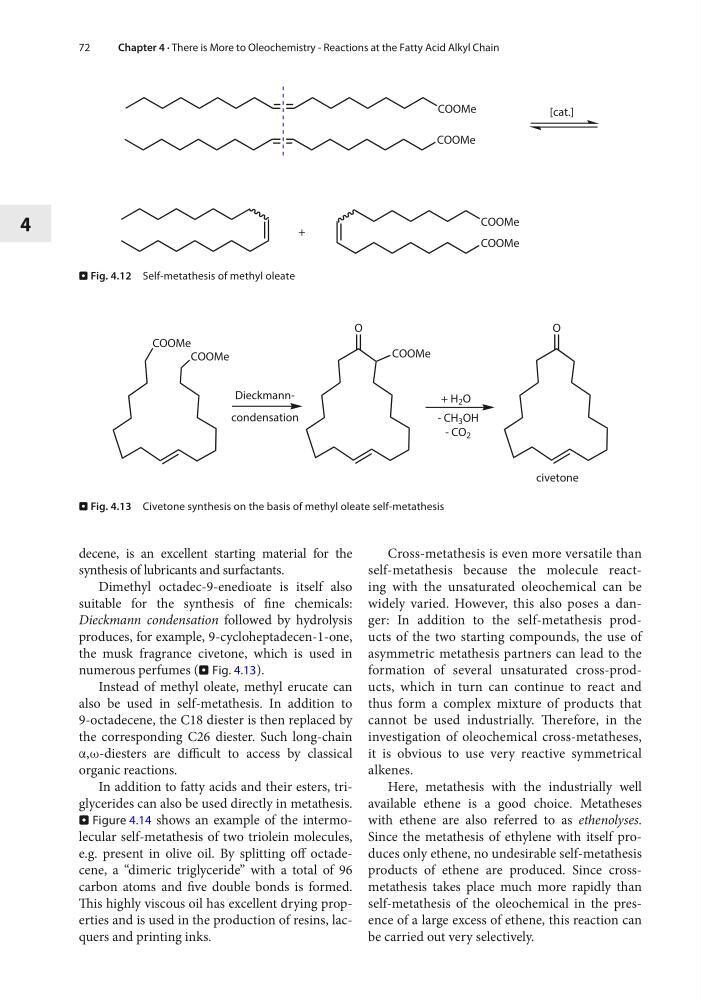
Dimethyl octadec-9-enedioate is itself also
suitable for the synthesis of fine chemicals:
Dieckmann condensation followed by hydrolysis
produces, for example, 9-cycloheptadecen-1-one,
the musk fragrance civetone, which is used in
numerous perfumes (. Fig. 4.13).
Instead of methyl oleate, methyl erucate can
also be used in self-metathesis. In addition to
9-octadecene, the C18 diester is then replaced by
the corresponding C26 diester. Such long-chain
α,ω-diesters are difficult to access by classical
organic reactions.
In addition to fatty acids and their esters, triglycerides can also be used directly in metathesis.
. Figure 4.14 shows an example of the intermolecular self-metathesis of two triolein molecules,
e.g. present in olive oil. By splitting off octadecene, a “dimeric triglyceride” with a total of 96
carbon atoms and five double bonds is formed.
This highly viscous oil has excellent drying properties and is used in the production of resins, lacquers and printing inks.
COOMe
COOMe
[cat.]
+
COOMe
COOMe
. Fig. 4.12 Self-metathesis of methyl oleate
COOMe
COOMe
O
COOMe
O
Dieckmanncondensation
+ H 2 O
- CH 3 OH
- CO 2
civetone
. Fig. 4.13 Civetone synthesis on the basis of methyl oleate self-metathesis
Chapter 4 · There is More to Oleochemistry - Reactions at the Fatty Acid Alkyl Chain
4
Cross-metathesis is even more versatile than
self-metathesis because the molecule reacting with the unsaturated oleochemical can be
widely varied. However, this also poses a danger: In addition to the self-metathesis products of the two starting compounds, the use of
asymmetric metathesis partners can lead to the
formation of several unsaturated cross-products, which in turn can continue to react and
thus form a complex mixture of products that
cannot be used industrially. Therefore, in the
investigation of oleochemical cross-metatheses,
it is obvious to use very reactive symmetrical
alkenes.
Here, metathesis with the industrially well
available ethene is a good choice. Metatheses
with ethene are also referred to as ethenolyses.
Since the metathesis of ethylene with itself produces only ethene, no undesirable self-metathesis
products of ethene are produced. Since crossmetathesis takes place much more rapidly than
self-metathesis of the oleochemical in the presence of a large excess of ethene, this reaction can
be carried out very selectively.
decene, is an excellent starting material for the
synthesis of lubricants and surfactants.
Dimethyl octadec-9-enedioate is itself also
suitable for the synthesis of fine chemicals:
Dieckmann condensation followed by hydrolysis
produces, for example, 9-cycloheptadecen-1-one,
the musk fragrance civetone, which is used in
numerous perfumes (. Fig. 4.13).
Instead of methyl oleate, methyl erucate can
also be used in self-metathesis. In addition to
9-octadecene, the C18 diester is then replaced by
the corresponding C26 diester. Such long-chain
α,ω-diesters are difficult to access by classical
organic reactions.
In addition to fatty acids and their esters, triglycerides can also be used directly in metathesis.
. Figure 4.14 shows an example of the intermolecular self-metathesis of two triolein molecules,
e.g. present in olive oil. By splitting off octadecene, a “dimeric triglyceride” with a total of 96
carbon atoms and five double bonds is formed.
This highly viscous oil has excellent drying properties and is used in the production of resins, lacquers and printing inks.
COOMe
COOMe
[cat.]
+
COOMe
COOMe
. Fig. 4.12 Self-metathesis of methyl oleate
COOMe
COOMe
O
COOMe
O
Dieckmanncondensation
+ H 2 O
- CH 3 OH
- CO 2
civetone
. Fig. 4.13 Civetone synthesis on the basis of methyl oleate self-metathesis