

48
Chapter 3 · The Basics of Oleochemistry - Basic Oleochemicals
3
thermally sensitive, they are gently distilled in
packed columns under vacuum (boiling points,
. Table 3.1).
Fatty alcohols have become very important,
especially because they can be converted into
numerous detergent substances. An overview of the
fatty alcohol markets can be found in . Fig. 3.13.
Due to the reactive hydroxyl group, fatty
alcohols have a very extensive downstream
chemistry. An overview of these reactions can be
found in . Fig. 3.14. However, in this textbook,
only the most important of these follow-up reactions can be briefly presented in the following.
production of the copper chromite catalysts or a
chromium oxide catalyst coated on alumina with
cadmium oxide as the “poisoning component”
is used, the C=C double bonds are retained.
Hence, not the waxy stearyl alcohol is yielded
from methyl oleate, but the liquid oleyl alcohol, also known under its trade name “Ocenol®”
(. Fig. 3.12). Because of the toxicity of chromium, this metal is now being replaced by other
metals, e.g. manganese.
Usually, the crude fatty alcohols from pressure hydrogenation are still purified by distillation to increase quality. Since they are
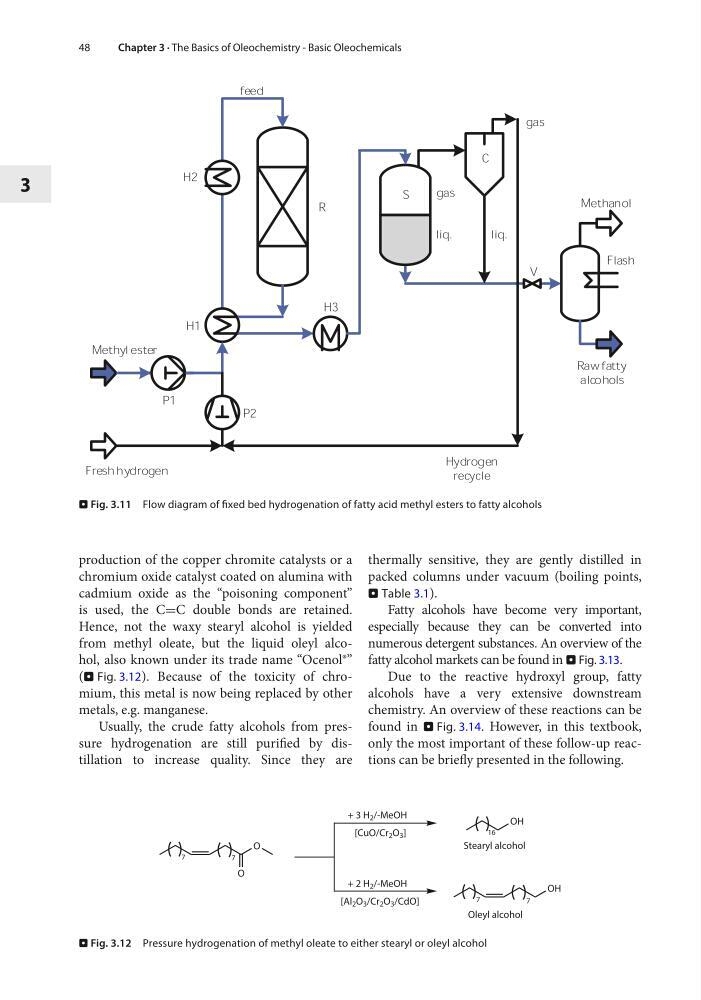
. Fig. 3.11 Flow diagram of fixed bed hydrogenation of fatty acid methyl esters to fatty alcohols
. Fig. 3.12 Pressure hydrogenation of methyl oleate to either stearyl or oleyl alcohol
O
O
OH
7
7
7
7
OH
16
+ 3 H 2 /-MeOH
[CuO/Cr 2 O 3 ]
[Al 2 O 3 /Cr 2 O 3 /CdO]
+ 2 H 2 /-MeOH
Stearyl alcohol
Oleyl alcohol
Chapter 3 · The Basics of Oleochemistry - Basic Oleochemicals
3
thermally sensitive, they are gently distilled in
packed columns under vacuum (boiling points,
. Table 3.1).
Fatty alcohols have become very important,
especially because they can be converted into
numerous detergent substances. An overview of the
fatty alcohol markets can be found in . Fig. 3.13.
Due to the reactive hydroxyl group, fatty
alcohols have a very extensive downstream
chemistry. An overview of these reactions can be
found in . Fig. 3.14. However, in this textbook,
only the most important of these follow-up reactions can be briefly presented in the following.
production of the copper chromite catalysts or a
chromium oxide catalyst coated on alumina with
cadmium oxide as the “poisoning component”
is used, the C=C double bonds are retained.
Hence, not the waxy stearyl alcohol is yielded
from methyl oleate, but the liquid oleyl alcohol, also known under its trade name “Ocenol®”
(. Fig. 3.12). Because of the toxicity of chromium, this metal is now being replaced by other
metals, e.g. manganese.
Usually, the crude fatty alcohols from pressure hydrogenation are still purified by distillation to increase quality. Since they are
. Fig. 3.11 Flow diagram of fixed bed hydrogenation of fatty acid methyl esters to fatty alcohols
. Fig. 3.12 Pressure hydrogenation of methyl oleate to either stearyl or oleyl alcohol
O
O
OH
7
7
7
7
OH
16
+ 3 H 2 /-MeOH
[CuO/Cr 2 O 3 ]
[Al 2 O 3 /Cr 2 O 3 /CdO]
+ 2 H 2 /-MeOH
Stearyl alcohol
Oleyl alcohol