

25
2
substances), which can lead to thyroid dysfunction. The “new” rapeseed mainly contains oleic
and linoleic acid and, in smaller quantities, linolenic acid. The old rape is of some importance as
an industrial and energy plant; the new rape can
be used safely for high-quality food.
2.2.4 Sunflower Oil
The original home of the sunflower is North
America. In 1510, the Spaniards brought the
sunflower to Europe, but it was not until the
nineteenth century that its importance as an oil
plant was recognized, when Peter the Great had
it planted on a larger scale in southern Russia.
The sunflower (Helianthus annuus) belongs to
the daisy family and is an annual plant that can
grow up to 5 m high. For commercial cultivation, however, 1–1.5 m high varieties are preferred, which can be harvested mechanically.
The plant forms a disk-shaped inflorescence
(see title picture of the book), which can contain
several thousand small fruits. These sunflower
seeds have an oil content of up to 57%, the rest
are mainly proteins, carbohydrates and minerals. The (old) sunflower oil contains mainly
linoleic acid (44–70%) and oleic acid (14–43%,
. Table 2.3) and is an excellent raw material for
the production of edible oil and margarine due
to the high proportion of essential linoleic acid
(BOX: MUFA or PUFA?). In the industry, it is processed to soaps and varnishes and partly serves
as a substitute for linseed oil. The press cake
remaining after extraction contains up to 50%
protein and is often used as animal feed.
Important new sunflower varieties have been
introduced, particularly in Russia. The “new”
sunflower is also called “high oleic” because it
contains up to 91% oleic acid but only a little
linoleic acid (3%) (. Table 2.3). This raw material leads to an oleic acid with a high degree
of purity and is therefore ideally suited for
chemical use, e.g. for the production of lacquers, paints and technical esters as well as for
cosmetic products.
2.2.3 Rapeseed Oil
Rapeseed oil is obtained from the seeds of rape
(Brassica napus oleifera). Rapeseed has long been
one of the most important oil plants in the temperate zone. Rapeseed grains were already found
in excavations of Germanic settlements. In the
late MiddleAges, rape oil was used in Germany
for lighting purposes. With the introduction of
petroleum at the end of the nineteenth century,
however, it lost this use.
Rape belongs botanically to the cruciferous
family. The plants grow up to 1.5 m high; the bright
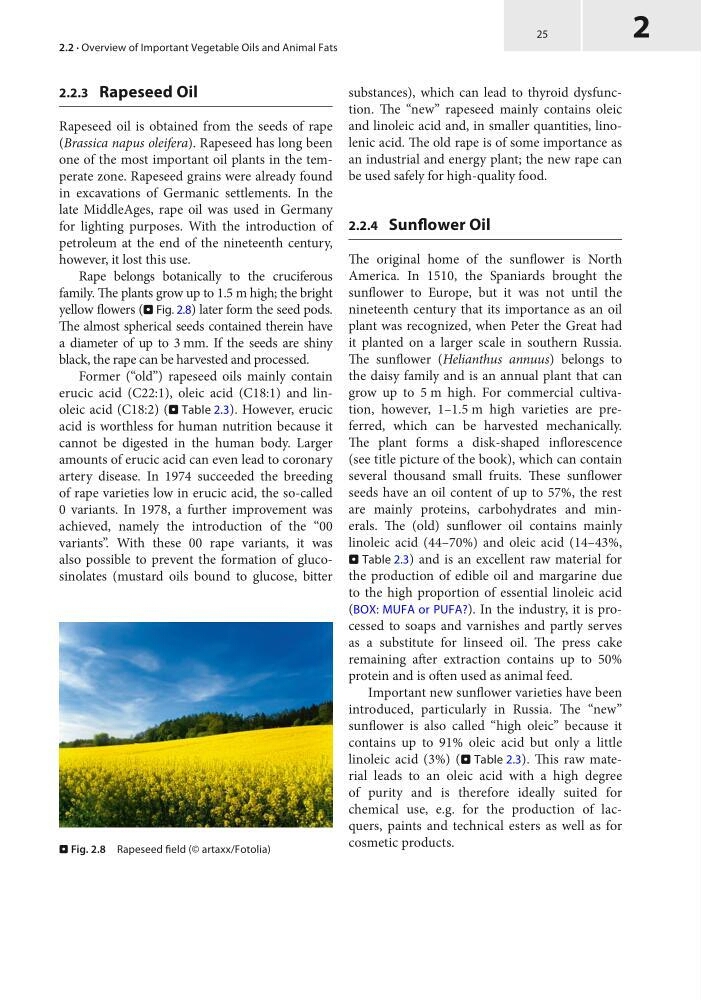
yellow flowers (. Fig. 2.8) later form the seed pods.
The almost spherical seeds contained therein have
a diameter of up to 3 mm. If the seeds are shiny
black, the rape can be harvested and processed.
Former (“old”) rapeseed oils mainly contain
erucic acid (C22:1), oleic acid (C18:1) and linoleic acid (C18:2) (. Table 2.3). However, erucic
acid is worthless for human nutrition because it
cannot be digested in the human body. Larger
amounts of erucic acid can even lead to coronary
artery disease. In 1974 succeeded the breeding
of rape varieties low in erucic acid, the so-called
0 variants. In 1978, a further improvement was
achieved, namely the introduction of the “00
variants”. With these 00 rape variants, it was
also possible to prevent the formation of glucosinolates (mustard oils bound to glucose, bitter
. Fig. 2.8 Rapeseed field (© artaxx/Fotolia)
2.2 · Overview of Important Vegetable Oils and Animal Fats
2
substances), which can lead to thyroid dysfunction. The “new” rapeseed mainly contains oleic
and linoleic acid and, in smaller quantities, linolenic acid. The old rape is of some importance as
an industrial and energy plant; the new rape can
be used safely for high-quality food.
2.2.4 Sunflower Oil
The original home of the sunflower is North
America. In 1510, the Spaniards brought the
sunflower to Europe, but it was not until the
nineteenth century that its importance as an oil
plant was recognized, when Peter the Great had
it planted on a larger scale in southern Russia.
The sunflower (Helianthus annuus) belongs to
the daisy family and is an annual plant that can
grow up to 5 m high. For commercial cultivation, however, 1–1.5 m high varieties are preferred, which can be harvested mechanically.
The plant forms a disk-shaped inflorescence
(see title picture of the book), which can contain
several thousand small fruits. These sunflower
seeds have an oil content of up to 57%, the rest
are mainly proteins, carbohydrates and minerals. The (old) sunflower oil contains mainly
linoleic acid (44–70%) and oleic acid (14–43%,
. Table 2.3) and is an excellent raw material for
the production of edible oil and margarine due
to the high proportion of essential linoleic acid
(BOX: MUFA or PUFA?). In the industry, it is processed to soaps and varnishes and partly serves
as a substitute for linseed oil. The press cake
remaining after extraction contains up to 50%
protein and is often used as animal feed.
Important new sunflower varieties have been
introduced, particularly in Russia. The “new”
sunflower is also called “high oleic” because it
contains up to 91% oleic acid but only a little
linoleic acid (3%) (. Table 2.3). This raw material leads to an oleic acid with a high degree
of purity and is therefore ideally suited for
chemical use, e.g. for the production of lacquers, paints and technical esters as well as for
cosmetic products.
2.2.3 Rapeseed Oil
Rapeseed oil is obtained from the seeds of rape
(Brassica napus oleifera). Rapeseed has long been
one of the most important oil plants in the temperate zone. Rapeseed grains were already found
in excavations of Germanic settlements. In the
late MiddleAges, rape oil was used in Germany
for lighting purposes. With the introduction of
petroleum at the end of the nineteenth century,
however, it lost this use.
Rape belongs botanically to the cruciferous
family. The plants grow up to 1.5 m high; the bright
yellow flowers (. Fig. 2.8) later form the seed pods.
The almost spherical seeds contained therein have
a diameter of up to 3 mm. If the seeds are shiny
black, the rape can be harvested and processed.
Former (“old”) rapeseed oils mainly contain
erucic acid (C22:1), oleic acid (C18:1) and linoleic acid (C18:2) (. Table 2.3). However, erucic
acid is worthless for human nutrition because it
cannot be digested in the human body. Larger
amounts of erucic acid can even lead to coronary
artery disease. In 1974 succeeded the breeding
of rape varieties low in erucic acid, the so-called
0 variants. In 1978, a further improvement was
achieved, namely the introduction of the “00
variants”. With these 00 rape variants, it was
also possible to prevent the formation of glucosinolates (mustard oils bound to glucose, bitter
. Fig. 2.8 Rapeseed field (© artaxx/Fotolia)
2.2 · Overview of Important Vegetable Oils and Animal Fats