

24
Chapter 2 · The Raw Materials of Oleochemistry - Oil Plants
2
and three rock-hard seeds. If the nutshell of these
seeds is broken, the “palm kernel”, which also contains fat, is reached (. Fig. 2.7).
Both components of the oil fruit are processed
separately and produce oils with different compositions: palm kernel oil, like coconut oil, contains
many laurics. The palm oil obtained from the flesh
consists mainly of the triglycerides of palmitic acid
(which takes its name from the oil palm) and oleic
acid. The pulp must be processed immediately
after harvesting; otherwise, the damaged fruit will
undergo enzymatic decomposition, which greatly
increases the acid number of the oil (BOX: Quality
Criteria for the Oleochemist). The hard-shelled cores,
on the other hand, can be stored well.
got to know the oil palm during their exploration
trips through West Africa, but it was not until the
middle of the nineteenth century that the Dutch
brought the first specimens to Indonesia, where
today - as in neighboring Malaysia - large plantations of the oil palm exist. While the coconut
palms are very slender and the aging leaves shed
completely, the Elaeis is relatively compact. The oil
palms have a height of 6 to a maximum of 15 m;
their stem remains intact for many years. The oil
palm supplies oil fruits with an annual production
of up to 6 tons per hectare for 50 years. Thousands
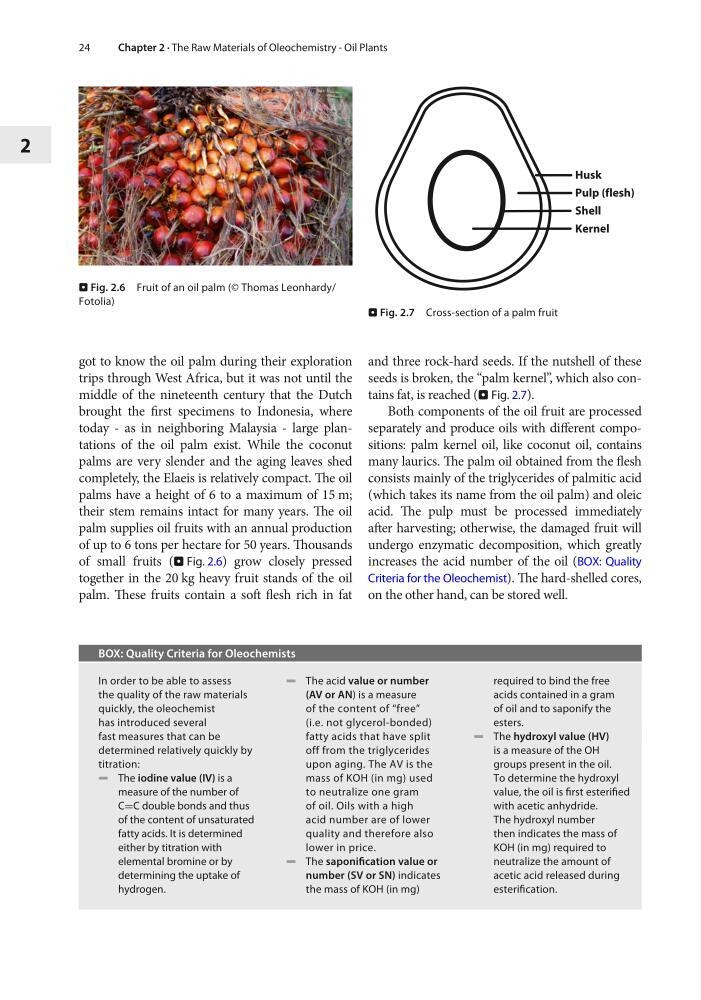
of small fruits (. Fig. 2.6) grow closely pressed
together in the 20 kg heavy fruit stands of the oil
palm. These fruits contain a soft flesh rich in fat
Shell
Pulp (flesh)
Husk
Kernel
. Fig. 2.7 Cross-section of a palm fruit
. Fig. 2.6 Fruit of an oil palm (© Thomas Leonhardy/
Fotolia)
BOX: Quality Criteria for Oleochemists
In order to be able to assess
the quality of the raw materials
quickly, the oleochemist
has introduced several
fast measures that can be
determined relatively quickly by
titration:
5 The iodine value (IV) is a
measure of the number of
C=C double bonds and thus
of the content of unsaturated
fatty acids. It is determined
either by titration with
elemental bromine or by
determining the uptake of
hydrogen.
5 The acid value or number
(AV or AN) is a measure
of the content of “free”
(i.e. not glycerol-bonded)
fatty acids that have split
off from the triglycerides
upon aging. The AV is the
mass of KOH (in mg) used
to neutralize one gram
of oil. Oils with a high
acid number are of lower
quality and therefore also
lower in price.
5 The saponification value or
number (SV or SN) indicates
the mass of KOH (in mg)
required to bind the free
acids contained in a gram
of oil and to saponify the
esters.
5 The hydroxyl value (HV)
is a measure of the OH
groups present in the oil.
To determine the hydroxyl
value, the oil is first esterified
with acetic anhydride.
The hydroxyl number
then indicates the mass of
KOH (in mg) required to
neutralize the amount of
acetic acid released during
esterification.
Chapter 2 · The Raw Materials of Oleochemistry - Oil Plants
2
and three rock-hard seeds. If the nutshell of these
seeds is broken, the “palm kernel”, which also contains fat, is reached (. Fig. 2.7).
Both components of the oil fruit are processed
separately and produce oils with different compositions: palm kernel oil, like coconut oil, contains
many laurics. The palm oil obtained from the flesh
consists mainly of the triglycerides of palmitic acid
(which takes its name from the oil palm) and oleic
acid. The pulp must be processed immediately
after harvesting; otherwise, the damaged fruit will
undergo enzymatic decomposition, which greatly
increases the acid number of the oil (BOX: Quality
Criteria for the Oleochemist). The hard-shelled cores,
on the other hand, can be stored well.
got to know the oil palm during their exploration
trips through West Africa, but it was not until the
middle of the nineteenth century that the Dutch
brought the first specimens to Indonesia, where
today - as in neighboring Malaysia - large plantations of the oil palm exist. While the coconut
palms are very slender and the aging leaves shed
completely, the Elaeis is relatively compact. The oil
palms have a height of 6 to a maximum of 15 m;
their stem remains intact for many years. The oil
palm supplies oil fruits with an annual production
of up to 6 tons per hectare for 50 years. Thousands
of small fruits (. Fig. 2.6) grow closely pressed
together in the 20 kg heavy fruit stands of the oil
palm. These fruits contain a soft flesh rich in fat
Shell
Pulp (flesh)
Husk
Kernel
. Fig. 2.7 Cross-section of a palm fruit
. Fig. 2.6 Fruit of an oil palm (© Thomas Leonhardy/
Fotolia)
BOX: Quality Criteria for Oleochemists
In order to be able to assess
the quality of the raw materials
quickly, the oleochemist
has introduced several
fast measures that can be
determined relatively quickly by
titration:
5 The iodine value (IV) is a
measure of the number of
C=C double bonds and thus
of the content of unsaturated
fatty acids. It is determined
either by titration with
elemental bromine or by
determining the uptake of
hydrogen.
5 The acid value or number
(AV or AN) is a measure
of the content of “free”
(i.e. not glycerol-bonded)
fatty acids that have split
off from the triglycerides
upon aging. The AV is the
mass of KOH (in mg) used
to neutralize one gram
of oil. Oils with a high
acid number are of lower
quality and therefore also
lower in price.
5 The saponification value or
number (SV or SN) indicates
the mass of KOH (in mg)
required to bind the free
acids contained in a gram
of oil and to saponify the
esters.
5 The hydroxyl value (HV)
is a measure of the OH
groups present in the oil.
To determine the hydroxyl
value, the oil is first esterified
with acetic anhydride.
The hydroxyl number
then indicates the mass of
KOH (in mg) required to
neutralize the amount of
acetic acid released during
esterification.