

114
Chapter 6 · Sweet Chemistry - Mono- and Disaccharides
6
be produced by oxidation of glycerol. They are
both, so to speak, the “progenitors” of carbohydrate chemistry and have the molecular formula
C 3 H 6 O 3 . Since they correspond to the general formula listed above with n = 3, they are also called
trioses. The most important monosaccharides
are compounds of three (trioses), four (tetroses),
five (pentoses) or six (hexoses) carbon atoms. A
monosaccharide containing a keto group, e.g. dihydroxyacetone, is also known as ketose, a monosaccharide containing an aldehyde function, e.g.
glycerol aldehyde, is also known as aldose. By combining both classification criteria, glycerol aldehyde
is called an aldotriose and 1,3-dihydroxyacetone a
ketotriose, respectively. Generally speaking: Monosaccharides are aliphatic aldehydes and ketones
with chain lengths between C 3 and C 6 additionally
containing numerous hydroxyl groups.
Even the simplest aldose, glycerol aldehyde,
has another characteristic of saccharides: They
all contain at least one, but usually several chiral
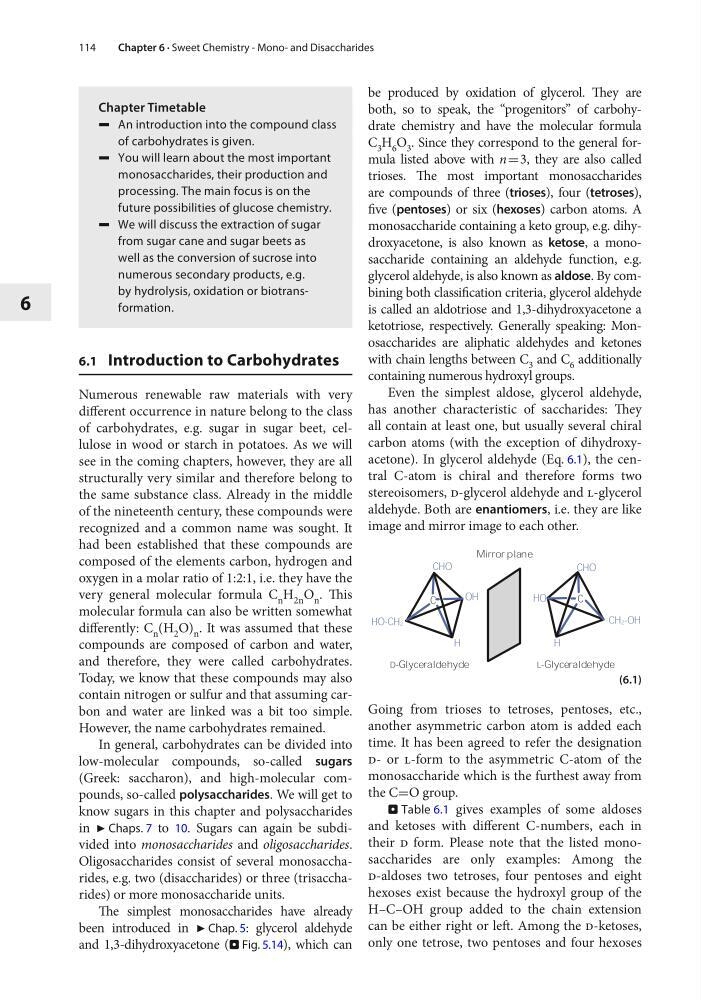
carbon atoms (with the exception of dihydroxyacetone). In glycerol aldehyde (Eq. 6.1), the central C-atom is chiral and therefore forms two
stereoisomers, d-glycerol aldehyde and l-glycerol
aldehyde. Both are enantiomers, i.e. they are like
image and mirror image to each other.
Going from trioses to tetroses, pentoses, etc.,
another asymmetric carbon atom is added each
time. It has been agreed to refer the designation
d- or l-form to the asymmetric C-atom of the
monosaccharide which is the furthest away from
the C=O group.
. Table 6.1 gives examples of some aldoses
and ketoses with different C-numbers, each in
their d form. Please note that the listed monosaccharides are only examples: Among the
d-aldoses two tetroses, four pentoses and eight
hexoses exist because the hydroxyl group of the
H–C–OH group added to the chain extension
can be either right or left. Among the d-ketoses,
only one tetrose, two pentoses and four hexoses
(6.1)
Chapter Timetable
5 An introduction into the compound class
of carbohydrates is given.
5 You will learn about the most important
monosaccharides, their production and
processing. The main focus is on the
future possibilities of glucose chemistry.
5 We will discuss the extraction of sugar
from sugar cane and sugar beets as
well as the conversion of sucrose into
numerous secondary products, e.g.
by hydrolysis, oxidation or biotransformation.
6.1 Introduction to Carbohydrates
Numerous renewable raw materials with very
different occurrence in nature belong to the class
of carbohydrates, e.g. sugar in sugar beet, cellulose in wood or starch in potatoes. As we will
see in the coming chapters, however, they are all
structurally very similar and therefore belong to
the same substance class. Already in the middle
of the nineteenth century, these compounds were
recognized and a common name was sought. It
had been established that these compounds are
composed of the elements carbon, hydrogen and
oxygen in a molar ratio of 1:2:1, i.e. they have the
very general molecular formula C n H 2n O n . This
molecular formula can also be written somewhat
differently: C n (H 2 O) n . It was assumed that these
compounds are composed of carbon and water,
and therefore, they were called carbohydrates.
Today, we know that these compounds may also
contain nitrogen or sulfur and that assuming carbon and water are linked was a bit too simple.
However, the name carbohydrates remained.
In general, carbohydrates can be divided into
low-molecular compounds, so-called sugars
(Greek: saccharon), and high-molecular compounds, so-called polysaccharides. We will get to
know sugars in this chapter and polysaccharides
in 7 Chaps. 7 to 10. Sugars can again be subdivided into monosaccharides and oligosaccharides.
Oligosaccharides consist of several monosaccharides, e.g. two (disaccharides) or three (trisaccharides) or more monosaccharide units.
The simplest monosaccharides have already
been introduced in 7 Chap. 5: glycerol aldehyde
and 1,3-dihydroxyacetone (. Fig. 5.14), which can
Chapter 6 · Sweet Chemistry - Mono- and Disaccharides
6
be produced by oxidation of glycerol. They are
both, so to speak, the “progenitors” of carbohydrate chemistry and have the molecular formula
C 3 H 6 O 3 . Since they correspond to the general formula listed above with n = 3, they are also called
trioses. The most important monosaccharides
are compounds of three (trioses), four (tetroses),
five (pentoses) or six (hexoses) carbon atoms. A
monosaccharide containing a keto group, e.g. dihydroxyacetone, is also known as ketose, a monosaccharide containing an aldehyde function, e.g.
glycerol aldehyde, is also known as aldose. By combining both classification criteria, glycerol aldehyde
is called an aldotriose and 1,3-dihydroxyacetone a
ketotriose, respectively. Generally speaking: Monosaccharides are aliphatic aldehydes and ketones
with chain lengths between C 3 and C 6 additionally
containing numerous hydroxyl groups.
Even the simplest aldose, glycerol aldehyde,
has another characteristic of saccharides: They
all contain at least one, but usually several chiral
carbon atoms (with the exception of dihydroxyacetone). In glycerol aldehyde (Eq. 6.1), the central C-atom is chiral and therefore forms two
stereoisomers, d-glycerol aldehyde and l-glycerol
aldehyde. Both are enantiomers, i.e. they are like
image and mirror image to each other.
Going from trioses to tetroses, pentoses, etc.,
another asymmetric carbon atom is added each
time. It has been agreed to refer the designation
d- or l-form to the asymmetric C-atom of the
monosaccharide which is the furthest away from
the C=O group.
. Table 6.1 gives examples of some aldoses
and ketoses with different C-numbers, each in
their d form. Please note that the listed monosaccharides are only examples: Among the
d-aldoses two tetroses, four pentoses and eight
hexoses exist because the hydroxyl group of the
H–C–OH group added to the chain extension
can be either right or left. Among the d-ketoses,
only one tetrose, two pentoses and four hexoses
(6.1)
Chapter Timetable
5 An introduction into the compound class
of carbohydrates is given.
5 You will learn about the most important
monosaccharides, their production and
processing. The main focus is on the
future possibilities of glucose chemistry.
5 We will discuss the extraction of sugar
from sugar cane and sugar beets as
well as the conversion of sucrose into
numerous secondary products, e.g.
by hydrolysis, oxidation or biotransformation.
6.1 Introduction to Carbohydrates
Numerous renewable raw materials with very
different occurrence in nature belong to the class
of carbohydrates, e.g. sugar in sugar beet, cellulose in wood or starch in potatoes. As we will
see in the coming chapters, however, they are all
structurally very similar and therefore belong to
the same substance class. Already in the middle
of the nineteenth century, these compounds were
recognized and a common name was sought. It
had been established that these compounds are
composed of the elements carbon, hydrogen and
oxygen in a molar ratio of 1:2:1, i.e. they have the
very general molecular formula C n H 2n O n . This
molecular formula can also be written somewhat
differently: C n (H 2 O) n . It was assumed that these
compounds are composed of carbon and water,
and therefore, they were called carbohydrates.
Today, we know that these compounds may also
contain nitrogen or sulfur and that assuming carbon and water are linked was a bit too simple.
However, the name carbohydrates remained.
In general, carbohydrates can be divided into
low-molecular compounds, so-called sugars
(Greek: saccharon), and high-molecular compounds, so-called polysaccharides. We will get to
know sugars in this chapter and polysaccharides
in 7 Chaps. 7 to 10. Sugars can again be subdivided into monosaccharides and oligosaccharides.
Oligosaccharides consist of several monosaccharides, e.g. two (disaccharides) or three (trisaccharides) or more monosaccharide units.
The simplest monosaccharides have already
been introduced in 7 Chap. 5: glycerol aldehyde
and 1,3-dihydroxyacetone (. Fig. 5.14), which can