

92
Chapter 5 · The Coproduct of Oleochemistry - Glycerol
5
After passing through the different purification
stages, glycerol is sold in various degrees of
purity:
5 The highest quality consists of 99.8% glycerol
and approx. 0.2% water. It is also known as
“high-purity pharmaceutical quality” and
can be used in food, pharmaceuticals and
cosmetics. The density at room temperature
is 1.26 g ml −1 .
5 For many purposes, the (cheaper) 86%
glycerol is more suitable. The rest is again
predominantly water. Due to its lower
viscosity, it can be processed much
easier.
5 In addition, several other qualities do exist
on the market containing more or less heavy
impurities and which can be yellow or brown
in color.
5 A special case is “kosher glycerol”, which is
obtained exclusively from vegetable fats, i.e.
not from animal fats.
At the beginning of the twentieth century, the
glycerol demand was covered exclusively from
fat processing, in particular from the saponification of fats. When in the 1940s soaps were partly
replaced by synthetic detergents in the USA
and at the same time, the demand for glycerol
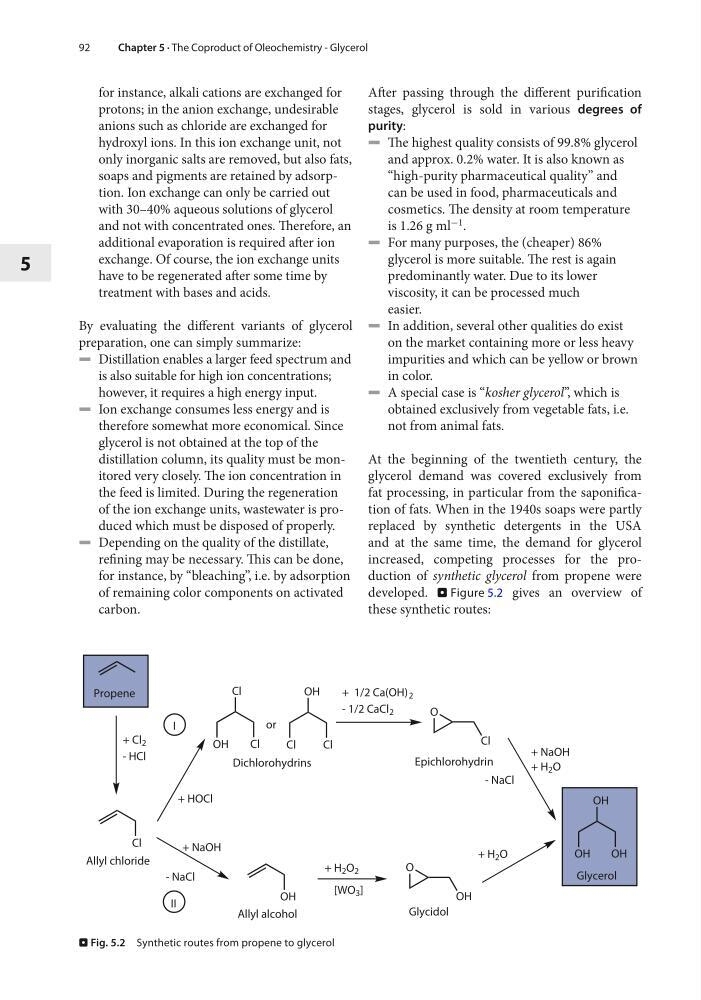
increased, competing processes for the production of synthetic glycerol from propene were
developed. . Figure 5.2 gives an overview of
these synthetic routes:
for instance, alkali cations are exchanged for
protons; in the anion exchange, undesirable
anions such as chloride are exchanged for
hydroxyl ions. In this ion exchange unit, not
only inorganic salts are removed, but also fats,
soaps and pigments are retained by adsorption. Ion exchange can only be carried out
with 30–40% aqueous solutions of glycerol
and not with concentrated ones. Therefore, an
additional evaporation is required after ion
exchange. Of course, the ion exchange units
have to be regenerated after some time by
treatment with bases and acids.
By evaluating the different variants of glycerol
preparation, one can simply summarize:
5 Distillation enables a larger feed spectrum and
is also suitable for high ion concentrations;
however, it requires a high energy input.
5 Ion exchange consumes less energy and is
therefore somewhat more economical. Since
glycerol is not obtained at the top of the
distillation column, its quality must be monitored very closely. The ion concentration in
the feed is limited. During the regeneration
of the ion exchange units, wastewater is produced which must be disposed of properly.
5 Depending on the quality of the distillate,
refining may be necessary. This can be done,
for instance, by “bleaching”, i.e. by adsorption
of remaining color components on activated
carbon.
Cl
Propene
+ Cl 2
- HCl
OH
Cl
Cl
or
Cl
Cl
OH
+ 1/2 Ca(OH) 2
- 1/2 CaCl 2
O
Cl
OH
OH
OH
OH
O
OH
+ H 2 O 2
[WO 3 ]
+ HOCl
+ NaOH
- NaCl
+ NaOH
- NaCl
Dichlorohydrins
Epichlorohydrin
+ H 2 O
Allyl alcohol
Glycidol
Glycerol
I
II
Allyl chloride
+ H 2 O
. Fig. 5.2 Synthetic routes from propene to glycerol
Chapter 5 · The Coproduct of Oleochemistry - Glycerol
5
After passing through the different purification
stages, glycerol is sold in various degrees of
purity:
5 The highest quality consists of 99.8% glycerol
and approx. 0.2% water. It is also known as
“high-purity pharmaceutical quality” and
can be used in food, pharmaceuticals and
cosmetics. The density at room temperature
is 1.26 g ml −1 .
5 For many purposes, the (cheaper) 86%
glycerol is more suitable. The rest is again
predominantly water. Due to its lower
viscosity, it can be processed much
easier.
5 In addition, several other qualities do exist
on the market containing more or less heavy
impurities and which can be yellow or brown
in color.
5 A special case is “kosher glycerol”, which is
obtained exclusively from vegetable fats, i.e.
not from animal fats.
At the beginning of the twentieth century, the
glycerol demand was covered exclusively from
fat processing, in particular from the saponification of fats. When in the 1940s soaps were partly
replaced by synthetic detergents in the USA
and at the same time, the demand for glycerol
increased, competing processes for the production of synthetic glycerol from propene were
developed. . Figure 5.2 gives an overview of
these synthetic routes:
for instance, alkali cations are exchanged for
protons; in the anion exchange, undesirable
anions such as chloride are exchanged for
hydroxyl ions. In this ion exchange unit, not
only inorganic salts are removed, but also fats,
soaps and pigments are retained by adsorption. Ion exchange can only be carried out
with 30–40% aqueous solutions of glycerol
and not with concentrated ones. Therefore, an
additional evaporation is required after ion
exchange. Of course, the ion exchange units
have to be regenerated after some time by
treatment with bases and acids.
By evaluating the different variants of glycerol
preparation, one can simply summarize:
5 Distillation enables a larger feed spectrum and
is also suitable for high ion concentrations;
however, it requires a high energy input.
5 Ion exchange consumes less energy and is
therefore somewhat more economical. Since
glycerol is not obtained at the top of the
distillation column, its quality must be monitored very closely. The ion concentration in
the feed is limited. During the regeneration
of the ion exchange units, wastewater is produced which must be disposed of properly.
5 Depending on the quality of the distillate,
refining may be necessary. This can be done,
for instance, by “bleaching”, i.e. by adsorption
of remaining color components on activated
carbon.
Cl
Propene
+ Cl 2
- HCl
OH
Cl
Cl
or
Cl
Cl
OH
+ 1/2 Ca(OH) 2
- 1/2 CaCl 2
O
Cl
OH
OH
OH
OH
O
OH
+ H 2 O 2
[WO 3 ]
+ HOCl
+ NaOH
- NaCl
+ NaOH
- NaCl
Dichlorohydrins
Epichlorohydrin
+ H 2 O
Allyl alcohol
Glycidol
Glycerol
I
II
Allyl chloride
+ H 2 O
. Fig. 5.2 Synthetic routes from propene to glycerol