

91
5
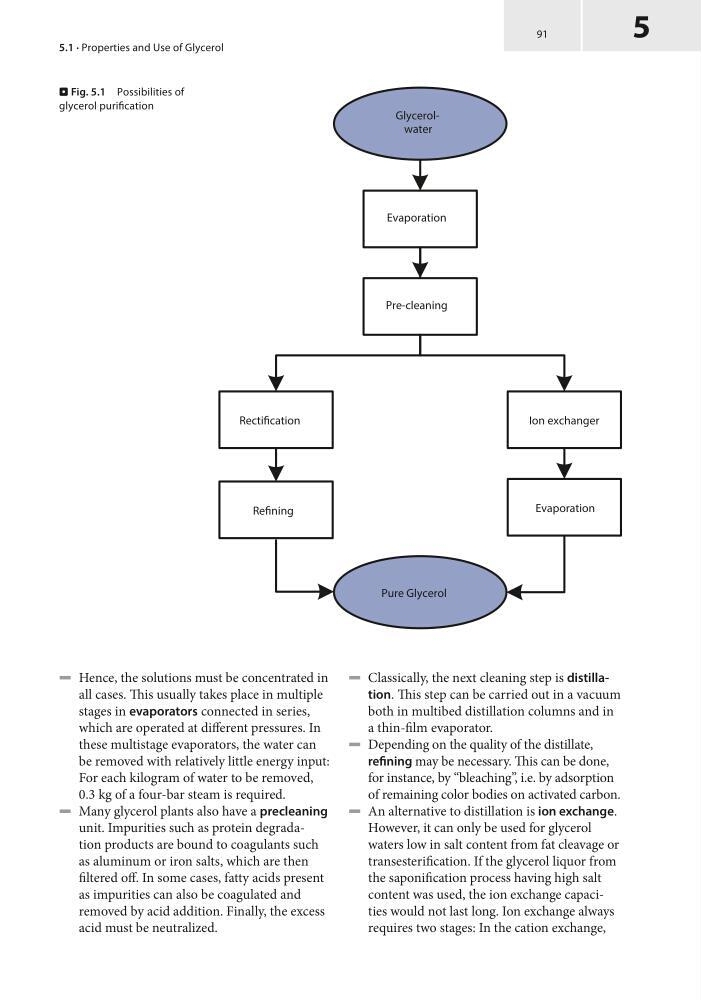
5 Classically, the next cleaning step is distillation. This step can be carried out in a vacuum
both in multibed distillation columns and in
a thin-film evaporator.
5 Depending on the quality of the distillate,
refining may be necessary. This can be done,
for instance, by “bleaching”, i.e. by adsorption
of remaining color bodies on activated carbon.
5 An alternative to distillation is ion exchange.
However, it can only be used for glycerol
waters low in salt content from fat cleavage or
transesterification. If the glycerol liquor from
the saponification process having high salt
content was used, the ion exchange capacities would not last long. Ion exchange always
requires two stages: In the cation exchange,
5 Hence, the solutions must be concentrated in
all cases. This usually takes place in multiple
stages in evaporators connected in series,
which are operated at different pressures. In
these multistage evaporators, the water can
be removed with relatively little energy input:
For each kilogram of water to be removed,
0.3 kg of a four-bar steam is required.
5 Many glycerol plants also have a precleaning
unit. Impurities such as protein degradation products are bound to coagulants such
as aluminum or iron salts, which are then
filtered off. In some cases, fatty acids present
as impurities can also be coagulated and
removed by acid addition. Finally, the excess
acid must be neutralized.
. Fig. 5.1 Possibilities of
glycerol purification
Glycerolwater
Evaporation
Pre-cleaning
Ion exchanger
Evaporation
Rectiication
Reening
Pure Glycerol
5.1 · Properties and Use of Glycerol
5
5 Classically, the next cleaning step is distillation. This step can be carried out in a vacuum
both in multibed distillation columns and in
a thin-film evaporator.
5 Depending on the quality of the distillate,
refining may be necessary. This can be done,
for instance, by “bleaching”, i.e. by adsorption
of remaining color bodies on activated carbon.
5 An alternative to distillation is ion exchange.
However, it can only be used for glycerol
waters low in salt content from fat cleavage or
transesterification. If the glycerol liquor from
the saponification process having high salt
content was used, the ion exchange capacities would not last long. Ion exchange always
requires two stages: In the cation exchange,
5 Hence, the solutions must be concentrated in
all cases. This usually takes place in multiple
stages in evaporators connected in series,
which are operated at different pressures. In
these multistage evaporators, the water can
be removed with relatively little energy input:
For each kilogram of water to be removed,
0.3 kg of a four-bar steam is required.
5 Many glycerol plants also have a precleaning
unit. Impurities such as protein degradation products are bound to coagulants such
as aluminum or iron salts, which are then
filtered off. In some cases, fatty acids present
as impurities can also be coagulated and
removed by acid addition. Finally, the excess
acid must be neutralized.
. Fig. 5.1 Possibilities of
glycerol purification
Glycerolwater
Evaporation
Pre-cleaning
Ion exchanger
Evaporation
Rectiication
Reening
Pure Glycerol
5.1 · Properties and Use of Glycerol