

7.2 Nonlinear Analysis of MFC Structures
145
0
100
200
300
0
50
0
0.5
1
1.5
Θ
1 (mm)
Θ
2 (mm)
Θ
3
(mm)
(a) MFC-d33 with fiber angle of 0
◦
0
100
200
300
0
50
0
0.5
1
Θ
1 (mm)
Θ
2 (mm)
Θ
3
(mm)
(b) MFC-d33 with fiber angle of 30
◦
0
100
200
300
0
50
0
0.5
1
Θ
1 (mm)
Θ
2 (mm)
Θ
3
(mm)
(c) MFC-d33 with fiber angle of 45 ◦
0
100
200
300
0
50
0
0.5
1
Θ
1 (mm)
Θ
2 (mm)
Θ
3
(mm)
(d) MFC-d33 with fiber angle of 60 ◦
0
100
200
300
0
50
0
0.5
1
Θ
1 (mm)
Θ
2 (mm)
Θ
3
(mm)
(e) MFC-d33 with fiber angle of 75
◦
0
100
200
300
0
50
0
0.5
1
Θ
1 (mm)
Θ
2 (mm)
Θ
3
(mm)
(f) MFC-d33 with fiber angle of 90
◦
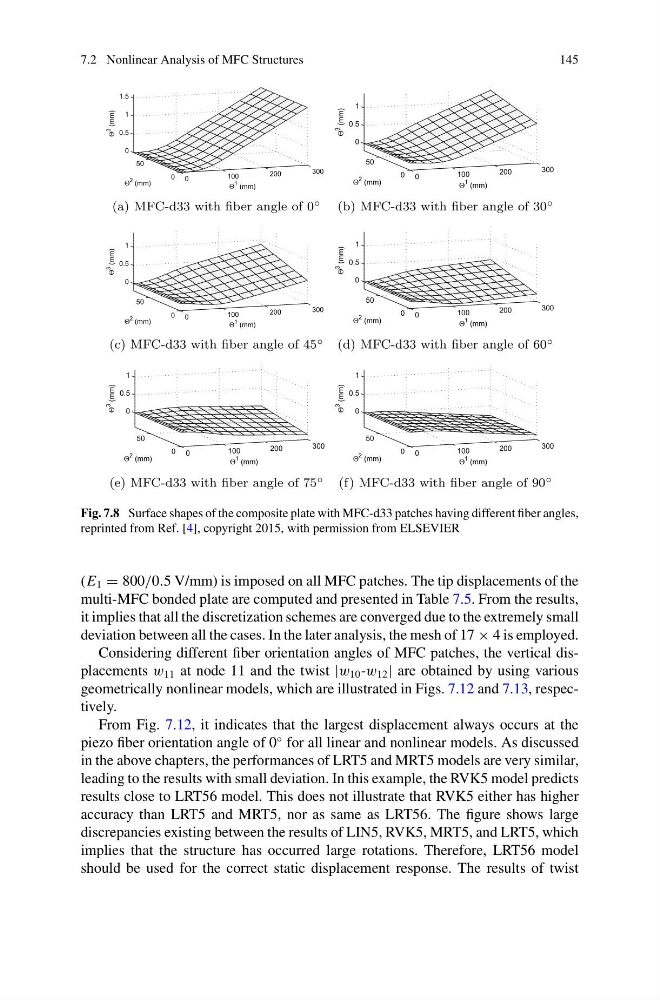
Fig. 7.8 Surface shapes of the composite plate with MFC-d33 patches having different fiber angles,
reprinted from Ref. [4], copyright 2015, with permission from ELSEVIER
(E 1 = 800/0.5 V/mm) is imposed on all MFC patches. The tip displacements of the
multi-MFC bonded plate are computed and presented in Table 7.5. From the results,
it implies that all the discretization schemes are converged due to the extremely small
deviation between all the cases. In the later analysis, the mesh of 17 × 4 is employed.
Considering different fiber orientation angles of MFC patches, the vertical displacements w 11 at node 11 and the twist |w 10 -w 12 | are obtained by using various
geometrically nonlinear models, which are illustrated in Figs. 7.12 and 7.13, respectively.
From Fig. 7.12, it indicates that the largest displacement always occurs at the
piezo fiber orientation angle of 0
◦ for all linear and nonlinear models. As discussed
in the above chapters, the performances of LRT5 and MRT5 models are very similar,
leading to the results with small deviation. In this example, the RVK5 model predicts
results close to LRT56 model. This does not illustrate that RVK5 either has higher
accuracy than LRT5 and MRT5, nor as same as LRT56. The figure shows large
discrepancies existing between the results of LIN5, RVK5, MRT5, and LRT5, which
implies that the structure has occurred large rotations. Therefore, LRT56 model
should be used for the correct static displacement response. The results of twist
145
0
100
200
300
0
50
0
0.5
1
1.5
Θ
1 (mm)
Θ
2 (mm)
Θ
3
(mm)
(a) MFC-d33 with fiber angle of 0
◦
0
100
200
300
0
50
0
0.5
1
Θ
1 (mm)
Θ
2 (mm)
Θ
3
(mm)
(b) MFC-d33 with fiber angle of 30
◦
0
100
200
300
0
50
0
0.5
1
Θ
1 (mm)
Θ
2 (mm)
Θ
3
(mm)
(c) MFC-d33 with fiber angle of 45 ◦
0
100
200
300
0
50
0
0.5
1
Θ
1 (mm)
Θ
2 (mm)
Θ
3
(mm)
(d) MFC-d33 with fiber angle of 60 ◦
0
100
200
300
0
50
0
0.5
1
Θ
1 (mm)
Θ
2 (mm)
Θ
3
(mm)
(e) MFC-d33 with fiber angle of 75
◦
0
100
200
300
0
50
0
0.5
1
Θ
1 (mm)
Θ
2 (mm)
Θ
3
(mm)
(f) MFC-d33 with fiber angle of 90
◦
Fig. 7.8 Surface shapes of the composite plate with MFC-d33 patches having different fiber angles,
reprinted from Ref. [4], copyright 2015, with permission from ELSEVIER
(E 1 = 800/0.5 V/mm) is imposed on all MFC patches. The tip displacements of the
multi-MFC bonded plate are computed and presented in Table 7.5. From the results,
it implies that all the discretization schemes are converged due to the extremely small
deviation between all the cases. In the later analysis, the mesh of 17 × 4 is employed.
Considering different fiber orientation angles of MFC patches, the vertical displacements w 11 at node 11 and the twist |w 10 -w 12 | are obtained by using various
geometrically nonlinear models, which are illustrated in Figs. 7.12 and 7.13, respectively.
From Fig. 7.12, it indicates that the largest displacement always occurs at the
piezo fiber orientation angle of 0
◦ for all linear and nonlinear models. As discussed
in the above chapters, the performances of LRT5 and MRT5 models are very similar,
leading to the results with small deviation. In this example, the RVK5 model predicts
results close to LRT56 model. This does not illustrate that RVK5 either has higher
accuracy than LRT5 and MRT5, nor as same as LRT56. The figure shows large
discrepancies existing between the results of LIN5, RVK5, MRT5, and LRT5, which
implies that the structure has occurred large rotations. Therefore, LRT56 model
should be used for the correct static displacement response. The results of twist