

5.4 Variational Formulations
85
of smart structures, the principle of virtual work is employed, which is given by
δW int = δW ext .
(5.27)
The variation of the kinetic energy, δT , can be calculated by [9]
δT =
V
ρ δ ˙
u
T ˙
u dV = −
V
ρ δu
T
¨
u dV ,
(5.28)
where ρ is the material density, ˙
and ¨
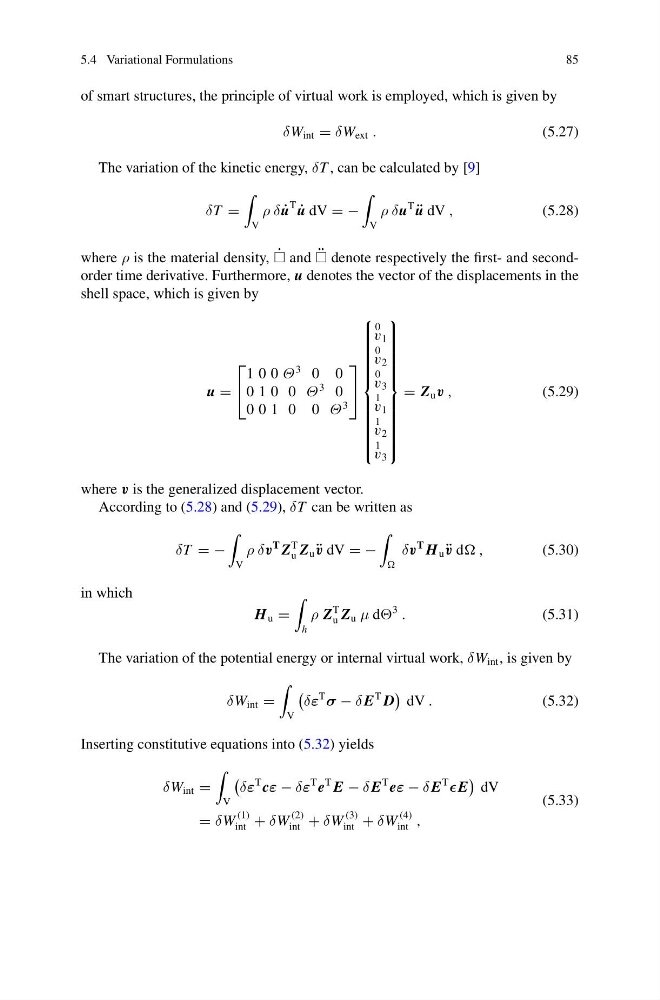
denote respectively the first- and secondorder time derivative. Furthermore, u denotes the vector of the displacements in the
shell space, which is given by
u =
⎡
⎣
1 0 0 Θ
3 0 0
0 1 0 0 Θ
3 0
0 0 1 0 0 Θ
3
⎤
⎦
⎧
⎪ ⎪ ⎪ ⎪ ⎪ ⎪ ⎪ ⎪ ⎪ ⎪ ⎨
⎪ ⎪ ⎪ ⎪ ⎪ ⎪ ⎪ ⎪ ⎪ ⎪ ⎩
0
v 1
0
v 2
0
v 3
1
v 1
1
v 2
1
v 3
⎫
⎪ ⎪ ⎪ ⎪ ⎪ ⎪ ⎪ ⎪ ⎪ ⎪ ⎬
⎪ ⎪ ⎪ ⎪ ⎪ ⎪ ⎪ ⎪ ⎪ ⎪ ⎭
= Z u v ,
(5.29)
where v is the generalized displacement vector.
According to (5.28) and (5.29), δT can be written as
δT = −
V
ρ δv
T Z
T
u Z u ¨
v dV = −
δv
T H u ¨
v d ,
(5.30)
in which
H u =
h
ρ Z
T
u Z u μ d
3
.
(5.31)
The variation of the potential energy or internal virtual work, δW int , is given by
δW int =
V
δε
T
σ − δ E
T D
dV .
(5.32)
Inserting constitutive equations into (5.32) yields
δW int =
V
δε
T cε − δε
T e
T E − δ E
T eε − δ E
T
E
dV
= δW
(1)
int + δW
(2)
int + δW
(3)
int + δW
(4)
int ,
(5.33)
85
of smart structures, the principle of virtual work is employed, which is given by
δW int = δW ext .
(5.27)
The variation of the kinetic energy, δT , can be calculated by [9]
δT =
V
ρ δ ˙
u
T ˙
u dV = −
V
ρ δu
T
¨
u dV ,
(5.28)
where ρ is the material density, ˙
and ¨
denote respectively the first- and secondorder time derivative. Furthermore, u denotes the vector of the displacements in the
shell space, which is given by
u =
⎡
⎣
1 0 0 Θ
3 0 0
0 1 0 0 Θ
3 0
0 0 1 0 0 Θ
3
⎤
⎦
⎧
⎪ ⎪ ⎪ ⎪ ⎪ ⎪ ⎪ ⎪ ⎪ ⎪ ⎨
⎪ ⎪ ⎪ ⎪ ⎪ ⎪ ⎪ ⎪ ⎪ ⎪ ⎩
0
v 1
0
v 2
0
v 3
1
v 1
1
v 2
1
v 3
⎫
⎪ ⎪ ⎪ ⎪ ⎪ ⎪ ⎪ ⎪ ⎪ ⎪ ⎬
⎪ ⎪ ⎪ ⎪ ⎪ ⎪ ⎪ ⎪ ⎪ ⎪ ⎭
= Z u v ,
(5.29)
where v is the generalized displacement vector.
According to (5.28) and (5.29), δT can be written as
δT = −
V
ρ δv
T Z
T
u Z u ¨
v dV = −
δv
T H u ¨
v d ,
(5.30)
in which
H u =
h
ρ Z
T
u Z u μ d
3
.
(5.31)
The variation of the potential energy or internal virtual work, δW int , is given by
δW int =
V
δε
T
σ − δ E
T D
dV .
(5.32)
Inserting constitutive equations into (5.32) yields
δW int =
V
δε
T cε − δε
T e
T E − δ E
T eε − δ E
T
E
dV
= δW
(1)
int + δW
(2)
int + δW
(3)
int + δW
(4)
int ,
(5.33)