

During the development of hydraulic power to large capacity, a series of technical problems have been solved as follows:
(1) Weight Reduction
Limit the weight of the structure and increase the power–weight ratio of the
system, so that the system can obtain excellent technical performance and
economic results. Therefore, reasonable design (such as integration of components and oil circuits, optimization of structural parameters) is required.
High-strength light alloys (such as aluminum alloy and titanium alloy) and
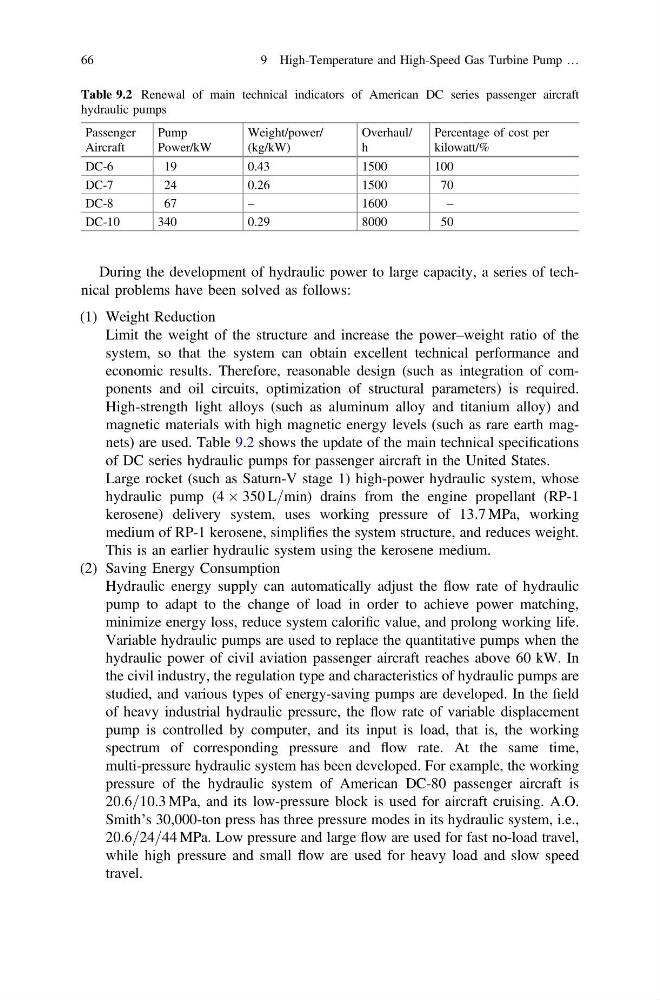
magnetic materials with high magnetic energy levels (such as rare earth magnets) are used. Table 9.2 shows the update of the main technical specifications
of DC series hydraulic pumps for passenger aircraft in the United States.
Large rocket (such as Saturn-V stage 1) high-power hydraulic system, whose
hydraulic pump (4 Â 350 L=min) drains from the engine propellant (RP-1
kerosene) delivery system, uses working pressure of 13:7 MPa, working
medium of RP-1 kerosene, simplifies the system structure, and reduces weight.
This is an earlier hydraulic system using the kerosene medium.
(2) Saving Energy Consumption
Hydraulic energy supply can automatically adjust the flow rate of hydraulic
pump to adapt to the change of load in order to achieve power matching,
minimize energy loss, reduce system calorific value, and prolong working life.
Variable hydraulic pumps are used to replace the quantitative pumps when the
hydraulic power of civil aviation passenger aircraft reaches above 60 kW. In
the civil industry, the regulation type and characteristics of hydraulic pumps are
studied, and various types of energy-saving pumps are developed. In the field
of heavy industrial hydraulic pressure, the flow rate of variable displacement
pump is controlled by computer, and its input is load, that is, the working
spectrum of corresponding pressure and flow rate. At the same time,
multi-pressure hydraulic system has been developed. For example, the working
pressure of the hydraulic system of American DC-80 passenger aircraft is
20:6=10:3 MPa, and its low-pressure block is used for aircraft cruising. A.O.
Smith’s 30,000-ton press has three pressure modes in its hydraulic system, i.e.,
20:6=24=44 MPa. Low pressure and large flow are used for fast no-load travel,
while high pressure and small flow are used for heavy load and slow speed
travel.
Table 9.2 Renewal of main technical indicators of American DC series passenger aircraft
hydraulic pumps
Passenger
Aircraft
Pump
Power/kW
Weight/power/
(kg/kW)
Overhaul/
h
Percentage of cost per
kilowatt/%
DC-6
19
0.43
1500
100
DC-7
24
0.26
1500
70
DC-8
67
–
1600
–
DC-10
340
0.29
8000
50
66
9 High-Temperature and High-Speed Gas Turbine Pump …
(1) Weight Reduction
Limit the weight of the structure and increase the power–weight ratio of the
system, so that the system can obtain excellent technical performance and
economic results. Therefore, reasonable design (such as integration of components and oil circuits, optimization of structural parameters) is required.
High-strength light alloys (such as aluminum alloy and titanium alloy) and
magnetic materials with high magnetic energy levels (such as rare earth magnets) are used. Table 9.2 shows the update of the main technical specifications
of DC series hydraulic pumps for passenger aircraft in the United States.
Large rocket (such as Saturn-V stage 1) high-power hydraulic system, whose
hydraulic pump (4 Â 350 L=min) drains from the engine propellant (RP-1
kerosene) delivery system, uses working pressure of 13:7 MPa, working
medium of RP-1 kerosene, simplifies the system structure, and reduces weight.
This is an earlier hydraulic system using the kerosene medium.
(2) Saving Energy Consumption
Hydraulic energy supply can automatically adjust the flow rate of hydraulic
pump to adapt to the change of load in order to achieve power matching,
minimize energy loss, reduce system calorific value, and prolong working life.
Variable hydraulic pumps are used to replace the quantitative pumps when the
hydraulic power of civil aviation passenger aircraft reaches above 60 kW. In
the civil industry, the regulation type and characteristics of hydraulic pumps are
studied, and various types of energy-saving pumps are developed. In the field
of heavy industrial hydraulic pressure, the flow rate of variable displacement
pump is controlled by computer, and its input is load, that is, the working
spectrum of corresponding pressure and flow rate. At the same time,
multi-pressure hydraulic system has been developed. For example, the working
pressure of the hydraulic system of American DC-80 passenger aircraft is
20:6=10:3 MPa, and its low-pressure block is used for aircraft cruising. A.O.
Smith’s 30,000-ton press has three pressure modes in its hydraulic system, i.e.,
20:6=24=44 MPa. Low pressure and large flow are used for fast no-load travel,
while high pressure and small flow are used for heavy load and slow speed
travel.
Table 9.2 Renewal of main technical indicators of American DC series passenger aircraft
hydraulic pumps
Passenger
Aircraft
Pump
Power/kW
Weight/power/
(kg/kW)
Overhaul/
h
Percentage of cost per
kilowatt/%
DC-6
19
0.43
1500
100
DC-7
24
0.26
1500
70
DC-8
67
–
1600
–
DC-10
340
0.29
8000
50
66
9 High-Temperature and High-Speed Gas Turbine Pump …