

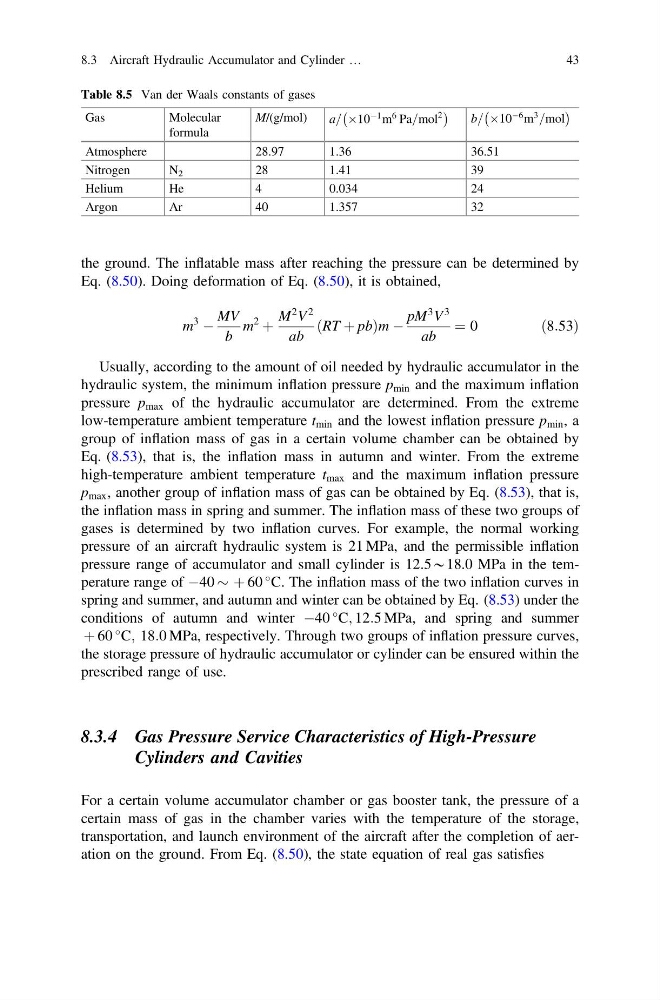
the ground. The inflatable mass after reaching the pressure can be determined by
Eq. (8.50). Doing deformation of Eq. (8.50), it is obtained,
m
3
À
MV
b
m
2
þ
M
2 V
2
ab
RT þ pb
ð
Þ m À
pM
3 V
3
ab
¼ 0
ð8:53Þ
Usually, according to the amount of oil needed by hydraulic accumulator in the
hydraulic system, the minimum inflation pressure p min and the maximum inflation
pressure p max of the hydraulic accumulator are determined. From the extreme
low-temperature ambient temperature t min and the lowest inflation pressure p min , a
group of inflation mass of gas in a certain volume chamber can be obtained by
Eq. (8.53), that is, the inflation mass in autumn and winter. From the extreme
high-temperature ambient temperature t max and the maximum inflation pressure
p max , another group of inflation mass of gas can be obtained by Eq. (8.53), that is,
the inflation mass in spring and summer. The inflation mass of these two groups of
gases is determined by two inflation curves. For example, the normal working
pressure of an aircraft hydraulic system is 21 MPa, and the permissible inflation
pressure range of accumulator and small cylinder is 12.5*18.0 MPa in the temperature range of À40 $ þ 60
C. The inflation mass of the two inflation curves in
spring and summer, and autumn and winter can be obtained by Eq. (8.53) under the
conditions of autumn and winter À40
C; 12:5 MPa, and spring and summer
þ 60
C; 18:0 MPa, respectively. Through two groups of inflation pressure curves,
the storage pressure of hydraulic accumulator or cylinder can be ensured within the
prescribed range of use.
8.3.4 Gas Pressure Service Characteristics of High-Pressure
Cylinders and Cavities
For a certain volume accumulator chamber or gas booster tank, the pressure of a
certain mass of gas in the chamber varies with the temperature of the storage,
transportation, and launch environment of the aircraft after the completion of aeration on the ground. From Eq. (8.50), the state equation of real gas satisfies
Table 8.5 Van der Waals constants of gases
Gas
Molecular
formula
M/(g/mol)
a= Â10
À1 m
6 Pa=mol
2
À
Á
b= Â10
À6 m
3 =mol
À
Á
Atmosphere
28.97
1.36
36.51
Nitrogen
N 2
28
1.41
39
Helium
He
4
0.034
24
Argon
Ar
40
1.357
32
8.3 Aircraft Hydraulic Accumulator and Cylinder …
43
Eq. (8.50). Doing deformation of Eq. (8.50), it is obtained,
m
3
À
MV
b
m
2
þ
M
2 V
2
ab
RT þ pb
ð
Þ m À
pM
3 V
3
ab
¼ 0
ð8:53Þ
Usually, according to the amount of oil needed by hydraulic accumulator in the
hydraulic system, the minimum inflation pressure p min and the maximum inflation
pressure p max of the hydraulic accumulator are determined. From the extreme
low-temperature ambient temperature t min and the lowest inflation pressure p min , a
group of inflation mass of gas in a certain volume chamber can be obtained by
Eq. (8.53), that is, the inflation mass in autumn and winter. From the extreme
high-temperature ambient temperature t max and the maximum inflation pressure
p max , another group of inflation mass of gas can be obtained by Eq. (8.53), that is,
the inflation mass in spring and summer. The inflation mass of these two groups of
gases is determined by two inflation curves. For example, the normal working
pressure of an aircraft hydraulic system is 21 MPa, and the permissible inflation
pressure range of accumulator and small cylinder is 12.5*18.0 MPa in the temperature range of À40 $ þ 60
C. The inflation mass of the two inflation curves in
spring and summer, and autumn and winter can be obtained by Eq. (8.53) under the
conditions of autumn and winter À40
C; 12:5 MPa, and spring and summer
þ 60
C; 18:0 MPa, respectively. Through two groups of inflation pressure curves,
the storage pressure of hydraulic accumulator or cylinder can be ensured within the
prescribed range of use.
8.3.4 Gas Pressure Service Characteristics of High-Pressure
Cylinders and Cavities
For a certain volume accumulator chamber or gas booster tank, the pressure of a
certain mass of gas in the chamber varies with the temperature of the storage,
transportation, and launch environment of the aircraft after the completion of aeration on the ground. From Eq. (8.50), the state equation of real gas satisfies
Table 8.5 Van der Waals constants of gases
Gas
Molecular
formula
M/(g/mol)
a= Â10
À1 m
6 Pa=mol
2
À
Á
b= Â10
À6 m
3 =mol
À
Á
Atmosphere
28.97
1.36
36.51
Nitrogen
N 2
28
1.41
39
Helium
He
4
0.034
24
Argon
Ar
40
1.357
32
8.3 Aircraft Hydraulic Accumulator and Cylinder …
43