

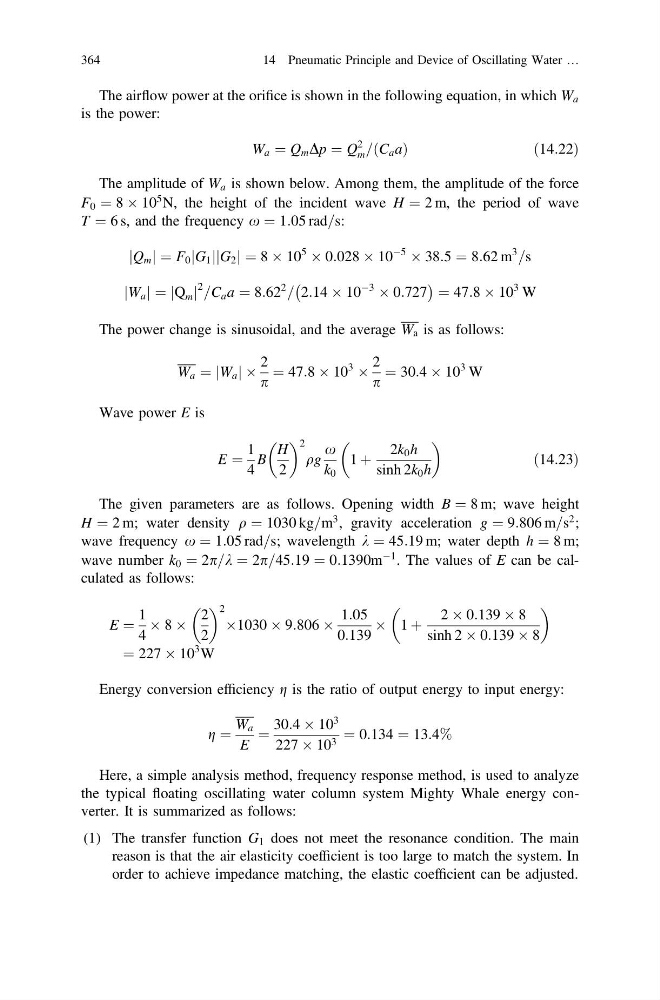
The airflow power at the orifice is shown in the following equation, in which W a
is the power:
W a ¼ Q m Dp ¼ Q
2
m = C a a
ð
Þ
ð14:22Þ
The amplitude of W a is shown below. Among them, the amplitude of the force
F 0 ¼ 8 Â 10
5 N, the height of the incident wave H ¼ 2 m, the period of wave
T ¼ 6 s, and the frequency x ¼ 1:05 rad=s:
Q m
j j ¼ F 0 G 1
j j G 2
j j ¼ 8 Â 10
5
 0:028  10
À5
 38:5 ¼ 8:62 m
3
=s
W a
j j ¼ Q m
j j
2 =C a a ¼ 8:62
2
= 2:14 Â 10
À3
 0:727
À
Á ¼ 47:8 Â 10
3 W
The power change is sinusoidal, and the average W a is as follows:
W a ¼ W a
j j Â
2
p
¼ 47:8 Â 10
3
Â
2
p
¼ 30:4 Â 10
3 W
Wave power E is
E ¼
1
4
B
H
2
2
qg
x
k 0
1 þ
2k 0 h
sinh 2k 0 h
ð14:23Þ
The given parameters are as follows. Opening width B ¼ 8 m; wave height
H ¼ 2 m; water density q ¼ 1030 kg=m
3 , gravity acceleration g ¼ 9:806 m=s
2 ;
wave frequency x ¼ 1:05 rad=s; wavelength k ¼ 45:19 m; water depth h ¼ 8 m;
wave number k 0 ¼ 2p=k ¼ 2p=45:19 ¼ 0:1390m
À1 . The values of E can be calculated as follows:
E ¼
1
4
 8 Â
2
2
2
Â1030 Â 9:806 Â
1:05
0:139
 1 þ
2 Â 0:139 Â 8
sinh 2 Â 0:139 Â 8
¼ 227 Â 10
3 W
Energy conversion efficiency g is the ratio of output energy to input energy:
g ¼
W a
E
¼
30:4 Â 10
3
227 Â 10 3 ¼ 0:134 ¼ 13:4%
Here, a simple analysis method, frequency response method, is used to analyze
the typical floating oscillating water column system Mighty Whale energy converter. It is summarized as follows:
(1) The transfer function G 1 does not meet the resonance condition. The main
reason is that the air elasticity coefficient is too large to match the system. In
order to achieve impedance matching, the elastic coefficient can be adjusted.
364
14 Pneumatic Principle and Device of Oscillating Water …
is the power:
W a ¼ Q m Dp ¼ Q
2
m = C a a
ð
Þ
ð14:22Þ
The amplitude of W a is shown below. Among them, the amplitude of the force
F 0 ¼ 8 Â 10
5 N, the height of the incident wave H ¼ 2 m, the period of wave
T ¼ 6 s, and the frequency x ¼ 1:05 rad=s:
Q m
j j ¼ F 0 G 1
j j G 2
j j ¼ 8 Â 10
5
 0:028  10
À5
 38:5 ¼ 8:62 m
3
=s
W a
j j ¼ Q m
j j
2 =C a a ¼ 8:62
2
= 2:14 Â 10
À3
 0:727
À
Á ¼ 47:8 Â 10
3 W
The power change is sinusoidal, and the average W a is as follows:
W a ¼ W a
j j Â
2
p
¼ 47:8 Â 10
3
Â
2
p
¼ 30:4 Â 10
3 W
Wave power E is
E ¼
1
4
B
H
2
2
qg
x
k 0
1 þ
2k 0 h
sinh 2k 0 h
ð14:23Þ
The given parameters are as follows. Opening width B ¼ 8 m; wave height
H ¼ 2 m; water density q ¼ 1030 kg=m
3 , gravity acceleration g ¼ 9:806 m=s
2 ;
wave frequency x ¼ 1:05 rad=s; wavelength k ¼ 45:19 m; water depth h ¼ 8 m;
wave number k 0 ¼ 2p=k ¼ 2p=45:19 ¼ 0:1390m
À1 . The values of E can be calculated as follows:
E ¼
1
4
 8 Â
2
2
2
Â1030 Â 9:806 Â
1:05
0:139
 1 þ
2 Â 0:139 Â 8
sinh 2 Â 0:139 Â 8
¼ 227 Â 10
3 W
Energy conversion efficiency g is the ratio of output energy to input energy:
g ¼
W a
E
¼
30:4 Â 10
3
227 Â 10 3 ¼ 0:134 ¼ 13:4%
Here, a simple analysis method, frequency response method, is used to analyze
the typical floating oscillating water column system Mighty Whale energy converter. It is summarized as follows:
(1) The transfer function G 1 does not meet the resonance condition. The main
reason is that the air elasticity coefficient is too large to match the system. In
order to achieve impedance matching, the elastic coefficient can be adjusted.
364
14 Pneumatic Principle and Device of Oscillating Water …