

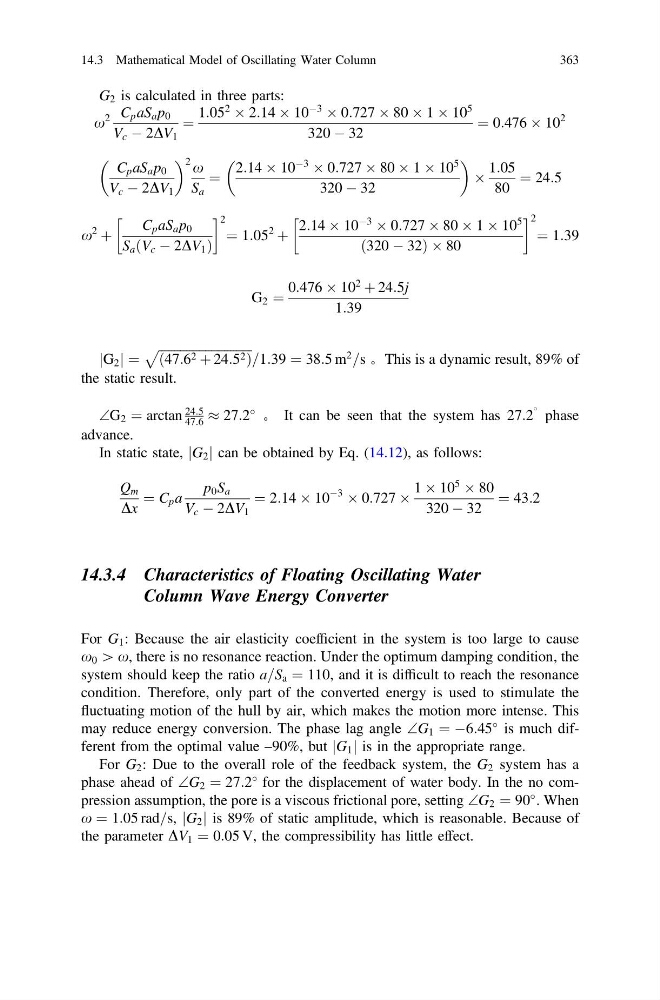
G 2 is calculated in three parts:
x
2 C p aS a p 0
V c À 2DV 1
¼
1:05
2
 2:14  10
À3
 0:727  80  1  10
5
320 À 32
¼ 0:476 Â 10
2
C p aS a p 0
V c À 2DV 1
2 x
S a
¼
2:14 Â 10
À3
 0:727  80  1  10
5
320 À 32
Â
1:05
80
¼ 24:5
x
2
þ
C p aS a p 0
S a V c À 2DV 1
ð
Þ
! 2
¼ 1:05
2
þ
2:14 Â 10
À3
 0:727  80  1  10
5
320 À 32
ð
ÞÂ80
! 2
¼ 1:39
G 2 ¼
0:476 Â 10
2
þ 24:5j
1:39
G 2
j j ¼
ffiffiffiffiffiffiffiffiffiffiffiffiffiffiffiffiffiffiffiffiffiffiffiffiffiffiffiffiffiffi
47:6 2 þ 24:5 2
ð
Þ
p
=1:39 ¼ 38:5 m
2
=s 。This is a dynamic result, 89% of
the static result.
\G 2 ¼ arctan
24:5
47:6 % 27:2
。 It can be seen that the system has 27:2
phase
advance.
In static state, G 2
j j can be obtained by Eq. (14.12), as follows:
Q m
Dx
¼ C p a
p 0 S a
V c À 2DV 1
¼ 2:14 Â 10
À3
 0:727 Â
1 Â 10
5
 80
320 À 32
¼ 43:2
14.3.4 Characteristics of Floating Oscillating Water
Column Wave Energy Converter
For G 1 : Because the air elasticity coefficient in the system is too large to cause
x 0 [ x, there is no resonance reaction. Under the optimum damping condition, the
system should keep the ratio a=S a ¼ 110, and it is difficult to reach the resonance
condition. Therefore, only part of the converted energy is used to stimulate the
fluctuating motion of the hull by air, which makes the motion more intense. This
may reduce energy conversion. The phase lag angle \G 1 ¼ À6:45
is much different from the optimal value –90%, but G 1
j j is in the appropriate range.
For G 2 : Due to the overall role of the feedback system, the G 2 system has a
phase ahead of \G 2 ¼ 27:2
for the displacement of water body. In the no compression assumption, the pore is a viscous frictional pore, setting \G 2 ¼ 90
. When
x ¼ 1:05 rad=s, G 2
j j is 89% of static amplitude, which is reasonable. Because of
the parameter DV 1 ¼ 0:05 V, the compressibility has little effect.
14.3 Mathematical Model of Oscillating Water Column
363
x
2 C p aS a p 0
V c À 2DV 1
¼
1:05
2
 2:14  10
À3
 0:727  80  1  10
5
320 À 32
¼ 0:476 Â 10
2
C p aS a p 0
V c À 2DV 1
2 x
S a
¼
2:14 Â 10
À3
 0:727  80  1  10
5
320 À 32
Â
1:05
80
¼ 24:5
x
2
þ
C p aS a p 0
S a V c À 2DV 1
ð
Þ
! 2
¼ 1:05
2
þ
2:14 Â 10
À3
 0:727  80  1  10
5
320 À 32
ð
ÞÂ80
! 2
¼ 1:39
G 2 ¼
0:476 Â 10
2
þ 24:5j
1:39
G 2
j j ¼
ffiffiffiffiffiffiffiffiffiffiffiffiffiffiffiffiffiffiffiffiffiffiffiffiffiffiffiffiffiffi
47:6 2 þ 24:5 2
ð
Þ
p
=1:39 ¼ 38:5 m
2
=s 。This is a dynamic result, 89% of
the static result.
\G 2 ¼ arctan
24:5
47:6 % 27:2
。 It can be seen that the system has 27:2
phase
advance.
In static state, G 2
j j can be obtained by Eq. (14.12), as follows:
Q m
Dx
¼ C p a
p 0 S a
V c À 2DV 1
¼ 2:14 Â 10
À3
 0:727 Â
1 Â 10
5
 80
320 À 32
¼ 43:2
14.3.4 Characteristics of Floating Oscillating Water
Column Wave Energy Converter
For G 1 : Because the air elasticity coefficient in the system is too large to cause
x 0 [ x, there is no resonance reaction. Under the optimum damping condition, the
system should keep the ratio a=S a ¼ 110, and it is difficult to reach the resonance
condition. Therefore, only part of the converted energy is used to stimulate the
fluctuating motion of the hull by air, which makes the motion more intense. This
may reduce energy conversion. The phase lag angle \G 1 ¼ À6:45
is much different from the optimal value –90%, but G 1
j j is in the appropriate range.
For G 2 : Due to the overall role of the feedback system, the G 2 system has a
phase ahead of \G 2 ¼ 27:2
for the displacement of water body. In the no compression assumption, the pore is a viscous frictional pore, setting \G 2 ¼ 90
. When
x ¼ 1:05 rad=s, G 2
j j is 89% of static amplitude, which is reasonable. Because of
the parameter DV 1 ¼ 0:05 V, the compressibility has little effect.
14.3 Mathematical Model of Oscillating Water Column
363