

Here, take the sonic flow as an example, make a specific introduction. Assuming
that flow coefficient is a function of inlet–outlet pressure ratio p 2 =p 1
ð
Þ, flow Q m is
also a function of pressure ratio, which can be expressed as follows:
Q m ¼ C q a
ð14:10Þ
where
C q Flow coefficient.
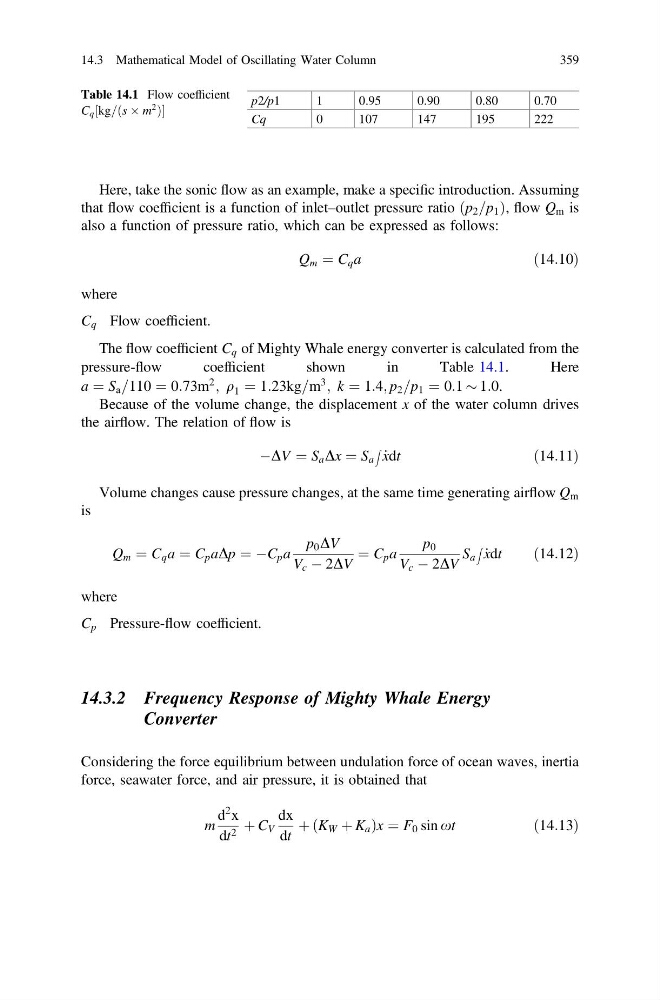
The flow coefficient C q of Mighty Whale energy converter is calculated from the
pressure-flow
coefficient
shown
in
Table 14.1.
Here
a ¼ S a =110 ¼ 0:73m
2
; q 1 ¼ 1:23kg=m
3
; k ¼ 1:4; p 2 =p 1 ¼ 0:1 $ 1:0.
Because of the volume change, the displacement x of the water column drives
the airflow. The relation of flow is
ÀDV ¼ S a Dx ¼ S a
Z _
xdt
ð14:11Þ
Volume changes cause pressure changes, at the same time generating airflow Q m
is
Q m ¼ C q a ¼ C p aDp ¼ ÀC p a
p 0 DV
V c À 2DV
¼ C p a
p 0
V c À 2DV
S a
Z _
xdt
ð14:12Þ
where
C p Pressure-flow coefficient.
14.3.2 Frequency Response of Mighty Whale Energy
Converter
Considering the force equilibrium between undulation force of ocean waves, inertia
force, seawater force, and air pressure, it is obtained that
m
d
2 x
dt 2 þ C V
dx
dt
þ K W þ K a
ð
Þ x ¼ F 0 sin xt
ð14:13Þ
Table 14.1 Flow coefficient
C q kg= s  m
2
ð
Þ
½
p2/p1
1
0.95
0.90
0.80
0.70
Cq
0
107
147
195
222
14.3 Mathematical Model of Oscillating Water Column
359
that flow coefficient is a function of inlet–outlet pressure ratio p 2 =p 1
ð
Þ, flow Q m is
also a function of pressure ratio, which can be expressed as follows:
Q m ¼ C q a
ð14:10Þ
where
C q Flow coefficient.
The flow coefficient C q of Mighty Whale energy converter is calculated from the
pressure-flow
coefficient
shown
in
Table 14.1.
Here
a ¼ S a =110 ¼ 0:73m
2
; q 1 ¼ 1:23kg=m
3
; k ¼ 1:4; p 2 =p 1 ¼ 0:1 $ 1:0.
Because of the volume change, the displacement x of the water column drives
the airflow. The relation of flow is
ÀDV ¼ S a Dx ¼ S a
Z _
xdt
ð14:11Þ
Volume changes cause pressure changes, at the same time generating airflow Q m
is
Q m ¼ C q a ¼ C p aDp ¼ ÀC p a
p 0 DV
V c À 2DV
¼ C p a
p 0
V c À 2DV
S a
Z _
xdt
ð14:12Þ
where
C p Pressure-flow coefficient.
14.3.2 Frequency Response of Mighty Whale Energy
Converter
Considering the force equilibrium between undulation force of ocean waves, inertia
force, seawater force, and air pressure, it is obtained that
m
d
2 x
dt 2 þ C V
dx
dt
þ K W þ K a
ð
Þ x ¼ F 0 sin xt
ð14:13Þ
Table 14.1 Flow coefficient
C q kg= s  m
2
ð
Þ
½
p2/p1
1
0.95
0.90
0.80
0.70
Cq
0
107
147
195
222
14.3 Mathematical Model of Oscillating Water Column
359