

when driving at low speed, the pressure drop is relative gentle. The higher the speed
is, the greater the resistance, the faster the pressure drop and the shorter the working
time of the system. Figure 13.7b shows the cylinder hydrogen transmission pressure characteristics of 70 MPa hydrogen transmission system at different speeds. At
the same speed, the working time of 70 MPa hydrogen transmission system is
longer than that of 35 MPa, and the downward trend of pressure is basically the
same.
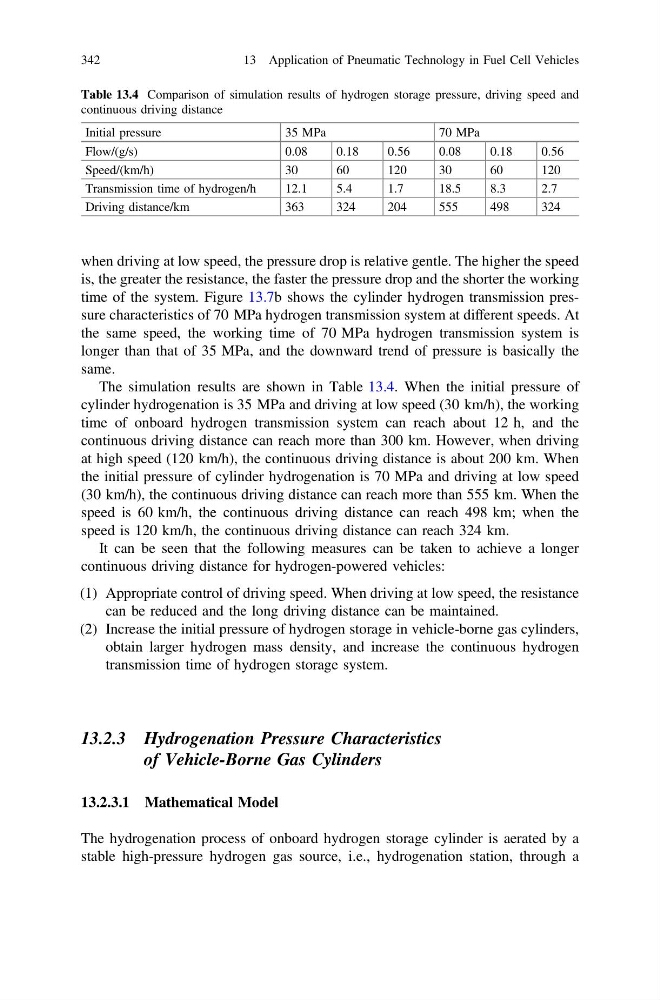
The simulation results are shown in Table 13.4. When the initial pressure of
cylinder hydrogenation is 35 MPa and driving at low speed (30 km/h), the working
time of onboard hydrogen transmission system can reach about 12 h, and the
continuous driving distance can reach more than 300 km. However, when driving
at high speed (120 km/h), the continuous driving distance is about 200 km. When
the initial pressure of cylinder hydrogenation is 70 MPa and driving at low speed
(30 km/h), the continuous driving distance can reach more than 555 km. When the
speed is 60 km/h, the continuous driving distance can reach 498 km; when the
speed is 120 km/h, the continuous driving distance can reach 324 km.
It can be seen that the following measures can be taken to achieve a longer
continuous driving distance for hydrogen-powered vehicles:
(1) Appropriate control of driving speed. When driving at low speed, the resistance
can be reduced and the long driving distance can be maintained.
(2) Increase the initial pressure of hydrogen storage in vehicle-borne gas cylinders,
obtain larger hydrogen mass density, and increase the continuous hydrogen
transmission time of hydrogen storage system.
13.2.3 Hydrogenation Pressure Characteristics
of Vehicle-Borne Gas Cylinders
13.2.3.1 Mathematical Model
The hydrogenation process of onboard hydrogen storage cylinder is aerated by a
stable high-pressure hydrogen gas source, i.e., hydrogenation station, through a
Table 13.4 Comparison of simulation results of hydrogen storage pressure, driving speed and
continuous driving distance
Initial pressure
35 MPa
70 MPa
Flow/(g/s)
0.08
0.18
0.56
0.08
0.18
0.56
Speed/(km/h)
30
60
120
30
60
120
Transmission time of hydrogen/h
12.1
5.4
1.7
18.5
8.3
2.7
Driving distance/km
363
324
204
555
498
324
342
13 Application of Pneumatic Technology in Fuel Cell Vehicles
is, the greater the resistance, the faster the pressure drop and the shorter the working
time of the system. Figure 13.7b shows the cylinder hydrogen transmission pressure characteristics of 70 MPa hydrogen transmission system at different speeds. At
the same speed, the working time of 70 MPa hydrogen transmission system is
longer than that of 35 MPa, and the downward trend of pressure is basically the
same.
The simulation results are shown in Table 13.4. When the initial pressure of
cylinder hydrogenation is 35 MPa and driving at low speed (30 km/h), the working
time of onboard hydrogen transmission system can reach about 12 h, and the
continuous driving distance can reach more than 300 km. However, when driving
at high speed (120 km/h), the continuous driving distance is about 200 km. When
the initial pressure of cylinder hydrogenation is 70 MPa and driving at low speed
(30 km/h), the continuous driving distance can reach more than 555 km. When the
speed is 60 km/h, the continuous driving distance can reach 498 km; when the
speed is 120 km/h, the continuous driving distance can reach 324 km.
It can be seen that the following measures can be taken to achieve a longer
continuous driving distance for hydrogen-powered vehicles:
(1) Appropriate control of driving speed. When driving at low speed, the resistance
can be reduced and the long driving distance can be maintained.
(2) Increase the initial pressure of hydrogen storage in vehicle-borne gas cylinders,
obtain larger hydrogen mass density, and increase the continuous hydrogen
transmission time of hydrogen storage system.
13.2.3 Hydrogenation Pressure Characteristics
of Vehicle-Borne Gas Cylinders
13.2.3.1 Mathematical Model
The hydrogenation process of onboard hydrogen storage cylinder is aerated by a
stable high-pressure hydrogen gas source, i.e., hydrogenation station, through a
Table 13.4 Comparison of simulation results of hydrogen storage pressure, driving speed and
continuous driving distance
Initial pressure
35 MPa
70 MPa
Flow/(g/s)
0.08
0.18
0.56
0.08
0.18
0.56
Speed/(km/h)
30
60
120
30
60
120
Transmission time of hydrogen/h
12.1
5.4
1.7
18.5
8.3
2.7
Driving distance/km
363
324
204
555
498
324
342
13 Application of Pneumatic Technology in Fuel Cell Vehicles