

obtained by material handbook. The application fields of large diameter DTH
hammer are mainly complex geology, driftstone, pebble, hard rock, soil, and granite.
(2) Element properties and mesh generation
The elements used for spherical teeth and rocks are hexahedral solid element
SOLID164. Because the focus of attention is not on the force exerted on the
spherical tooth bit, and in order to speed up the analysis and reduce the memory
occupation, the bit is set as a rigid body. As a whole, all the forces exerted on the
spherical teeth act on the center of mass of the bit, which reduces the requirement
for the bit meshing. The spherical teeth are divided into free meshes. The division
of rock is relatively simple. Considering that the middle area is the main stress area,
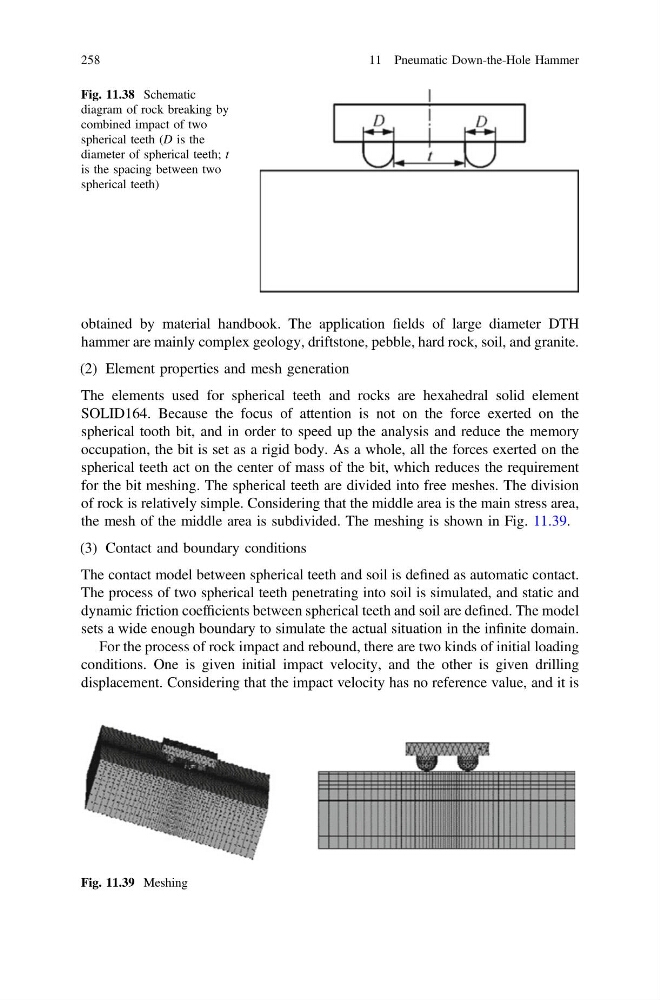
the mesh of the middle area is subdivided. The meshing is shown in Fig. 11.39.
(3) Contact and boundary conditions
The contact model between spherical teeth and soil is defined as automatic contact.
The process of two spherical teeth penetrating into soil is simulated, and static and
dynamic friction coefficients between spherical teeth and soil are defined. The model
sets a wide enough boundary to simulate the actual situation in the infinite domain.
For the process of rock impact and rebound, there are two kinds of initial loading
conditions. One is given initial impact velocity, and the other is given drilling
displacement. Considering that the impact velocity has no reference value, and it is
Fig. 11.39 Meshing
Fig. 11.38 Schematic
diagram of rock breaking by
combined impact of two
spherical teeth (D is the
diameter of spherical teeth; t
is the spacing between two
spherical teeth)
258
11 Pneumatic Down-the-Hole Hammer
hammer are mainly complex geology, driftstone, pebble, hard rock, soil, and granite.
(2) Element properties and mesh generation
The elements used for spherical teeth and rocks are hexahedral solid element
SOLID164. Because the focus of attention is not on the force exerted on the
spherical tooth bit, and in order to speed up the analysis and reduce the memory
occupation, the bit is set as a rigid body. As a whole, all the forces exerted on the
spherical teeth act on the center of mass of the bit, which reduces the requirement
for the bit meshing. The spherical teeth are divided into free meshes. The division
of rock is relatively simple. Considering that the middle area is the main stress area,
the mesh of the middle area is subdivided. The meshing is shown in Fig. 11.39.
(3) Contact and boundary conditions
The contact model between spherical teeth and soil is defined as automatic contact.
The process of two spherical teeth penetrating into soil is simulated, and static and
dynamic friction coefficients between spherical teeth and soil are defined. The model
sets a wide enough boundary to simulate the actual situation in the infinite domain.
For the process of rock impact and rebound, there are two kinds of initial loading
conditions. One is given initial impact velocity, and the other is given drilling
displacement. Considering that the impact velocity has no reference value, and it is
Fig. 11.39 Meshing
Fig. 11.38 Schematic
diagram of rock breaking by
combined impact of two
spherical teeth (D is the
diameter of spherical teeth; t
is the spacing between two
spherical teeth)
258
11 Pneumatic Down-the-Hole Hammer