

A 2 ¼ p r 2 þ B 2
ð
Þ
2 Àpr
2
2
ð11:74Þ
where
r 1 , r 2 Minimum distance of spherical teeth from the center of bit;
B 1 , B 2 Cutting width of spherical teeth.
If B 1 þ B 2 ¼ D (D is spherical tooth diameter), then A 1 \A 2 . If the cutting depth
S 1 ¼ S 2 , then the cutting volume V 1 \V 2 . In order to make the life of each spherical
tooth equal, the cutting volume must be equal. There are two ways to realize the
equal life at r 1 and r 2 . Firstly, from the angle of coverage (the working contours of
adjacent cutting teeth intersect in the direction of drill radius are called coverage),
B 2 can be reduced by adjusting the coverage, and A 1 ¼ A 2 is obtained. Secondly,
from the point of view of overlap (several cutting teeth on the same circumference
cutting strata at the same time called overlap), it is to distribute several cutting teeth
of the same size on the area A 2 of spherical teeth passing through r 2 . The two
methods mentioned above can make the volume of rock cut by each cutting tooth
equal and the wear degree equal.
(2) Principle of total sectional excision
In rotary drilling, the bit layout can ensure that there is no uncut clearance between
the bits.
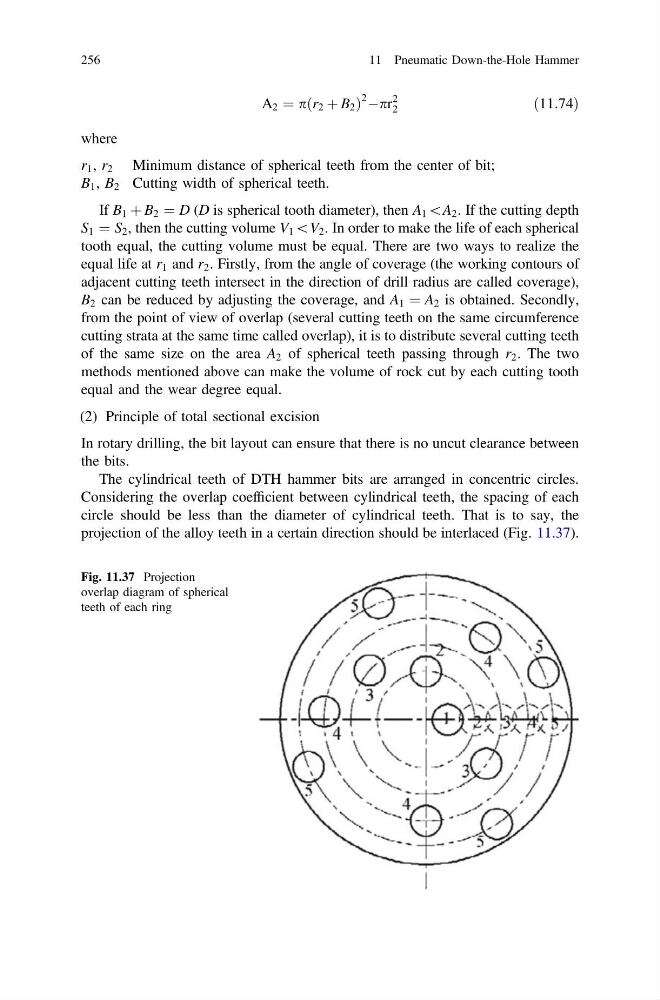
The cylindrical teeth of DTH hammer bits are arranged in concentric circles.
Considering the overlap coefficient between cylindrical teeth, the spacing of each
circle should be less than the diameter of cylindrical teeth. That is to say, the
projection of the alloy teeth in a certain direction should be interlaced (Fig. 11.37).
Fig. 11.37 Projection
overlap diagram of spherical
teeth of each ring
256
11 Pneumatic Down-the-Hole Hammer
ð
Þ
2 Àpr
2
2
ð11:74Þ
where
r 1 , r 2 Minimum distance of spherical teeth from the center of bit;
B 1 , B 2 Cutting width of spherical teeth.
If B 1 þ B 2 ¼ D (D is spherical tooth diameter), then A 1 \A 2 . If the cutting depth
S 1 ¼ S 2 , then the cutting volume V 1 \V 2 . In order to make the life of each spherical
tooth equal, the cutting volume must be equal. There are two ways to realize the
equal life at r 1 and r 2 . Firstly, from the angle of coverage (the working contours of
adjacent cutting teeth intersect in the direction of drill radius are called coverage),
B 2 can be reduced by adjusting the coverage, and A 1 ¼ A 2 is obtained. Secondly,
from the point of view of overlap (several cutting teeth on the same circumference
cutting strata at the same time called overlap), it is to distribute several cutting teeth
of the same size on the area A 2 of spherical teeth passing through r 2 . The two
methods mentioned above can make the volume of rock cut by each cutting tooth
equal and the wear degree equal.
(2) Principle of total sectional excision
In rotary drilling, the bit layout can ensure that there is no uncut clearance between
the bits.
The cylindrical teeth of DTH hammer bits are arranged in concentric circles.
Considering the overlap coefficient between cylindrical teeth, the spacing of each
circle should be less than the diameter of cylindrical teeth. That is to say, the
projection of the alloy teeth in a certain direction should be interlaced (Fig. 11.37).
Fig. 11.37 Projection
overlap diagram of spherical
teeth of each ring
256
11 Pneumatic Down-the-Hole Hammer