

It can be seen that the spherical teeth will cause damage to the rock under the
action of static pressure or impact. The rock contacted with the top of the spherical
teeth under static pressure will be destroyed and cracks will occur at both ends of
the top of the spherical teeth. With the increase of the force, the rock will eventually
cause damage. Under the impact force, the spherical teeth destroy the rock more
obviously and quickly, not only forming a crushing crater, but also producing
fatigue cracks on the rock near the crater, which provides favorable conditions for
the next impact or rotary rock breaking.
11.5.3.3 Basic Principles for Bit Layout of Large Diameter DTH
Hammer
The arrangement of large diameter DTH hammer bits should consider the
rock-breaking efficiency and energy utilization efficiency of spherical teeth, as well
as the restriction of bit structure, such as the location of slag discharge port. The
basic principles are as follows.
(1) Equal Volume Crushing Principle
In order to make the life of each spherical tooth equal, the cutting volume should be
equal.
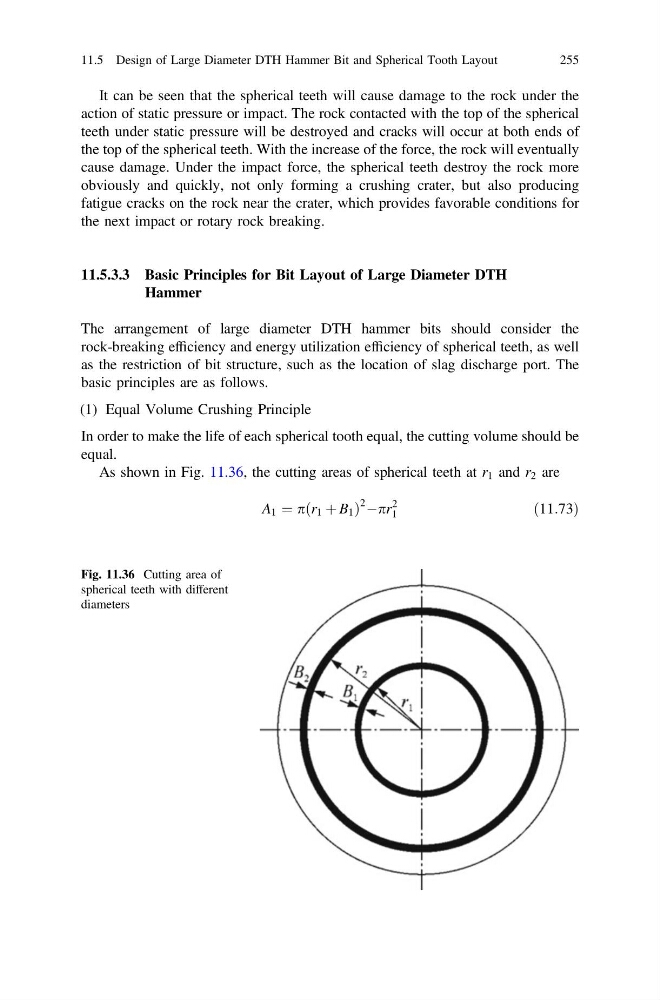
As shown in Fig. 11.36, the cutting areas of spherical teeth at r 1 and r 2 are
A 1 ¼ p r 1 þ B 1
ð
Þ
2 Àpr
2
1
ð11:73Þ
Fig. 11.36 Cutting area of
spherical teeth with different
diameters
11.5 Design of Large Diameter DTH Hammer Bit and Spherical Tooth Layout
255
action of static pressure or impact. The rock contacted with the top of the spherical
teeth under static pressure will be destroyed and cracks will occur at both ends of
the top of the spherical teeth. With the increase of the force, the rock will eventually
cause damage. Under the impact force, the spherical teeth destroy the rock more
obviously and quickly, not only forming a crushing crater, but also producing
fatigue cracks on the rock near the crater, which provides favorable conditions for
the next impact or rotary rock breaking.
11.5.3.3 Basic Principles for Bit Layout of Large Diameter DTH
Hammer
The arrangement of large diameter DTH hammer bits should consider the
rock-breaking efficiency and energy utilization efficiency of spherical teeth, as well
as the restriction of bit structure, such as the location of slag discharge port. The
basic principles are as follows.
(1) Equal Volume Crushing Principle
In order to make the life of each spherical tooth equal, the cutting volume should be
equal.
As shown in Fig. 11.36, the cutting areas of spherical teeth at r 1 and r 2 are
A 1 ¼ p r 1 þ B 1
ð
Þ
2 Àpr
2
1
ð11:73Þ
Fig. 11.36 Cutting area of
spherical teeth with different
diameters
11.5 Design of Large Diameter DTH Hammer Bit and Spherical Tooth Layout
255