

F ¼ f  P
ð11:59Þ
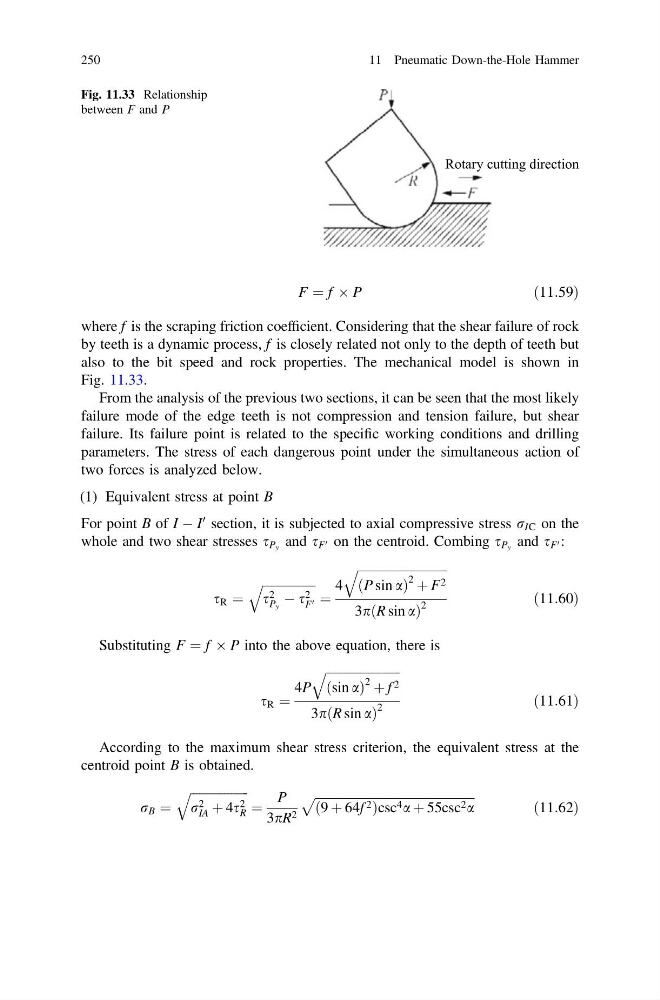
where f is the scraping friction coefficient. Considering that the shear failure of rock
by teeth is a dynamic process, f is closely related not only to the depth of teeth but
also to the bit speed and rock properties. The mechanical model is shown in
Fig. 11.33.
From the analysis of the previous two sections, it can be seen that the most likely
failure mode of the edge teeth is not compression and tension failure, but shear
failure. Its failure point is related to the specific working conditions and drilling
parameters. The stress of each dangerous point under the simultaneous action of
two forces is analyzed below.
(1) Equivalent stress at point B
For point B of I À I
0 section, it is subjected to axial compressive stress r IC on the
whole and two shear stresses s P y and s F 0 on the centroid. Combing s P y and s F 0 :
s R ¼
ffiffiffiffiffiffiffiffiffiffiffiffiffiffiffiffiffi
s 2
P y
À s 2
F 0
q
¼
4
ffiffiffiffiffiffiffiffiffiffiffiffiffiffiffiffiffiffiffiffiffiffiffiffiffiffiffiffi ffi
P sin a
ð
Þ
2 þ F 2
q
3p R sin a
ð
Þ
2
ð11:60Þ
Substituting F ¼ f  P into the above equation, there is
s R ¼
4P
ffiffiffiffiffiffiffiffiffiffiffiffiffiffiffiffiffiffiffiffiffiffiffiffi
sin a
ð
Þ
2 þ f 2
q
3p R sin a
ð
Þ
2
ð11:61Þ
According to the maximum shear stress criterion, the equivalent stress at the
centroid point B is obtained.
r B ¼
ffiffiffiffiffiffiffiffiffiffiffiffiffiffiffiffiffiffi ffi
r 2
IA þ 4s 2
R
q
¼
P
3pR 2
ffiffiffiffiffiffiffiffiffiffiffiffiffiffiffiffiffiffiffiffiffiffiffiffiffiffiffiffiffiffiffiffiffiffiffiffiffiffiffiffiffiffiffiffiffiffiffiffiffiffiffi
9 þ 64f 2
ð
Þ csc 4 a þ 55csc 2 a
p
ð11:62Þ
Rotary cutting direction
Fig. 11.33 Relationship
between F and P
250
11 Pneumatic Down-the-Hole Hammer
ð11:59Þ
where f is the scraping friction coefficient. Considering that the shear failure of rock
by teeth is a dynamic process, f is closely related not only to the depth of teeth but
also to the bit speed and rock properties. The mechanical model is shown in
Fig. 11.33.
From the analysis of the previous two sections, it can be seen that the most likely
failure mode of the edge teeth is not compression and tension failure, but shear
failure. Its failure point is related to the specific working conditions and drilling
parameters. The stress of each dangerous point under the simultaneous action of
two forces is analyzed below.
(1) Equivalent stress at point B
For point B of I À I
0 section, it is subjected to axial compressive stress r IC on the
whole and two shear stresses s P y and s F 0 on the centroid. Combing s P y and s F 0 :
s R ¼
ffiffiffiffiffiffiffiffiffiffiffiffiffiffiffiffiffi
s 2
P y
À s 2
F 0
q
¼
4
ffiffiffiffiffiffiffiffiffiffiffiffiffiffiffiffiffiffiffiffiffiffiffiffiffiffiffiffi ffi
P sin a
ð
Þ
2 þ F 2
q
3p R sin a
ð
Þ
2
ð11:60Þ
Substituting F ¼ f  P into the above equation, there is
s R ¼
4P
ffiffiffiffiffiffiffiffiffiffiffiffiffiffiffiffiffiffiffiffiffiffiffiffi
sin a
ð
Þ
2 þ f 2
q
3p R sin a
ð
Þ
2
ð11:61Þ
According to the maximum shear stress criterion, the equivalent stress at the
centroid point B is obtained.
r B ¼
ffiffiffiffiffiffiffiffiffiffiffiffiffiffiffiffiffiffi ffi
r 2
IA þ 4s 2
R
q
¼
P
3pR 2
ffiffiffiffiffiffiffiffiffiffiffiffiffiffiffiffiffiffiffiffiffiffiffiffiffiffiffiffiffiffiffiffiffiffiffiffiffiffiffiffiffiffiffiffiffiffiffiffiffiffiffi
9 þ 64f 2
ð
Þ csc 4 a þ 55csc 2 a
p
ð11:62Þ
Rotary cutting direction
Fig. 11.33 Relationship
between F and P
250
11 Pneumatic Down-the-Hole Hammer