

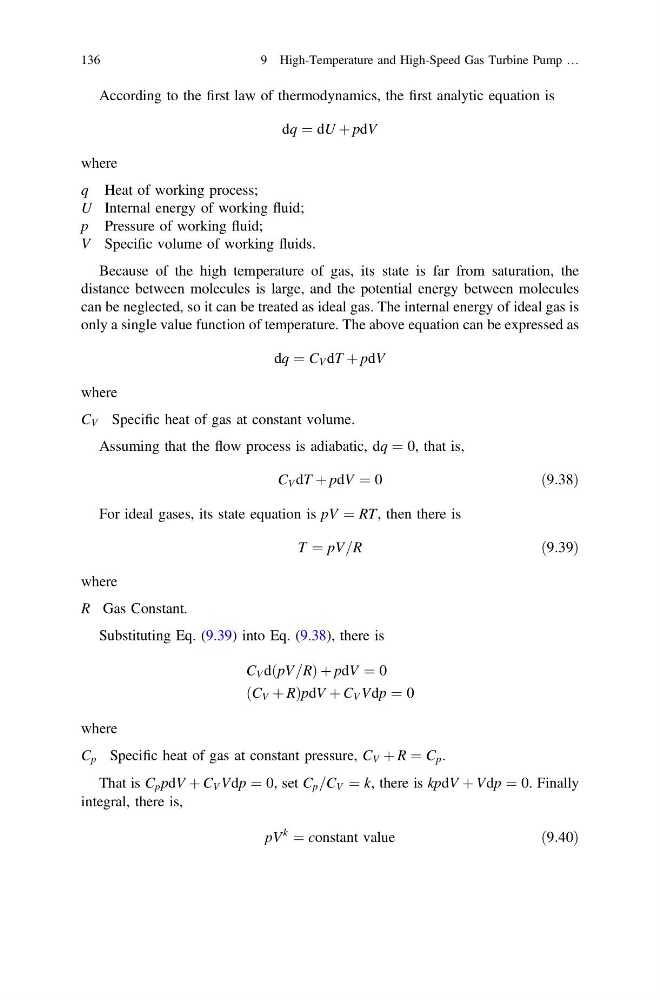
According to the first law of thermodynamics, the first analytic equation is
dq ¼ dU þ pdV
where
q Heat of working process;
U Internal energy of working fluid;
p Pressure of working fluid;
V Specific volume of working fluids.
Because of the high temperature of gas, its state is far from saturation, the
distance between molecules is large, and the potential energy between molecules
can be neglected, so it can be treated as ideal gas. The internal energy of ideal gas is
only a single value function of temperature. The above equation can be expressed as
dq ¼ C V dT þ pdV
where
C V Specific heat of gas at constant volume.
Assuming that the flow process is adiabatic, dq ¼ 0, that is,
C V dT þ pdV ¼ 0
ð9:38Þ
For ideal gases, its state equation is pV ¼ RT, then there is
T ¼ pV=R
ð9:39Þ
where
R Gas Constant.
Substituting Eq. (9.39) into Eq. (9.38), there is
C V d pV=R
ð
ÞþpdV ¼ 0
ðC V þ RÞpdV þ C V Vdp ¼ 0
where
C p Specific heat of gas at constant pressure, C V þ R ¼ C p .
That is C p pdV þ C V Vdp ¼ 0, set C p =C V ¼ k, there is kpdV þ Vdp ¼ 0. Finally
integral, there is,
pV
k
¼ constant value
ð9:40Þ
136
9 High-Temperature and High-Speed Gas Turbine Pump …
dq ¼ dU þ pdV
where
q Heat of working process;
U Internal energy of working fluid;
p Pressure of working fluid;
V Specific volume of working fluids.
Because of the high temperature of gas, its state is far from saturation, the
distance between molecules is large, and the potential energy between molecules
can be neglected, so it can be treated as ideal gas. The internal energy of ideal gas is
only a single value function of temperature. The above equation can be expressed as
dq ¼ C V dT þ pdV
where
C V Specific heat of gas at constant volume.
Assuming that the flow process is adiabatic, dq ¼ 0, that is,
C V dT þ pdV ¼ 0
ð9:38Þ
For ideal gases, its state equation is pV ¼ RT, then there is
T ¼ pV=R
ð9:39Þ
where
R Gas Constant.
Substituting Eq. (9.39) into Eq. (9.38), there is
C V d pV=R
ð
ÞþpdV ¼ 0
ðC V þ RÞpdV þ C V Vdp ¼ 0
where
C p Specific heat of gas at constant pressure, C V þ R ¼ C p .
That is C p pdV þ C V Vdp ¼ 0, set C p =C V ¼ k, there is kpdV þ Vdp ¼ 0. Finally
integral, there is,
pV
k
¼ constant value
ð9:40Þ
136
9 High-Temperature and High-Speed Gas Turbine Pump …