

coefficient of the grain is unchanged, but actually changes. It directly affects the
burning rate and flow rate of the grain, and then affects the gas pressure. From
the above equations, it can be seen that burning rate r and burning pressure p c
are functions of burning rate temperature coefficient a t . From the above
equations, it can be seen that when the ambient temperature T and the ambient
burning rate temperature coefficient a t are constant, a t depends only on the
temperature sensitivity coefficient a T .
At present, the range of temperature sensitivity coefficient a T of retarded charge
used in engineering is usually 0:0025 $ 0:0045, and the difference between
maximum and minimum values is 1.8 times.
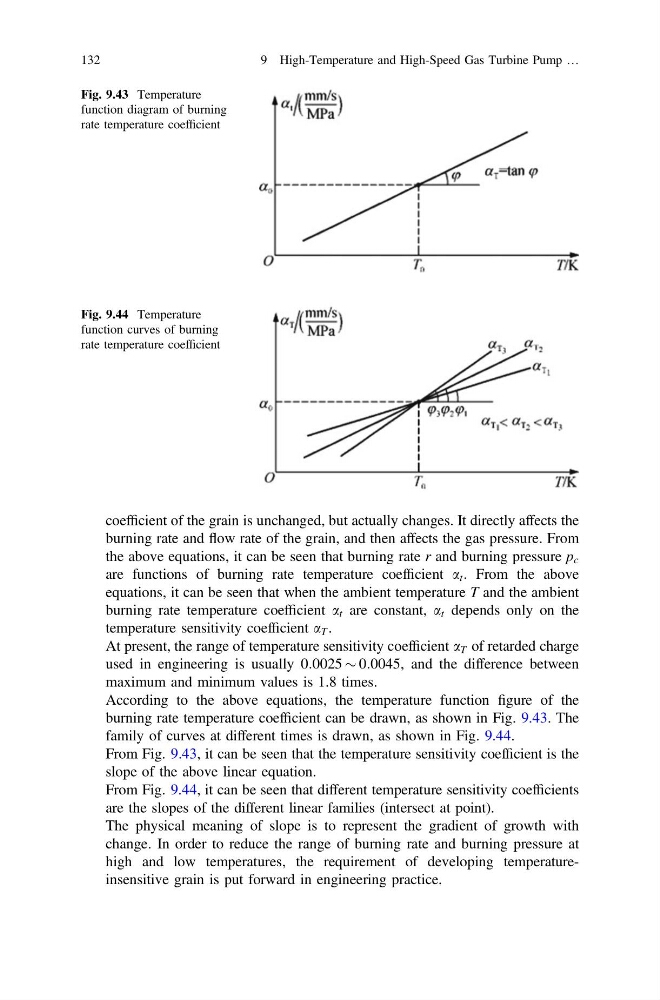
According to the above equations, the temperature function figure of the
burning rate temperature coefficient can be drawn, as shown in Fig. 9.43. The
family of curves at different times is drawn, as shown in Fig. 9.44.
From Fig. 9.43, it can be seen that the temperature sensitivity coefficient is the
slope of the above linear equation.
From Fig. 9.44, it can be seen that different temperature sensitivity coefficients
are the slopes of the different linear families (intersect at point).
The physical meaning of slope is to represent the gradient of growth with
change. In order to reduce the range of burning rate and burning pressure at
high and low temperatures, the requirement of developing temperatureinsensitive grain is put forward in engineering practice.
Fig. 9.44 Temperature
function curves of burning
rate temperature coefficient
Fig. 9.43 Temperature
function diagram of burning
rate temperature coefficient
132
9 High-Temperature and High-Speed Gas Turbine Pump …
burning rate and flow rate of the grain, and then affects the gas pressure. From
the above equations, it can be seen that burning rate r and burning pressure p c
are functions of burning rate temperature coefficient a t . From the above
equations, it can be seen that when the ambient temperature T and the ambient
burning rate temperature coefficient a t are constant, a t depends only on the
temperature sensitivity coefficient a T .
At present, the range of temperature sensitivity coefficient a T of retarded charge
used in engineering is usually 0:0025 $ 0:0045, and the difference between
maximum and minimum values is 1.8 times.
According to the above equations, the temperature function figure of the
burning rate temperature coefficient can be drawn, as shown in Fig. 9.43. The
family of curves at different times is drawn, as shown in Fig. 9.44.
From Fig. 9.43, it can be seen that the temperature sensitivity coefficient is the
slope of the above linear equation.
From Fig. 9.44, it can be seen that different temperature sensitivity coefficients
are the slopes of the different linear families (intersect at point).
The physical meaning of slope is to represent the gradient of growth with
change. In order to reduce the range of burning rate and burning pressure at
high and low temperatures, the requirement of developing temperatureinsensitive grain is put forward in engineering practice.
Fig. 9.44 Temperature
function curves of burning
rate temperature coefficient
Fig. 9.43 Temperature
function diagram of burning
rate temperature coefficient
132
9 High-Temperature and High-Speed Gas Turbine Pump …