

À40 $ þ 60
C. When the physical and chemical properties of the grain and the
related structural parameters are determined, the gas output power or pressure
of the slow-burning charge of solid–gas generator is the inherent state function
of the initial ambient temperature of grain. In the above temperature range, the
corresponding output power and pressure vary greatly, reaching 2.5 times and
2.2 times, respectively.
In order to ensure that the output power or pressure varies in a small range in
the whole temperature range, gas regulating valves are usually installed in the
gas system. The valve is essentially a gas overflow constant pressure valve.
With the increase of ambient temperature, it overflows part of the gas, and tries
to keep the gas pressure unchanged to control the pressure range of the combustion chamber of the gas generator in front of the nozzle.
(2) Effect of grain pressure index
The influence of grain pressure index leads to the appearance of zero pressure
index grain. The assumed grain pressure index n ¼ 0:5 is actually variable and
has a great influence on combustion pressure.
Set h ¼
1
1Àn , substituting into equation (9.29), it is obtained,
p c ¼ d
a 1
A 1
A b
A 0
! h
ð9:36Þ
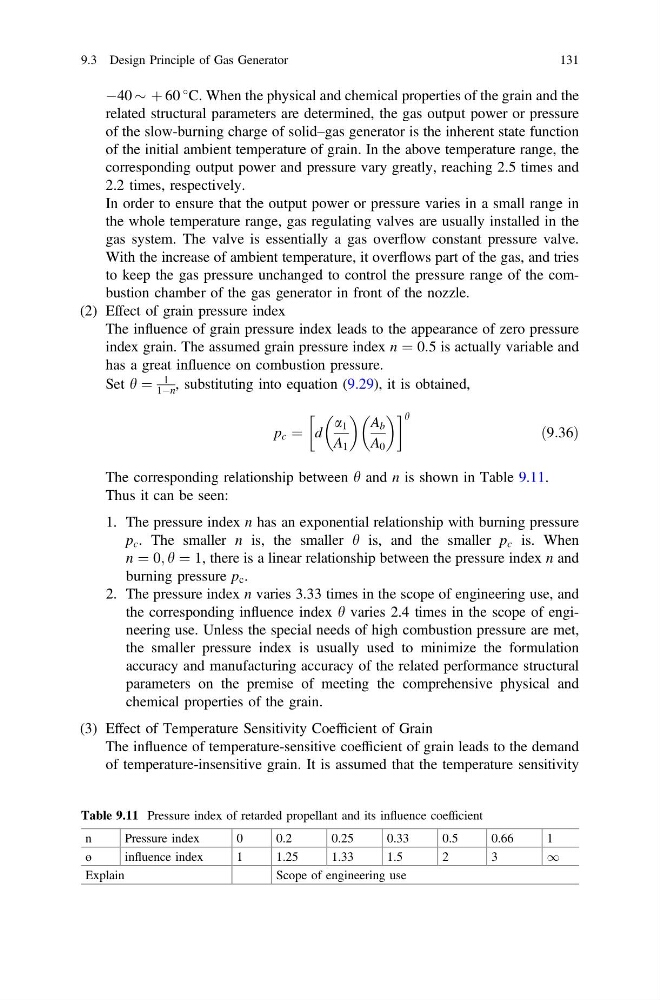
The corresponding relationship between h and n is shown in Table 9.11.
Thus it can be seen:
1. The pressure index n has an exponential relationship with burning pressure
p c . The smaller n is, the smaller h is, and the smaller p c is. When
n ¼ 0; h ¼ 1, there is a linear relationship between the pressure index n and
burning pressure p c .
2. The pressure index n varies 3.33 times in the scope of engineering use, and
the corresponding influence index h varies 2.4 times in the scope of engineering use. Unless the special needs of high combustion pressure are met,
the smaller pressure index is usually used to minimize the formulation
accuracy and manufacturing accuracy of the related performance structural
parameters on the premise of meeting the comprehensive physical and
chemical properties of the grain.
(3) Effect of Temperature Sensitivity Coefficient of Grain
The influence of temperature-sensitive coefficient of grain leads to the demand
of temperature-insensitive grain. It is assumed that the temperature sensitivity
Table 9.11 Pressure index of retarded propellant and its influence coefficient
n
Pressure index
0
0.2
0.25
0.33
0.5
0.66
1
ө
influence index
1
1.25
1.33
1.5
2
3
1
Explain
Scope of engineering use
9.3 Design Principle of Gas Generator
131
C. When the physical and chemical properties of the grain and the
related structural parameters are determined, the gas output power or pressure
of the slow-burning charge of solid–gas generator is the inherent state function
of the initial ambient temperature of grain. In the above temperature range, the
corresponding output power and pressure vary greatly, reaching 2.5 times and
2.2 times, respectively.
In order to ensure that the output power or pressure varies in a small range in
the whole temperature range, gas regulating valves are usually installed in the
gas system. The valve is essentially a gas overflow constant pressure valve.
With the increase of ambient temperature, it overflows part of the gas, and tries
to keep the gas pressure unchanged to control the pressure range of the combustion chamber of the gas generator in front of the nozzle.
(2) Effect of grain pressure index
The influence of grain pressure index leads to the appearance of zero pressure
index grain. The assumed grain pressure index n ¼ 0:5 is actually variable and
has a great influence on combustion pressure.
Set h ¼
1
1Àn , substituting into equation (9.29), it is obtained,
p c ¼ d
a 1
A 1
A b
A 0
! h
ð9:36Þ
The corresponding relationship between h and n is shown in Table 9.11.
Thus it can be seen:
1. The pressure index n has an exponential relationship with burning pressure
p c . The smaller n is, the smaller h is, and the smaller p c is. When
n ¼ 0; h ¼ 1, there is a linear relationship between the pressure index n and
burning pressure p c .
2. The pressure index n varies 3.33 times in the scope of engineering use, and
the corresponding influence index h varies 2.4 times in the scope of engineering use. Unless the special needs of high combustion pressure are met,
the smaller pressure index is usually used to minimize the formulation
accuracy and manufacturing accuracy of the related performance structural
parameters on the premise of meeting the comprehensive physical and
chemical properties of the grain.
(3) Effect of Temperature Sensitivity Coefficient of Grain
The influence of temperature-sensitive coefficient of grain leads to the demand
of temperature-insensitive grain. It is assumed that the temperature sensitivity
Table 9.11 Pressure index of retarded propellant and its influence coefficient
n
Pressure index
0
0.2
0.25
0.33
0.5
0.66
1
ө
influence index
1
1.25
1.33
1.5
2
3
1
Explain
Scope of engineering use
9.3 Design Principle of Gas Generator
131