

N-acetylglucosamine (GlcNAc) through a b-1,4-glycosidic bond. The MurNGlyc
unit is linked to a linear stem peptide chain consisting of amino acids L-Alanine (LAla), D-Glutamic acid (D-Glu), meso-diaminopimelic acid (meso-DAP) or L-Lysine
(L-Lys) and D-Alanine (D-Ala). In Gram-positive bacterial PG, the adjacent stem
peptides are highly cross-linked and the cross-linking takes place between D-Ala
4
and meso-DAP
3 of neighboring stem peptides (D-Ala
4
! meso-DAP
3 ), called a
classical type of PG cross-link mediated by D,D-transpeptidase enzyme [42]. D,Dtranspeptidase is the molecular target of b-lactam antibiotics. However, Mtb is
resistant to b-lactam antibiotics because of the production of chromosomally
encoded Ambler class A b-lactamase enzyme, which cleaves the b-lactam ring of
the antibiotic and also due to the presence of non-classical type PG cross-link
between neighboring meso-DAP
3
–meso-DAP
3 residues. The non-classical type of
PG cross-linking is catalyzed by L,D-transpeptidase (Ldt) enzymes [43]. In Mtb,
two functional Ldt paralogs are present, namely Ldt Mt1 and Ldt Mt2 ; among them,
Ldt Mt2 is predominantly expressed than Ldt Mt1 and both these enzymes signify an
important druggable target [44, 45]. Recently, the crystal structure of Ldt in
complex with Meropenem, Biapenem, Tebipenem drugs are reported, which is very
useful for structure-based anti-bacterial drug discovery against this target [46, 47].
2.2 Target-Based Drug Design Toward Mtb Regulatory
Process
The literature reports suggest that the integrated signaling networks in mycobacteria
play significant roles in host–pathogen interactions as well as in intracellular survival
strategies [48]. The response regulators DevR and DevS form a well-characterized
two-component regulatory system of Mtb, which is important for the adaptation and
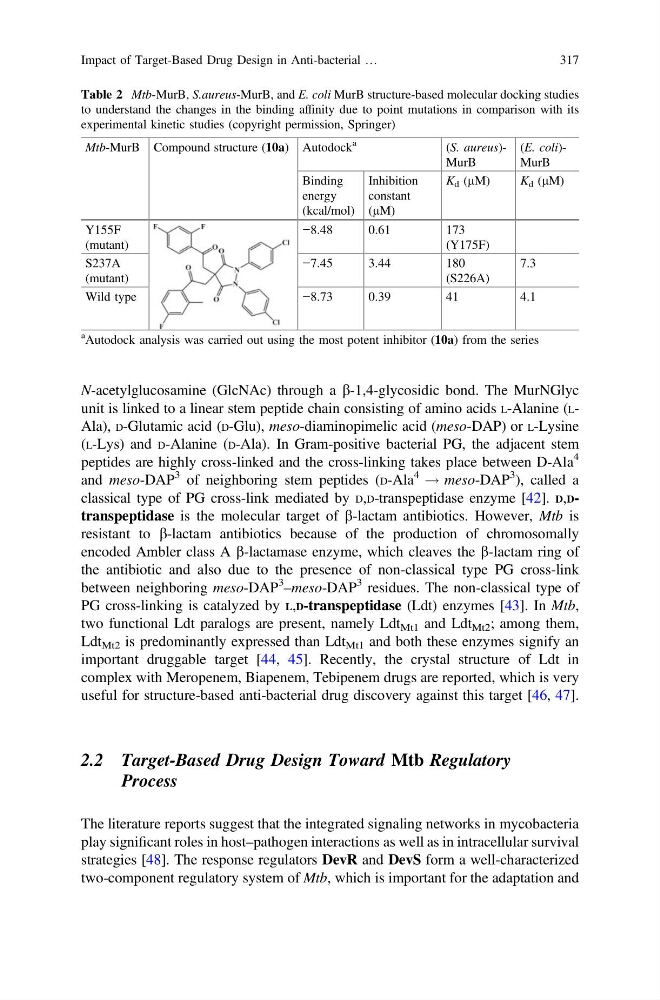
Table 2 Mtb-MurB, S.aureus-MurB, and E. coli MurB structure-based molecular docking studies
to understand the changes in the binding affinity due to point mutations in comparison with its
experimental kinetic studies (copyright permission, Springer)
Mtb-MurB Compound structure (10a) Autodock
a
(S. aureus)MurB
(E. coli)MurB
Binding
energy
(kcal/mol)
Inhibition
constant
(lM)
K d (lM)
K d (lM)
Y155F
(mutant)
−8.48
0.61
173
(Y175F)
S237A
(mutant)
−7.45
3.44
180
(S226A)
7.3
Wild type
−8.73
0.39
41
4.1
a Autodock analysis was carried out using the most potent inhibitor (10a) from the series
Impact of Target-Based Drug Design in Anti-bacterial …
317
unit is linked to a linear stem peptide chain consisting of amino acids L-Alanine (LAla), D-Glutamic acid (D-Glu), meso-diaminopimelic acid (meso-DAP) or L-Lysine
(L-Lys) and D-Alanine (D-Ala). In Gram-positive bacterial PG, the adjacent stem
peptides are highly cross-linked and the cross-linking takes place between D-Ala
4
and meso-DAP
3 of neighboring stem peptides (D-Ala
4
! meso-DAP
3 ), called a
classical type of PG cross-link mediated by D,D-transpeptidase enzyme [42]. D,Dtranspeptidase is the molecular target of b-lactam antibiotics. However, Mtb is
resistant to b-lactam antibiotics because of the production of chromosomally
encoded Ambler class A b-lactamase enzyme, which cleaves the b-lactam ring of
the antibiotic and also due to the presence of non-classical type PG cross-link
between neighboring meso-DAP
3
–meso-DAP
3 residues. The non-classical type of
PG cross-linking is catalyzed by L,D-transpeptidase (Ldt) enzymes [43]. In Mtb,
two functional Ldt paralogs are present, namely Ldt Mt1 and Ldt Mt2 ; among them,
Ldt Mt2 is predominantly expressed than Ldt Mt1 and both these enzymes signify an
important druggable target [44, 45]. Recently, the crystal structure of Ldt in
complex with Meropenem, Biapenem, Tebipenem drugs are reported, which is very
useful for structure-based anti-bacterial drug discovery against this target [46, 47].
2.2 Target-Based Drug Design Toward Mtb Regulatory
Process
The literature reports suggest that the integrated signaling networks in mycobacteria
play significant roles in host–pathogen interactions as well as in intracellular survival
strategies [48]. The response regulators DevR and DevS form a well-characterized
two-component regulatory system of Mtb, which is important for the adaptation and
Table 2 Mtb-MurB, S.aureus-MurB, and E. coli MurB structure-based molecular docking studies
to understand the changes in the binding affinity due to point mutations in comparison with its
experimental kinetic studies (copyright permission, Springer)
Mtb-MurB Compound structure (10a) Autodock
a
(S. aureus)MurB
(E. coli)MurB
Binding
energy
(kcal/mol)
Inhibition
constant
(lM)
K d (lM)
K d (lM)
Y155F
(mutant)
−8.48
0.61
173
(Y175F)
S237A
(mutant)
−7.45
3.44
180
(S226A)
7.3
Wild type
−8.73
0.39
41
4.1
a Autodock analysis was carried out using the most potent inhibitor (10a) from the series
Impact of Target-Based Drug Design in Anti-bacterial …
317