

2.1 Molecular Targets Involved in Cell Wall Biosynthesis
and Its Inhibitors
The Mtb cell wall is unique, and its low permeability makes the drug difficult to
penetrate the cell wall, which in turn cause bacterial survival in the host [11]. The
primary targets involved in anti-TB drug discovery process are associated with Mtb
cell wall biosynthesis pathway. The Mtb cell wall has covalently linked arabinogalactan, mycolic acid, and peptidoglycan (PG) layers. The enzymes associated
with the biosynthesis of these layers are excellent druggable targets and are depicted
in Fig. 3. In order to understand the structure–function relationships and biological
mechanism of action of these targets for discovering small-molecule inhibitors,
different research groups worldwide used structural biology and computational
techniques [12]. Some of the best-known Mtb druggable targets and its inhibitors
are explained below to understand its molecular mechanism of inhibition.
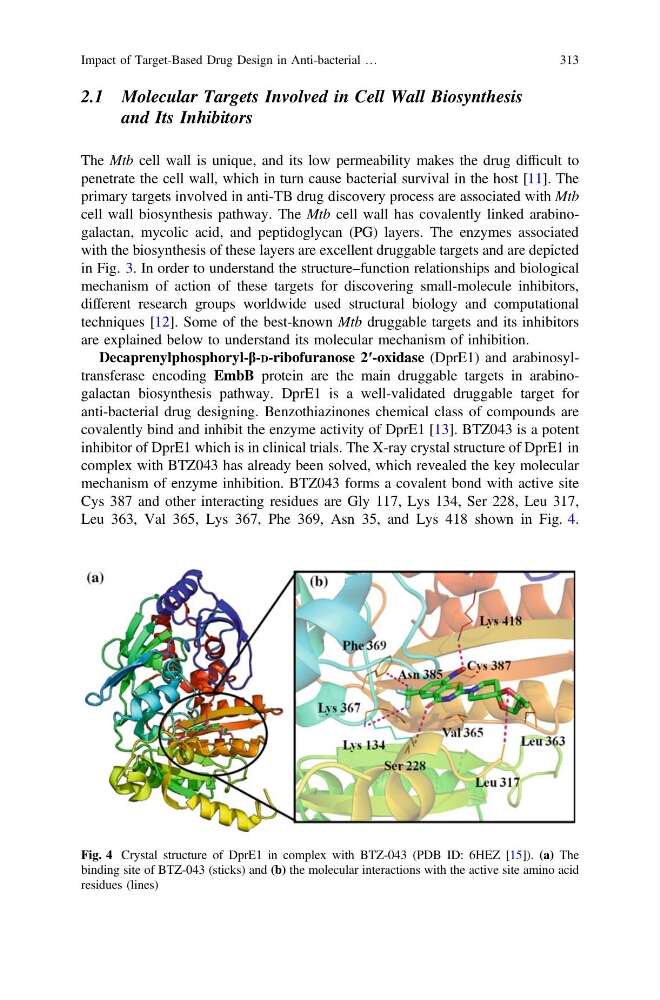
Decaprenylphosphoryl-b-D-ribofuranose 2′-oxidase (DprE1) and arabinosyltransferase encoding EmbB protein are the main druggable targets in arabinogalactan biosynthesis pathway. DprE1 is a well-validated druggable target for
anti-bacterial drug designing. Benzothiazinones chemical class of compounds are
covalently bind and inhibit the enzyme activity of DprE1 [13]. BTZ043 is a potent
inhibitor of DprE1 which is in clinical trials. The X-ray crystal structure of DprE1 in
complex with BTZ043 has already been solved, which revealed the key molecular
mechanism of enzyme inhibition. BTZ043 forms a covalent bond with active site
Cys 387 and other interacting residues are Gly 117, Lys 134, Ser 228, Leu 317,
Leu 363, Val 365, Lys 367, Phe 369, Asn 35, and Lys 418 shown in Fig. 4.
Fig. 4 Crystal structure of DprE1 in complex with BTZ-043 (PDB ID: 6HEZ [15]). (a) The
binding site of BTZ-043 (sticks) and (b) the molecular interactions with the active site amino acid
residues (lines)
Impact of Target-Based Drug Design in Anti-bacterial …
313
and Its Inhibitors
The Mtb cell wall is unique, and its low permeability makes the drug difficult to
penetrate the cell wall, which in turn cause bacterial survival in the host [11]. The
primary targets involved in anti-TB drug discovery process are associated with Mtb
cell wall biosynthesis pathway. The Mtb cell wall has covalently linked arabinogalactan, mycolic acid, and peptidoglycan (PG) layers. The enzymes associated
with the biosynthesis of these layers are excellent druggable targets and are depicted
in Fig. 3. In order to understand the structure–function relationships and biological
mechanism of action of these targets for discovering small-molecule inhibitors,
different research groups worldwide used structural biology and computational
techniques [12]. Some of the best-known Mtb druggable targets and its inhibitors
are explained below to understand its molecular mechanism of inhibition.
Decaprenylphosphoryl-b-D-ribofuranose 2′-oxidase (DprE1) and arabinosyltransferase encoding EmbB protein are the main druggable targets in arabinogalactan biosynthesis pathway. DprE1 is a well-validated druggable target for
anti-bacterial drug designing. Benzothiazinones chemical class of compounds are
covalently bind and inhibit the enzyme activity of DprE1 [13]. BTZ043 is a potent
inhibitor of DprE1 which is in clinical trials. The X-ray crystal structure of DprE1 in
complex with BTZ043 has already been solved, which revealed the key molecular
mechanism of enzyme inhibition. BTZ043 forms a covalent bond with active site
Cys 387 and other interacting residues are Gly 117, Lys 134, Ser 228, Leu 317,
Leu 363, Val 365, Lys 367, Phe 369, Asn 35, and Lys 418 shown in Fig. 4.
Fig. 4 Crystal structure of DprE1 in complex with BTZ-043 (PDB ID: 6HEZ [15]). (a) The
binding site of BTZ-043 (sticks) and (b) the molecular interactions with the active site amino acid
residues (lines)
Impact of Target-Based Drug Design in Anti-bacterial …
313