

power to streamline the drug discovery and development process is gaining interest.
In past few years, several resources are being reported including Mtb druggable
target databases and even software for predicting molecular targets. This will further facilitate the identification and development of novel anti-bacterial compounds.
One of the most challenging parts of computer-assisted modeling and biochemical
screening toward antibiotic development is that the compounds may lack biological
activity in the later stages of clinical studies.
2 Mtb Druggable Target Identification and Validation
The whole genome sequencing of the Mtb H37Rv strain in 1998 has revealed
several crucial genes which are necessary for growth, survival, and virulence of the
bacteria. This led to the target-based design of new anti-tubercular molecules.
Further, the drug should be orally effective, cell wall permeability, metabolically
stable, and target vulnerability by addressing the drug resistance [6]. Successful
integration of computational and wet-laboratory studies is reported for different Mtb
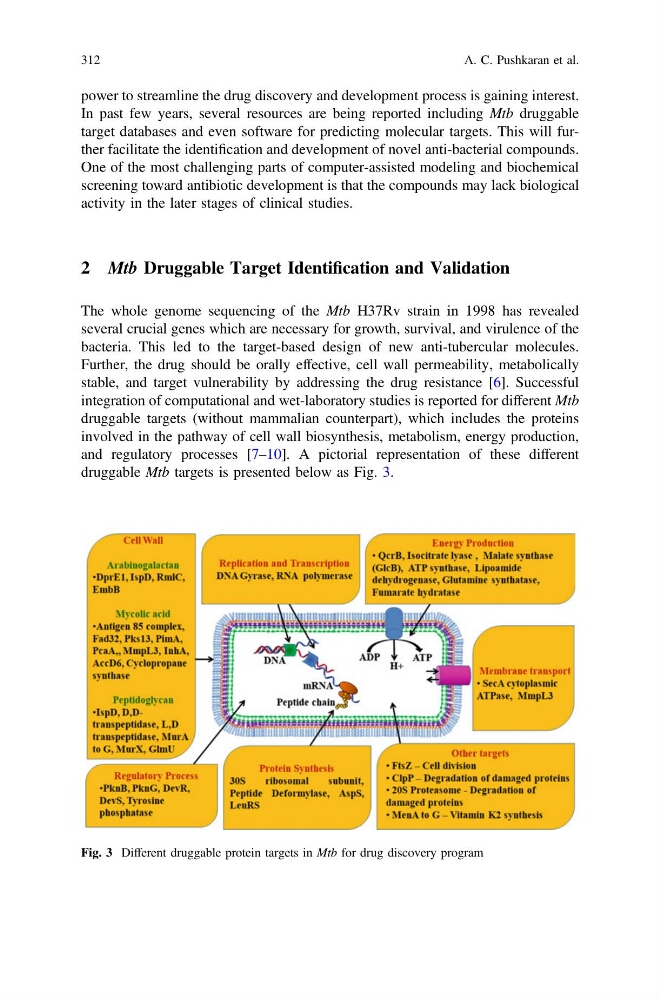
druggable targets (without mammalian counterpart), which includes the proteins
involved in the pathway of cell wall biosynthesis, metabolism, energy production,
and regulatory processes [7–10]. A pictorial representation of these different
druggable Mtb targets is presented below as Fig. 3.
Fig. 3 Different druggable protein targets in Mtb for drug discovery program
312
A. C. Pushkaran et al.
In past few years, several resources are being reported including Mtb druggable
target databases and even software for predicting molecular targets. This will further facilitate the identification and development of novel anti-bacterial compounds.
One of the most challenging parts of computer-assisted modeling and biochemical
screening toward antibiotic development is that the compounds may lack biological
activity in the later stages of clinical studies.
2 Mtb Druggable Target Identification and Validation
The whole genome sequencing of the Mtb H37Rv strain in 1998 has revealed
several crucial genes which are necessary for growth, survival, and virulence of the
bacteria. This led to the target-based design of new anti-tubercular molecules.
Further, the drug should be orally effective, cell wall permeability, metabolically
stable, and target vulnerability by addressing the drug resistance [6]. Successful
integration of computational and wet-laboratory studies is reported for different Mtb
druggable targets (without mammalian counterpart), which includes the proteins
involved in the pathway of cell wall biosynthesis, metabolism, energy production,
and regulatory processes [7–10]. A pictorial representation of these different
druggable Mtb targets is presented below as Fig. 3.
Fig. 3 Different druggable protein targets in Mtb for drug discovery program
312
A. C. Pushkaran et al.