

1 Introduction
Tuberculosis (TB) is a highly infectious disease caused by Mycobacterium tuberculosis (Mtb). The global incidence of TB disease can be controlled by effective
chemotherapy; however, these are moderately protective, so novel effective
anti-tuberculosis agents are required to fight against TB. According to World Health
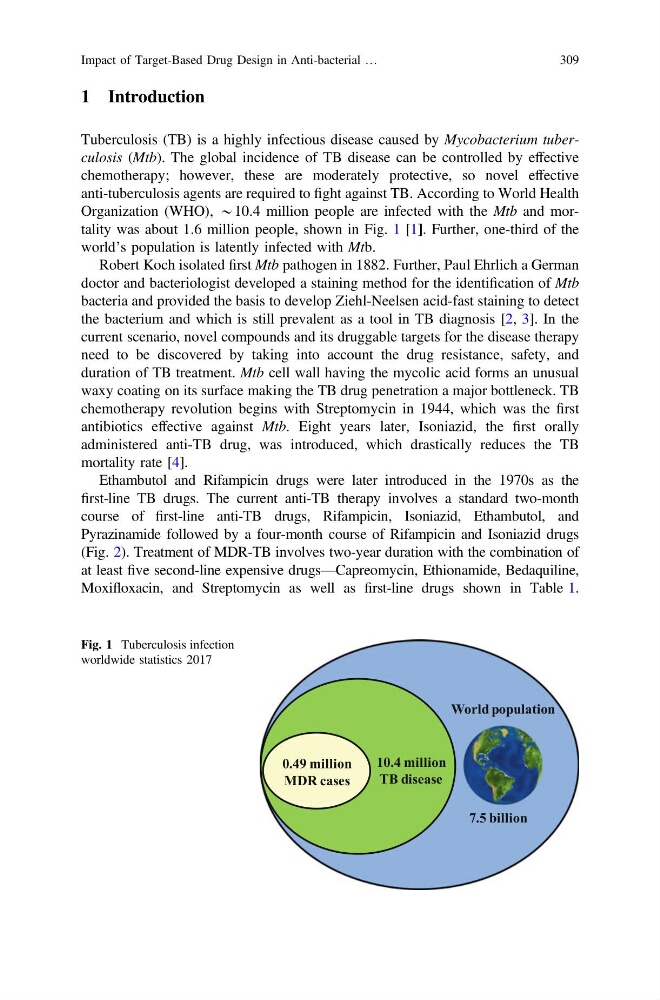
Organization (WHO), *10.4 million people are infected with the Mtb and mortality was about 1.6 million people, shown in Fig. 1 [1]. Further, one-third of the
world’s population is latently infected with Mtb.
Robert Koch isolated first Mtb pathogen in 1882. Further, Paul Ehrlich a German
doctor and bacteriologist developed a staining method for the identification of Mtb
bacteria and provided the basis to develop Ziehl-Neelsen acid-fast staining to detect
the bacterium and which is still prevalent as a tool in TB diagnosis [2, 3]. In the
current scenario, novel compounds and its druggable targets for the disease therapy
need to be discovered by taking into account the drug resistance, safety, and
duration of TB treatment. Mtb cell wall having the mycolic acid forms an unusual
waxy coating on its surface making the TB drug penetration a major bottleneck. TB
chemotherapy revolution begins with Streptomycin in 1944, which was the first
antibiotics effective against Mtb. Eight years later, Isoniazid, the first orally
administered anti-TB drug, was introduced, which drastically reduces the TB
mortality rate [4].
Ethambutol and Rifampicin drugs were later introduced in the 1970s as the
first-line TB drugs. The current anti-TB therapy involves a standard two-month
course of first-line anti-TB drugs, Rifampicin, Isoniazid, Ethambutol, and
Pyrazinamide followed by a four-month course of Rifampicin and Isoniazid drugs
(Fig. 2). Treatment of MDR-TB involves two-year duration with the combination of
at least five second-line expensive drugs—Capreomycin, Ethionamide, Bedaquiline,
Moxifloxacin, and Streptomycin as well as first-line drugs shown in Table 1.
World population
7.5 billion
10.4 million
TB disease
0.49 million
MDR cases
Fig. 1 Tuberculosis infection
worldwide statistics 2017
Impact of Target-Based Drug Design in Anti-bacterial …
309
Tuberculosis (TB) is a highly infectious disease caused by Mycobacterium tuberculosis (Mtb). The global incidence of TB disease can be controlled by effective
chemotherapy; however, these are moderately protective, so novel effective
anti-tuberculosis agents are required to fight against TB. According to World Health
Organization (WHO), *10.4 million people are infected with the Mtb and mortality was about 1.6 million people, shown in Fig. 1 [1]. Further, one-third of the
world’s population is latently infected with Mtb.
Robert Koch isolated first Mtb pathogen in 1882. Further, Paul Ehrlich a German
doctor and bacteriologist developed a staining method for the identification of Mtb
bacteria and provided the basis to develop Ziehl-Neelsen acid-fast staining to detect
the bacterium and which is still prevalent as a tool in TB diagnosis [2, 3]. In the
current scenario, novel compounds and its druggable targets for the disease therapy
need to be discovered by taking into account the drug resistance, safety, and
duration of TB treatment. Mtb cell wall having the mycolic acid forms an unusual
waxy coating on its surface making the TB drug penetration a major bottleneck. TB
chemotherapy revolution begins with Streptomycin in 1944, which was the first
antibiotics effective against Mtb. Eight years later, Isoniazid, the first orally
administered anti-TB drug, was introduced, which drastically reduces the TB
mortality rate [4].
Ethambutol and Rifampicin drugs were later introduced in the 1970s as the
first-line TB drugs. The current anti-TB therapy involves a standard two-month
course of first-line anti-TB drugs, Rifampicin, Isoniazid, Ethambutol, and
Pyrazinamide followed by a four-month course of Rifampicin and Isoniazid drugs
(Fig. 2). Treatment of MDR-TB involves two-year duration with the combination of
at least five second-line expensive drugs—Capreomycin, Ethionamide, Bedaquiline,
Moxifloxacin, and Streptomycin as well as first-line drugs shown in Table 1.
World population
7.5 billion
10.4 million
TB disease
0.49 million
MDR cases
Fig. 1 Tuberculosis infection
worldwide statistics 2017
Impact of Target-Based Drug Design in Anti-bacterial …
309