

Andrographis paniculata (Siriyanangai), Vitex negundo (Nochi), Acalypha indica
(Kuppameni), Corallocarpus epigaeus (Akasakarudan), Leucas aspera Spreng
(Thumbi), and Tinospora cordifolia (Shindilkodi) plants are reported to have
medicinal value, especially with antidote property. The extracts were collected and
GC-MS analysis was carried out. From these eight medicinal plants, we have
identified 100 different compounds from the methanolic extract. Glide SP was used
to screen these compounds with the four different targets (PDB ID: 2B17 and 3H1X
[185, 186], PDB ID: 1DB5 and 1KVO [187, 188]), followed by induced fit docking
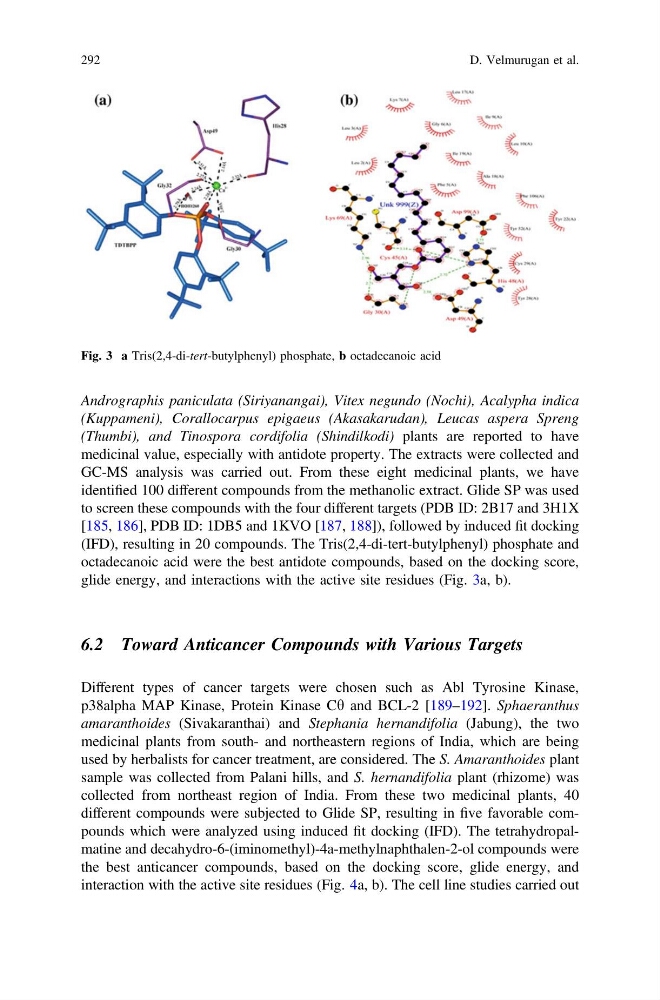
(IFD), resulting in 20 compounds. The Tris(2,4-di-tert-butylphenyl) phosphate and
octadecanoic acid were the best antidote compounds, based on the docking score,
glide energy, and interactions with the active site residues (Fig. 3a, b).
6.2 Toward Anticancer Compounds with Various Targets
Different types of cancer targets were chosen such as Abl Tyrosine Kinase,
p38alpha MAP Kinase, Protein Kinase Ch and BCL-2 [189–192]. Sphaeranthus
amaranthoides (Sivakaranthai) and Stephania hernandifolia (Jabung), the two
medicinal plants from south- and northeastern regions of India, which are being
used by herbalists for cancer treatment, are considered. The S. Amaranthoides plant
sample was collected from Palani hills, and S. hernandifolia plant (rhizome) was
collected from northeast region of India. From these two medicinal plants, 40
different compounds were subjected to Glide SP, resulting in five favorable compounds which were analyzed using induced fit docking (IFD). The tetrahydropalmatine and decahydro-6-(iminomethyl)-4a-methylnaphthalen-2-ol compounds were
the best anticancer compounds, based on the docking score, glide energy, and
interaction with the active site residues (Fig. 4a, b). The cell line studies carried out
Fig. 3 a Tris(2,4-di-tert-butylphenyl) phosphate, b octadecanoic acid
292
D. Velmurugan et al.
(Kuppameni), Corallocarpus epigaeus (Akasakarudan), Leucas aspera Spreng
(Thumbi), and Tinospora cordifolia (Shindilkodi) plants are reported to have
medicinal value, especially with antidote property. The extracts were collected and
GC-MS analysis was carried out. From these eight medicinal plants, we have
identified 100 different compounds from the methanolic extract. Glide SP was used
to screen these compounds with the four different targets (PDB ID: 2B17 and 3H1X
[185, 186], PDB ID: 1DB5 and 1KVO [187, 188]), followed by induced fit docking
(IFD), resulting in 20 compounds. The Tris(2,4-di-tert-butylphenyl) phosphate and
octadecanoic acid were the best antidote compounds, based on the docking score,
glide energy, and interactions with the active site residues (Fig. 3a, b).
6.2 Toward Anticancer Compounds with Various Targets
Different types of cancer targets were chosen such as Abl Tyrosine Kinase,
p38alpha MAP Kinase, Protein Kinase Ch and BCL-2 [189–192]. Sphaeranthus
amaranthoides (Sivakaranthai) and Stephania hernandifolia (Jabung), the two
medicinal plants from south- and northeastern regions of India, which are being
used by herbalists for cancer treatment, are considered. The S. Amaranthoides plant
sample was collected from Palani hills, and S. hernandifolia plant (rhizome) was
collected from northeast region of India. From these two medicinal plants, 40
different compounds were subjected to Glide SP, resulting in five favorable compounds which were analyzed using induced fit docking (IFD). The tetrahydropalmatine and decahydro-6-(iminomethyl)-4a-methylnaphthalen-2-ol compounds were
the best anticancer compounds, based on the docking score, glide energy, and
interaction with the active site residues (Fig. 4a, b). The cell line studies carried out
Fig. 3 a Tris(2,4-di-tert-butylphenyl) phosphate, b octadecanoic acid
292
D. Velmurugan et al.