

6 Applications of SBDD Using Natural Products
The molecular modeling, docking, and SBDD modules were executed using various modules available in Schrodinger suite (USA) [183]. Glide docking followed
by flexible docking using induced fit docking protocol was used in all the cases.
Molecular simulations were carried to analyze the stability of ligand–protein
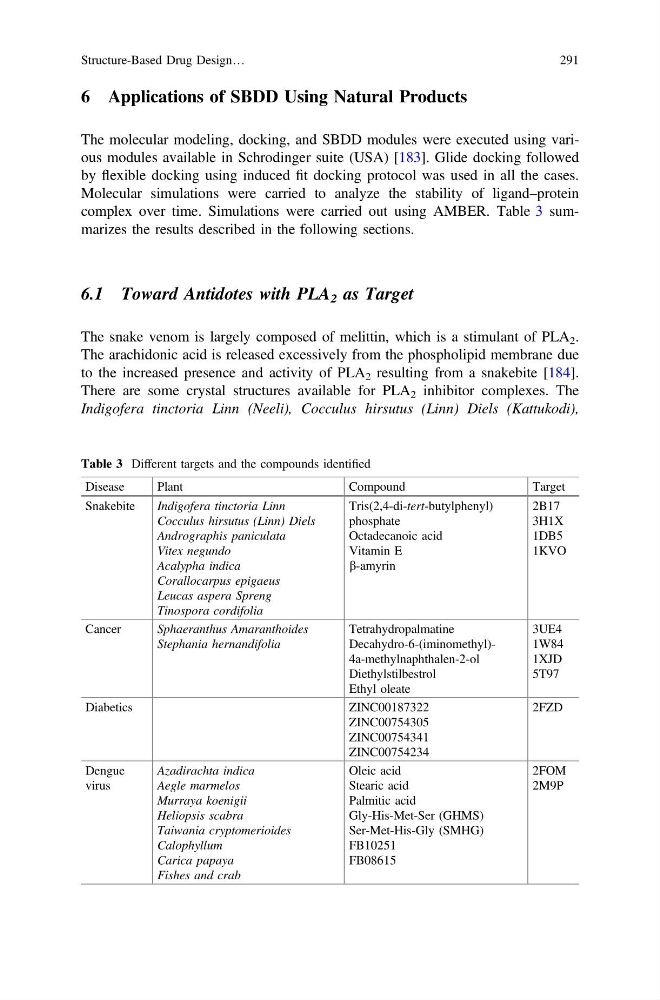
complex over time. Simulations were carried out using AMBER. Table 3 summarizes the results described in the following sections.
6.1 Toward Antidotes with PLA 2 as Target
The snake venom is largely composed of melittin, which is a stimulant of PLA 2 .
The arachidonic acid is released excessively from the phospholipid membrane due
to the increased presence and activity of PLA 2 resulting from a snakebite [184].
There are some crystal structures available for PLA 2 inhibitor complexes. The
Indigofera tinctoria Linn (Neeli), Cocculus hirsutus (Linn) Diels (Kattukodi),
Table 3 Different targets and the compounds identified
Disease
Plant
Compound
Target
Snakebite
Indigofera tinctoria Linn
Cocculus hirsutus (Linn) Diels
Andrographis paniculata
Vitex negundo
Acalypha indica
Corallocarpus epigaeus
Leucas aspera Spreng
Tinospora cordifolia
Tris(2,4-di-tert-butylphenyl)
phosphate
Octadecanoic acid
Vitamin E
b-amyrin
2B17
3H1X
1DB5
1KVO
Cancer
Sphaeranthus Amaranthoides
Stephania hernandifolia
Tetrahydropalmatine
Decahydro-6-(iminomethyl)4a-methylnaphthalen-2-ol
Diethylstilbestrol
Ethyl oleate
3UE4
1W84
1XJD
5T97
Diabetics
ZINC00187322
ZINC00754305
ZINC00754341
ZINC00754234
2FZD
Dengue
virus
Azadirachta indica
Aegle marmelos
Murraya koenigii
Heliopsis scabra
Taiwania cryptomerioides
Calophyllum
Carica papaya
Fishes and crab
Oleic acid
Stearic acid
Palmitic acid
Gly-His-Met-Ser (GHMS)
Ser-Met-His-Gly (SMHG)
FB10251
FB08615
2FOM
2M9P
Structure-Based Drug Design…
291
The molecular modeling, docking, and SBDD modules were executed using various modules available in Schrodinger suite (USA) [183]. Glide docking followed
by flexible docking using induced fit docking protocol was used in all the cases.
Molecular simulations were carried to analyze the stability of ligand–protein
complex over time. Simulations were carried out using AMBER. Table 3 summarizes the results described in the following sections.
6.1 Toward Antidotes with PLA 2 as Target
The snake venom is largely composed of melittin, which is a stimulant of PLA 2 .
The arachidonic acid is released excessively from the phospholipid membrane due
to the increased presence and activity of PLA 2 resulting from a snakebite [184].
There are some crystal structures available for PLA 2 inhibitor complexes. The
Indigofera tinctoria Linn (Neeli), Cocculus hirsutus (Linn) Diels (Kattukodi),
Table 3 Different targets and the compounds identified
Disease
Plant
Compound
Target
Snakebite
Indigofera tinctoria Linn
Cocculus hirsutus (Linn) Diels
Andrographis paniculata
Vitex negundo
Acalypha indica
Corallocarpus epigaeus
Leucas aspera Spreng
Tinospora cordifolia
Tris(2,4-di-tert-butylphenyl)
phosphate
Octadecanoic acid
Vitamin E
b-amyrin
2B17
3H1X
1DB5
1KVO
Cancer
Sphaeranthus Amaranthoides
Stephania hernandifolia
Tetrahydropalmatine
Decahydro-6-(iminomethyl)4a-methylnaphthalen-2-ol
Diethylstilbestrol
Ethyl oleate
3UE4
1W84
1XJD
5T97
Diabetics
ZINC00187322
ZINC00754305
ZINC00754341
ZINC00754234
2FZD
Dengue
virus
Azadirachta indica
Aegle marmelos
Murraya koenigii
Heliopsis scabra
Taiwania cryptomerioides
Calophyllum
Carica papaya
Fishes and crab
Oleic acid
Stearic acid
Palmitic acid
Gly-His-Met-Ser (GHMS)
Ser-Met-His-Gly (SMHG)
FB10251
FB08615
2FOM
2M9P
Structure-Based Drug Design…
291