

effect of salt which is considered in a mean-field sense. This approximation is more
appropriate for many drug design applications.
Generalized Born model
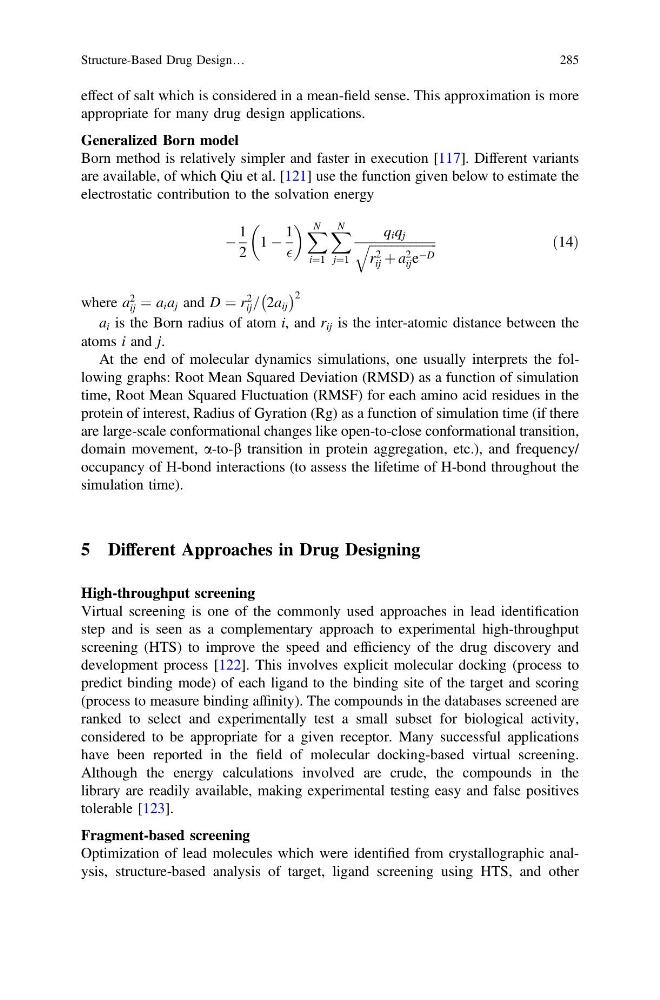
Born method is relatively simpler and faster in execution [117]. Different variants
are available, of which Qiu et al. [121] use the function given below to estimate the
electrostatic contribution to the solvation energy
À
1
2
1 À
1
X N
i¼1
X N
j¼1
q i q j
ffiffiffiffiffiffiffiffiffiffiffiffiffiffiffiffiffiffiffiffiffi ffi
r 2
ij þ a 2
ij e ÀD
q
ð14Þ
where a
2
ij ¼ a i a j and D ¼ r
2
ij = 2a ij
À Á 2
a i is the Born radius of atom i, and r ij is the inter-atomic distance between the
atoms i and j.
At the end of molecular dynamics simulations, one usually interprets the following graphs: Root Mean Squared Deviation (RMSD) as a function of simulation
time, Root Mean Squared Fluctuation (RMSF) for each amino acid residues in the
protein of interest, Radius of Gyration (Rg) as a function of simulation time (if there
are large-scale conformational changes like open-to-close conformational transition,
domain movement, a-to-b transition in protein aggregation, etc.), and frequency/
occupancy of H-bond interactions (to assess the lifetime of H-bond throughout the
simulation time).
5 Different Approaches in Drug Designing
High-throughput screening
Virtual screening is one of the commonly used approaches in lead identification
step and is seen as a complementary approach to experimental high-throughput
screening (HTS) to improve the speed and efficiency of the drug discovery and
development process [122]. This involves explicit molecular docking (process to
predict binding mode) of each ligand to the binding site of the target and scoring
(process to measure binding affinity). The compounds in the databases screened are
ranked to select and experimentally test a small subset for biological activity,
considered to be appropriate for a given receptor. Many successful applications
have been reported in the field of molecular docking-based virtual screening.
Although the energy calculations involved are crude, the compounds in the
library are readily available, making experimental testing easy and false positives
tolerable [123].
Fragment-based screening
Optimization of lead molecules which were identified from crystallographic analysis, structure-based analysis of target, ligand screening using HTS, and other
Structure-Based Drug Design…
285
appropriate for many drug design applications.
Generalized Born model
Born method is relatively simpler and faster in execution [117]. Different variants
are available, of which Qiu et al. [121] use the function given below to estimate the
electrostatic contribution to the solvation energy
À
1
2
1 À
1
X N
i¼1
X N
j¼1
q i q j
ffiffiffiffiffiffiffiffiffiffiffiffiffiffiffiffiffiffiffiffiffi ffi
r 2
ij þ a 2
ij e ÀD
q
ð14Þ
where a
2
ij ¼ a i a j and D ¼ r
2
ij = 2a ij
À Á 2
a i is the Born radius of atom i, and r ij is the inter-atomic distance between the
atoms i and j.
At the end of molecular dynamics simulations, one usually interprets the following graphs: Root Mean Squared Deviation (RMSD) as a function of simulation
time, Root Mean Squared Fluctuation (RMSF) for each amino acid residues in the
protein of interest, Radius of Gyration (Rg) as a function of simulation time (if there
are large-scale conformational changes like open-to-close conformational transition,
domain movement, a-to-b transition in protein aggregation, etc.), and frequency/
occupancy of H-bond interactions (to assess the lifetime of H-bond throughout the
simulation time).
5 Different Approaches in Drug Designing
High-throughput screening
Virtual screening is one of the commonly used approaches in lead identification
step and is seen as a complementary approach to experimental high-throughput
screening (HTS) to improve the speed and efficiency of the drug discovery and
development process [122]. This involves explicit molecular docking (process to
predict binding mode) of each ligand to the binding site of the target and scoring
(process to measure binding affinity). The compounds in the databases screened are
ranked to select and experimentally test a small subset for biological activity,
considered to be appropriate for a given receptor. Many successful applications
have been reported in the field of molecular docking-based virtual screening.
Although the energy calculations involved are crude, the compounds in the
library are readily available, making experimental testing easy and false positives
tolerable [123].
Fragment-based screening
Optimization of lead molecules which were identified from crystallographic analysis, structure-based analysis of target, ligand screening using HTS, and other
Structure-Based Drug Design…
285