

discovery in past decades, it is advisable to make upfront choices before selecting
and acquiring chemical libraries for a challenging target like epigenetics. This
chapter offers a set of chemoinformatic tools to identify possible risk factors and
pitfalls, and explores the synergy with experimental methods to advance the discovery of small molecules that modulate various epigenetic targets.
2 Overview: Epigenetic Control of Gene Expression
Chromatin organization
Multicellular organisms have the large genome, and it must maintain the integrity
and specialized functions of different cell types. Therefore, eukaryotes have evolved
a dynamic and efficient packaging system, where chromosomal DNA is organized
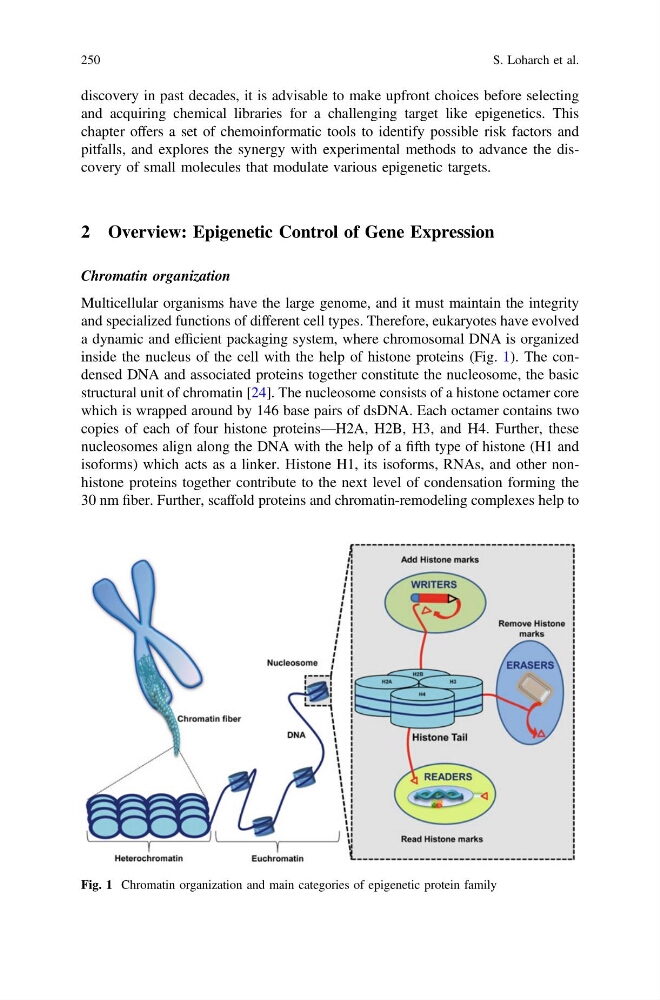
inside the nucleus of the cell with the help of histone proteins (Fig. 1). The condensed DNA and associated proteins together constitute the nucleosome, the basic
structural unit of chromatin [24]. The nucleosome consists of a histone octamer core
which is wrapped around by 146 base pairs of dsDNA. Each octamer contains two
copies of each of four histone proteins—H2A, H2B, H3, and H4. Further, these
nucleosomes align along the DNA with the help of a fifth type of histone (H1 and
isoforms) which acts as a linker. Histone H1, its isoforms, RNAs, and other nonhistone proteins together contribute to the next level of condensation forming the
30 nm fiber. Further, scaffold proteins and chromatin-remodeling complexes help to
Fig. 1 Chromatin organization and main categories of epigenetic protein family
250
S. Loharch et al.
and acquiring chemical libraries for a challenging target like epigenetics. This
chapter offers a set of chemoinformatic tools to identify possible risk factors and
pitfalls, and explores the synergy with experimental methods to advance the discovery of small molecules that modulate various epigenetic targets.
2 Overview: Epigenetic Control of Gene Expression
Chromatin organization
Multicellular organisms have the large genome, and it must maintain the integrity
and specialized functions of different cell types. Therefore, eukaryotes have evolved
a dynamic and efficient packaging system, where chromosomal DNA is organized
inside the nucleus of the cell with the help of histone proteins (Fig. 1). The condensed DNA and associated proteins together constitute the nucleosome, the basic
structural unit of chromatin [24]. The nucleosome consists of a histone octamer core
which is wrapped around by 146 base pairs of dsDNA. Each octamer contains two
copies of each of four histone proteins—H2A, H2B, H3, and H4. Further, these
nucleosomes align along the DNA with the help of a fifth type of histone (H1 and
isoforms) which acts as a linker. Histone H1, its isoforms, RNAs, and other nonhistone proteins together contribute to the next level of condensation forming the
30 nm fiber. Further, scaffold proteins and chromatin-remodeling complexes help to
Fig. 1 Chromatin organization and main categories of epigenetic protein family
250
S. Loharch et al.