

where the angular bracket <> indicates ensemble over the MD trajectory, E
LÀS
coul and
E
LÀS
vdW are electrostatic and van der Waals interactions between the ligand and its
medium in the vicinity (PL—protein–ligand complex; L—ligand in solvent), and a
is the weighting parameter for electrostatic interactions, which is most often set to
0.5 [78]. This value is assumed due to the linear response of the surroundings to the
electrostatic field and was validated using more extensive computations on the ions
(Na
+ and Ca
2+ ) in water [80]. b is the weighting parameter for van der Waals
interactions and is set to 0.16−0.18 [81], which is a subject of much debate owing
to the difficulty in estimating the vdW’s contribution to the free energy of binding.
However, these values are obtained by empirical fitting the experimental binding
free energies. Moreover, the linear response of the vdW term is assumed by
observing the linear trend in the interaction of the hydrocarbons with the solvent
(water) that depends on the number of carbons in a hydrocarbon.
2.3.2 Non-partitioning-Based Methods
In non-partitioning methods, there is no partitioning of the free energy into various
components. Statistical mechanics plays a crucial role in deriving the relationship
between the free energy of a system and the ensemble average of the Hamiltonian
that describes the system. These methods are far more accurate than the previously
mentioned end-state free energy methods, but at the same time, are computationally
very demanding. Hence, while dealing with a large dataset of molecules against a
particular protein target, it is worthwhile to screen the molecules using a fast
method like high-throughput virtual screening [82, 83], followed by a flexible
docking-based screening, then use an end-state free energy method, and finally
employ the non-partitioning methods to study few tens of molecules. Here, we will
present a brief discussion on FEP and TI methods along with their mathematical
treatment, and then move on to explain the idea behind alchemical free energy
predictions.
Free Energy Perturbation (FEP) and Thermodynamic Integration (TI)
Most of the methods for free energy calculations are generally formulated in terms
of estimating the relative free energy differences, DG, between two equilibrium
states, or binding of two similar ligands to a common target. The free energy
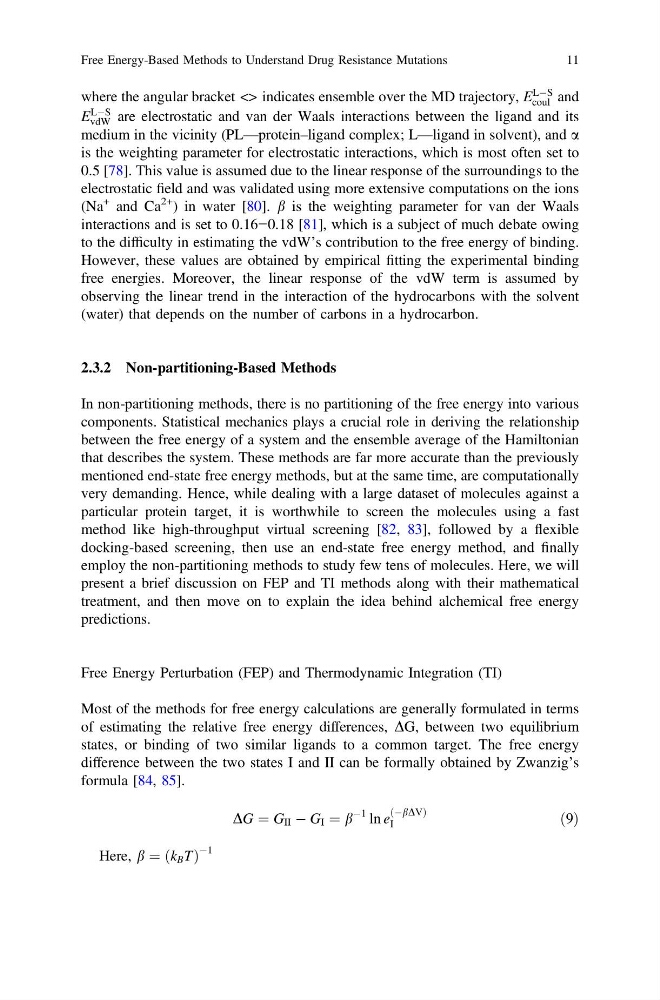
difference between the two states I and II can be formally obtained by Zwanzig’s
formula [84, 85].
DG ¼ G II À G I ¼ b
À1 ln e
ÀbDV
ð
Þ
I
ð9Þ
Here, b ¼ k B T
ð
Þ
À1
Free Energy-Based Methods to Understand Drug Resistance Mutations
11
LÀS
coul and
E
LÀS
vdW are electrostatic and van der Waals interactions between the ligand and its
medium in the vicinity (PL—protein–ligand complex; L—ligand in solvent), and a
is the weighting parameter for electrostatic interactions, which is most often set to
0.5 [78]. This value is assumed due to the linear response of the surroundings to the
electrostatic field and was validated using more extensive computations on the ions
(Na
+ and Ca
2+ ) in water [80]. b is the weighting parameter for van der Waals
interactions and is set to 0.16−0.18 [81], which is a subject of much debate owing
to the difficulty in estimating the vdW’s contribution to the free energy of binding.
However, these values are obtained by empirical fitting the experimental binding
free energies. Moreover, the linear response of the vdW term is assumed by
observing the linear trend in the interaction of the hydrocarbons with the solvent
(water) that depends on the number of carbons in a hydrocarbon.
2.3.2 Non-partitioning-Based Methods
In non-partitioning methods, there is no partitioning of the free energy into various
components. Statistical mechanics plays a crucial role in deriving the relationship
between the free energy of a system and the ensemble average of the Hamiltonian
that describes the system. These methods are far more accurate than the previously
mentioned end-state free energy methods, but at the same time, are computationally
very demanding. Hence, while dealing with a large dataset of molecules against a
particular protein target, it is worthwhile to screen the molecules using a fast
method like high-throughput virtual screening [82, 83], followed by a flexible
docking-based screening, then use an end-state free energy method, and finally
employ the non-partitioning methods to study few tens of molecules. Here, we will
present a brief discussion on FEP and TI methods along with their mathematical
treatment, and then move on to explain the idea behind alchemical free energy
predictions.
Free Energy Perturbation (FEP) and Thermodynamic Integration (TI)
Most of the methods for free energy calculations are generally formulated in terms
of estimating the relative free energy differences, DG, between two equilibrium
states, or binding of two similar ligands to a common target. The free energy
difference between the two states I and II can be formally obtained by Zwanzig’s
formula [84, 85].
DG ¼ G II À G I ¼ b
À1 ln e
ÀbDV
ð
Þ
I
ð9Þ
Here, b ¼ k B T
ð
Þ
À1
Free Energy-Based Methods to Understand Drug Resistance Mutations
11