

Due to the ease in doing calculations and lower computational demand,
molecular docking methods are routinely used to rank the compounds according to
their binding affinity or using other scoring. The pharmaceutical companies use this
approach very efficiently to screen the chemical database containing millions of
compounds against a potential target in the early virtual screening process before
they can be synthezised as lead series. An elaborate list on use of molecular
docking-based screening to design candidate drug molecules for various targets,
namely G protein-coupled receptors, enzymes, ion channels, can be found in this
reference [27].
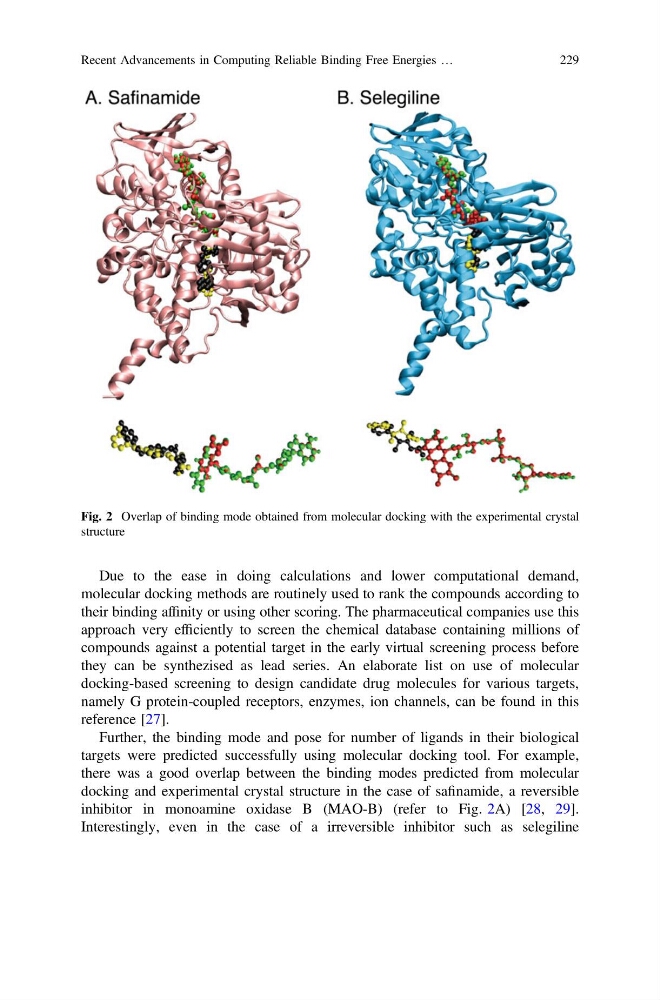
Further, the binding mode and pose for number of ligands in their biological
targets were predicted successfully using molecular docking tool. For example,
there was a good overlap between the binding modes predicted from molecular
docking and experimental crystal structure in the case of safinamide, a reversible
inhibitor in monoamine oxidase B (MAO-B) (refer to Fig. 2A) [28, 29].
Interestingly, even in the case of a irreversible inhibitor such as selegiline
Fig. 2 Overlap of binding mode obtained from molecular docking with the experimental crystal
structure
Recent Advancements in Computing Reliable Binding Free Energies …
229
molecular docking methods are routinely used to rank the compounds according to
their binding affinity or using other scoring. The pharmaceutical companies use this
approach very efficiently to screen the chemical database containing millions of
compounds against a potential target in the early virtual screening process before
they can be synthezised as lead series. An elaborate list on use of molecular
docking-based screening to design candidate drug molecules for various targets,
namely G protein-coupled receptors, enzymes, ion channels, can be found in this
reference [27].
Further, the binding mode and pose for number of ligands in their biological
targets were predicted successfully using molecular docking tool. For example,
there was a good overlap between the binding modes predicted from molecular
docking and experimental crystal structure in the case of safinamide, a reversible
inhibitor in monoamine oxidase B (MAO-B) (refer to Fig. 2A) [28, 29].
Interestingly, even in the case of a irreversible inhibitor such as selegiline
Fig. 2 Overlap of binding mode obtained from molecular docking with the experimental crystal
structure
Recent Advancements in Computing Reliable Binding Free Energies …
229