

to a receptor which in turn can be used to optimize drug potency, absorption,
distribution and metabolism. These methods are so general and also can be used to
compute absolute free energies of a ligand or drug in crystalline or in different
solvent environments making it feasible to predict other PD and PK properties like
bioavailability, permeability and solubility [15, 16]. Very recently, machine
learning approaches are also contributing to the computation of interaction energies
of protein–ligand and protein–protein complexes and the progress in the use of such
approaches for drug discovery projects will be discussed at the end.
4 Force-Field-Based Free Energies of Drug Target
Binding
A force-field describes how the atomic and molecular systems behave at finite
temperature, pressure and in a specific physiological condition or under any
external fields. Force-fields have potential energy functions to explain the interactions of intermolecular and intramolecular degrees of freedom within a system. In
particular, the former dictates the packing, relative orientation of molecules, while
the internal geometry is dictated by the latter potentials. The currently available
potential energy functions in different force-fields were parameterized using many
experimental thermodynamic data and structural data [17]. For example, crystal
structure database (CSD) can be easily utilized to get the information about the
characteristic equilibrium radii of atoms which then dictate the size and overall
structure of the materials. Similarly, the heat of vaporization can be used to get
information about the well depths of the interaction potential which then gives
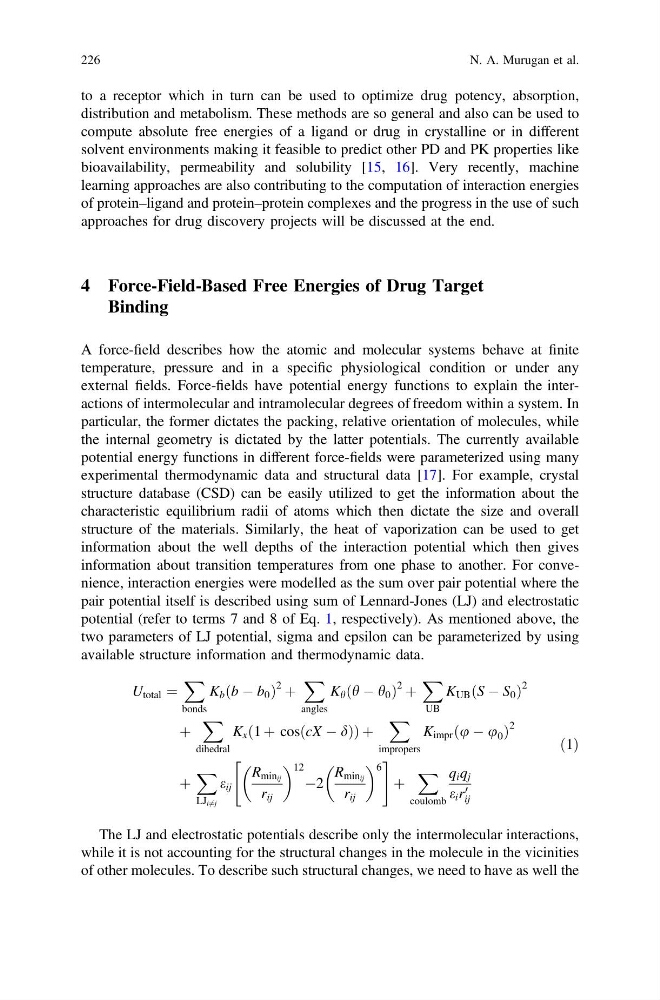
information about transition temperatures from one phase to another. For convenience, interaction energies were modelled as the sum over pair potential where the
pair potential itself is described using sum of Lennard-Jones (LJ) and electrostatic
potential (refer to terms 7 and 8 of Eq. 1, respectively). As mentioned above, the
two parameters of LJ potential, sigma and epsilon can be parameterized by using
available structure information and thermodynamic data.
U total ¼
X
bonds
K b ðb À b 0 Þ
2 þ
X
angles
K h ðh À h 0 Þ
2 þ
X
UB
K UB ðS À S 0 Þ
2
þ
X
dihedral
K x ð1 þ cosðcX À dÞÞ þ
X
impropers
K impr ðu À u 0 Þ
2
þ
X
LJ i6 ¼j
e ij
R min ij
r ij
12
À2
R min ij
r ij
6
"
#
þ
X
coulomb
q i q j
e i r 0
ij
ð1Þ
The LJ and electrostatic potentials describe only the intermolecular interactions,
while it is not accounting for the structural changes in the molecule in the vicinities
of other molecules. To describe such structural changes, we need to have as well the
226
N. A. Murugan et al.
distribution and metabolism. These methods are so general and also can be used to
compute absolute free energies of a ligand or drug in crystalline or in different
solvent environments making it feasible to predict other PD and PK properties like
bioavailability, permeability and solubility [15, 16]. Very recently, machine
learning approaches are also contributing to the computation of interaction energies
of protein–ligand and protein–protein complexes and the progress in the use of such
approaches for drug discovery projects will be discussed at the end.
4 Force-Field-Based Free Energies of Drug Target
Binding
A force-field describes how the atomic and molecular systems behave at finite
temperature, pressure and in a specific physiological condition or under any
external fields. Force-fields have potential energy functions to explain the interactions of intermolecular and intramolecular degrees of freedom within a system. In
particular, the former dictates the packing, relative orientation of molecules, while
the internal geometry is dictated by the latter potentials. The currently available
potential energy functions in different force-fields were parameterized using many
experimental thermodynamic data and structural data [17]. For example, crystal
structure database (CSD) can be easily utilized to get the information about the
characteristic equilibrium radii of atoms which then dictate the size and overall
structure of the materials. Similarly, the heat of vaporization can be used to get
information about the well depths of the interaction potential which then gives
information about transition temperatures from one phase to another. For convenience, interaction energies were modelled as the sum over pair potential where the
pair potential itself is described using sum of Lennard-Jones (LJ) and electrostatic
potential (refer to terms 7 and 8 of Eq. 1, respectively). As mentioned above, the
two parameters of LJ potential, sigma and epsilon can be parameterized by using
available structure information and thermodynamic data.
U total ¼
X
bonds
K b ðb À b 0 Þ
2 þ
X
angles
K h ðh À h 0 Þ
2 þ
X
UB
K UB ðS À S 0 Þ
2
þ
X
dihedral
K x ð1 þ cosðcX À dÞÞ þ
X
impropers
K impr ðu À u 0 Þ
2
þ
X
LJ i6 ¼j
e ij
R min ij
r ij
12
À2
R min ij
r ij
6
"
#
þ
X
coulomb
q i q j
e i r 0
ij
ð1Þ
The LJ and electrostatic potentials describe only the intermolecular interactions,
while it is not accounting for the structural changes in the molecule in the vicinities
of other molecules. To describe such structural changes, we need to have as well the
226
N. A. Murugan et al.