

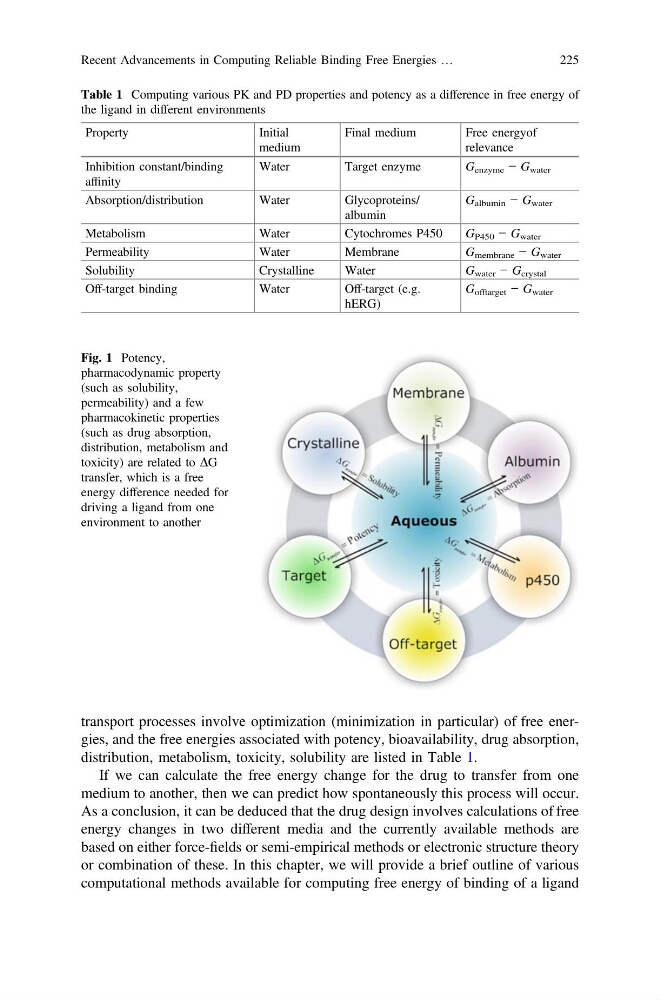
transport processes involve optimization (minimization in particular) of free energies, and the free energies associated with potency, bioavailability, drug absorption,
distribution, metabolism, toxicity, solubility are listed in Table 1.
If we can calculate the free energy change for the drug to transfer from one
medium to another, then we can predict how spontaneously this process will occur.
As a conclusion, it can be deduced that the drug design involves calculations of free
energy changes in two different media and the currently available methods are
based on either force-fields or semi-empirical methods or electronic structure theory
or combination of these. In this chapter, we will provide a brief outline of various
computational methods available for computing free energy of binding of a ligand
Table 1 Computing various PK and PD properties and potency as a difference in free energy of
the ligand in different environments
Property
Initial
medium
Final medium
Free energyof
relevance
Inhibition constant/binding
affinity
Water
Target enzyme
G enzyme − G water
Absorption/distribution
Water
Glycoproteins/
albumin
G albumin − G water
Metabolism
Water
Cytochromes P450
G P450 − G water
Permeability
Water
Membrane
G membrane − G water
Solubility
Crystalline
Water
G water − G crystal
Off-target binding
Water
Off-target (e.g.
hERG)
G offtarget − G water
Fig. 1 Potency,
pharmacodynamic property
(such as solubility,
permeability) and a few
pharmacokinetic properties
(such as drug absorption,
distribution, metabolism and
toxicity) are related to DG
transfer, which is a free
energy difference needed for
driving a ligand from one
environment to another
Recent Advancements in Computing Reliable Binding Free Energies …
225
distribution, metabolism, toxicity, solubility are listed in Table 1.
If we can calculate the free energy change for the drug to transfer from one
medium to another, then we can predict how spontaneously this process will occur.
As a conclusion, it can be deduced that the drug design involves calculations of free
energy changes in two different media and the currently available methods are
based on either force-fields or semi-empirical methods or electronic structure theory
or combination of these. In this chapter, we will provide a brief outline of various
computational methods available for computing free energy of binding of a ligand
Table 1 Computing various PK and PD properties and potency as a difference in free energy of
the ligand in different environments
Property
Initial
medium
Final medium
Free energyof
relevance
Inhibition constant/binding
affinity
Water
Target enzyme
G enzyme − G water
Absorption/distribution
Water
Glycoproteins/
albumin
G albumin − G water
Metabolism
Water
Cytochromes P450
G P450 − G water
Permeability
Water
Membrane
G membrane − G water
Solubility
Crystalline
Water
G water − G crystal
Off-target binding
Water
Off-target (e.g.
hERG)
G offtarget − G water
Fig. 1 Potency,
pharmacodynamic property
(such as solubility,
permeability) and a few
pharmacokinetic properties
(such as drug absorption,
distribution, metabolism and
toxicity) are related to DG
transfer, which is a free
energy difference needed for
driving a ligand from one
environment to another
Recent Advancements in Computing Reliable Binding Free Energies …
225