

of the Ala59 at the position where the phenyl ring of the teriflunomide binds.
Similar position in PfDHODH cavity is comparatively less congested (Ala59 is
replaced by Phe188) and seems to accommodate the inhibitors which might provide
a cylindrical geometry. Considering this structural feature, six molecules which are
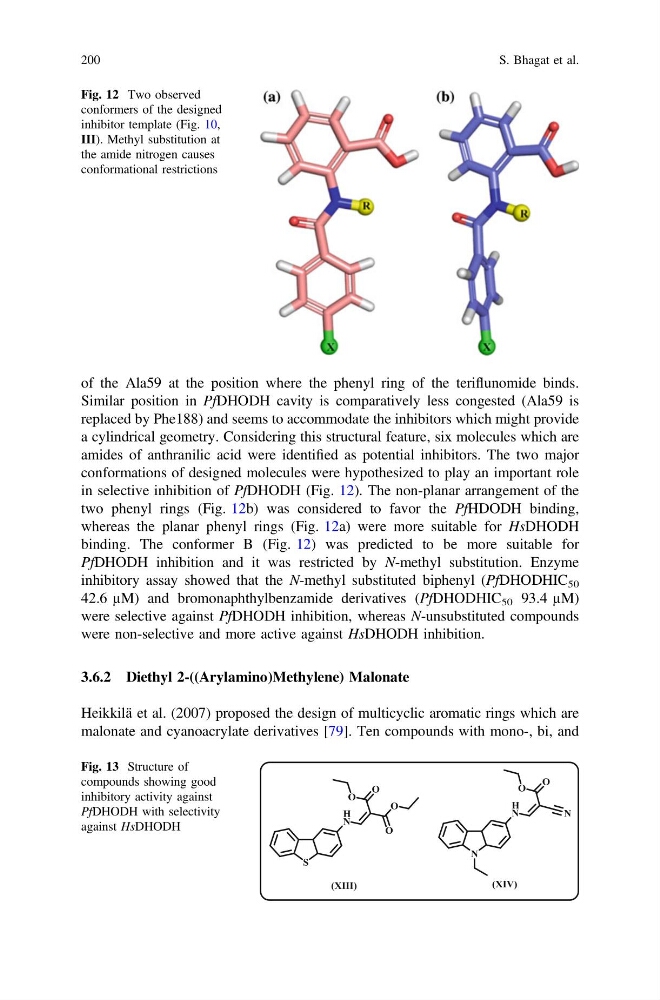
amides of anthranilic acid were identified as potential inhibitors. The two major
conformations of designed molecules were hypothesized to play an important role
in selective inhibition of PfDHODH (Fig. 12). The non-planar arrangement of the
two phenyl rings (Fig. 12b) was considered to favor the PfHDODH binding,
whereas the planar phenyl rings (Fig. 12a) were more suitable for HsDHODH
binding. The conformer B (Fig. 12) was predicted to be more suitable for
PfDHODH inhibition and it was restricted by N-methyl substitution. Enzyme
inhibitory assay showed that the N-methyl substituted biphenyl (PfDHODHIC 50
42.6 µM) and bromonaphthylbenzamide derivatives (PfDHODHIC 50 93.4 µM)
were selective against PfDHODH inhibition, whereas N-unsubstituted compounds
were non-selective and more active against HsDHODH inhibition.
3.6.2 Diethyl 2-((Arylamino)Methylene) Malonate
Heikkilä et al. (2007) proposed the design of multicyclic aromatic rings which are
malonate and cyanoacrylate derivatives [79]. Ten compounds with mono-, bi, and
Fig. 12 Two observed
conformers of the designed
inhibitor template (Fig. 10,
III). Methyl substitution at
the amide nitrogen causes
conformational restrictions
Fig. 13 Structure of
compounds showing good
inhibitory activity against
PfDHODH with selectivity
against HsDHODH
200
S. Bhagat et al.
Similar position in PfDHODH cavity is comparatively less congested (Ala59 is
replaced by Phe188) and seems to accommodate the inhibitors which might provide
a cylindrical geometry. Considering this structural feature, six molecules which are
amides of anthranilic acid were identified as potential inhibitors. The two major
conformations of designed molecules were hypothesized to play an important role
in selective inhibition of PfDHODH (Fig. 12). The non-planar arrangement of the
two phenyl rings (Fig. 12b) was considered to favor the PfHDODH binding,
whereas the planar phenyl rings (Fig. 12a) were more suitable for HsDHODH
binding. The conformer B (Fig. 12) was predicted to be more suitable for
PfDHODH inhibition and it was restricted by N-methyl substitution. Enzyme
inhibitory assay showed that the N-methyl substituted biphenyl (PfDHODHIC 50
42.6 µM) and bromonaphthylbenzamide derivatives (PfDHODHIC 50 93.4 µM)
were selective against PfDHODH inhibition, whereas N-unsubstituted compounds
were non-selective and more active against HsDHODH inhibition.
3.6.2 Diethyl 2-((Arylamino)Methylene) Malonate
Heikkilä et al. (2007) proposed the design of multicyclic aromatic rings which are
malonate and cyanoacrylate derivatives [79]. Ten compounds with mono-, bi, and
Fig. 12 Two observed
conformers of the designed
inhibitor template (Fig. 10,
III). Methyl substitution at
the amide nitrogen causes
conformational restrictions
Fig. 13 Structure of
compounds showing good
inhibitory activity against
PfDHODH with selectivity
against HsDHODH
200
S. Bhagat et al.