

Inhibition of PfDHODH can be considered by either blocking the DHO (substrate)-binding site or CoQ (co-substrate)-binding site. In most of the species, the
DHO-binding site is conserved which can lead to selectivity issues. High variability
is observed in ubiquinone-binding site which renders it to be the preferential site for
species-selective DHODH inhibition. Selectivity against HsDHODH and
PfDHODH is the major requirement for designing antimalarial leads.
The CoQ-binding tunnel is divided into three regions, i.e., mouth, waist, and end
of the tunnel. Structural and chemical composition differences in these regions lead
to the species-selective inhibition. The mouth of the HsDHODH is broader compared to PfDHODH due to a slight kink provided by Leu Hs 42. This leads to an
average r.m.s backbone displacement of 2.2 Å between the human and PfDHODH
protein domain. Also, substitution of Phe Pf 171 and Met Pf 536 for Leu Hs 42 and
Pro Hs 364, respectively, brings the N-terminal of the first helix closer to the
C-terminal of the second helix which is responsible for the narrow mouth of the
tunnel in PfDHODH. End of the tunnel in case of PfDHODH is comparatively
smaller than the HsDHODH which is due to the replacement of Val Hs 134 and
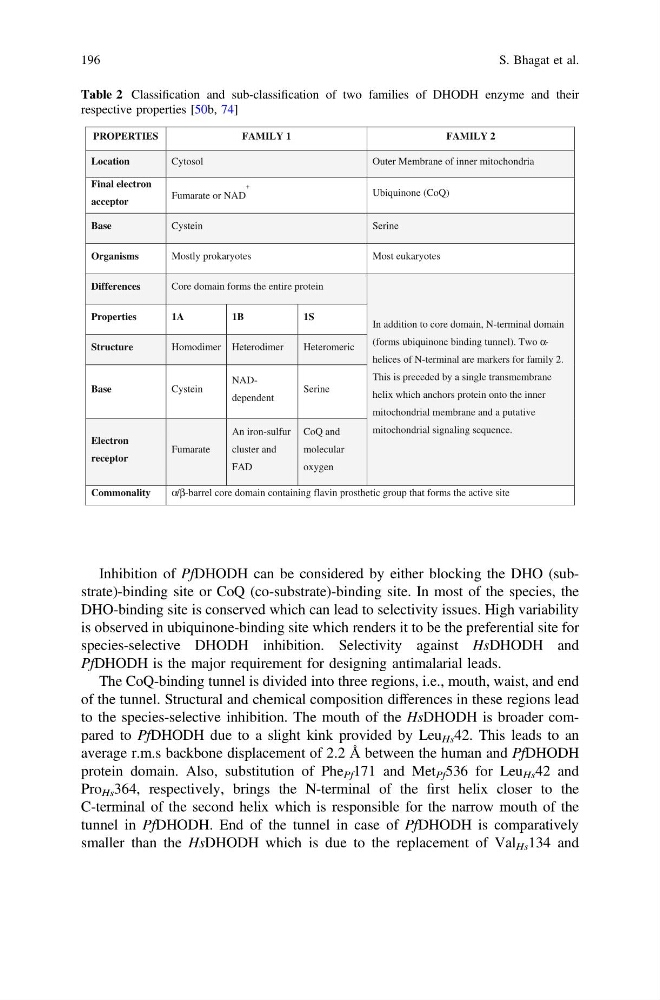
Table 2 Classification and sub-classification of two families of DHODH enzyme and their
respective properties [50b, 74]
PROPERTIES
FAMILY 1
FAMILY 2
Location
Cytosol
Outer Membrane of inner mitochondria
Final electron
acceptor
Fumarate or NAD
+
Ubiquinone (CoQ)
Base
Cystein
Serine
Organisms
Mostly prokaryotes
Most eukaryotes
Differences
Core domain forms the entire protein
In addition to core domain, N-terminal domain
(forms ubiquinone binding tunnel). Two αhelices of N-terminal are markers for family 2.
This is preceded by a single transmembrane
helix which anchors protein onto the inner
mitochondrial membrane and a putative
mitochondrial signaling sequence.
Properties
1A
1B
1S
Structure
Homodimer Heterodimer
Heteromeric
Base
Cystein
NADdependent
Serine
Electron
receptor
Fumarate
An iron-sulfur
cluster and
FAD
CoQ and
molecular
oxygen
Commonality
α/β-barrel core domain containing flavin prosthetic group that forms the active site
196
S. Bhagat et al.
DHO-binding site is conserved which can lead to selectivity issues. High variability
is observed in ubiquinone-binding site which renders it to be the preferential site for
species-selective DHODH inhibition. Selectivity against HsDHODH and
PfDHODH is the major requirement for designing antimalarial leads.
The CoQ-binding tunnel is divided into three regions, i.e., mouth, waist, and end
of the tunnel. Structural and chemical composition differences in these regions lead
to the species-selective inhibition. The mouth of the HsDHODH is broader compared to PfDHODH due to a slight kink provided by Leu Hs 42. This leads to an
average r.m.s backbone displacement of 2.2 Å between the human and PfDHODH
protein domain. Also, substitution of Phe Pf 171 and Met Pf 536 for Leu Hs 42 and
Pro Hs 364, respectively, brings the N-terminal of the first helix closer to the
C-terminal of the second helix which is responsible for the narrow mouth of the
tunnel in PfDHODH. End of the tunnel in case of PfDHODH is comparatively
smaller than the HsDHODH which is due to the replacement of Val Hs 134 and
Table 2 Classification and sub-classification of two families of DHODH enzyme and their
respective properties [50b, 74]
PROPERTIES
FAMILY 1
FAMILY 2
Location
Cytosol
Outer Membrane of inner mitochondria
Final electron
acceptor
Fumarate or NAD
+
Ubiquinone (CoQ)
Base
Cystein
Serine
Organisms
Mostly prokaryotes
Most eukaryotes
Differences
Core domain forms the entire protein
In addition to core domain, N-terminal domain
(forms ubiquinone binding tunnel). Two αhelices of N-terminal are markers for family 2.
This is preceded by a single transmembrane
helix which anchors protein onto the inner
mitochondrial membrane and a putative
mitochondrial signaling sequence.
Properties
1A
1B
1S
Structure
Homodimer Heterodimer
Heteromeric
Base
Cystein
NADdependent
Serine
Electron
receptor
Fumarate
An iron-sulfur
cluster and
FAD
CoQ and
molecular
oxygen
Commonality
α/β-barrel core domain containing flavin prosthetic group that forms the active site
196
S. Bhagat et al.