

good potency [20] and exert their antimalarial effect through inhibitory interaction
with the ATP-binding pocket of PfPI4 K [21]. However, these compounds failed to
provide prevention against parasite in human due to poor solubility and causes
serious hERG liability (Arrhythmia). The reason for toxicity might be catalytic
similarity between human and parasite enzyme as suggested by the homology
model designed by Rajkhowa et al. [19].
2.3 PfNDH2 (P. falciparum NADH-Ubiquinone
Oxidoreductase)
PfNADH-ubiquinone oxidoreductase is an enzyme of respiratory chain, present on
the inner mitochondrial membrane. It is involved in the transfer of electrons from
NADH to subsequent CoQ (ubiquinone) for CoQ–H 2 production and is coupled
with translocation of proton or Na
+ across the membrane in mammals [22]. This
enzyme is also present in P. falciparum, but it does not pump protons across the
membrane; however, it still maintains the redox state of the cell. The human NDH2
is inhibited by rotenone, but PfNDH2 enzyme was found be insensitive to it.
A flavin reagent DPI (diphenyl iodonium chloride) inhibits the PfNDH2 enzyme
which leads to the depolarization of mitochondrial membrane potential and finally
parasite cell death [23].
The PfNDH2 enzyme exists in homodimer form comprising of four domains
(1) C-terminal domain (CTD) helps in dimerization, conserved in plasmodium
species; (2) two Rossmann fold domains, A and B, which bind to FAD and NADH
cofactors, respectively; (3) domain C which shares no homology with other
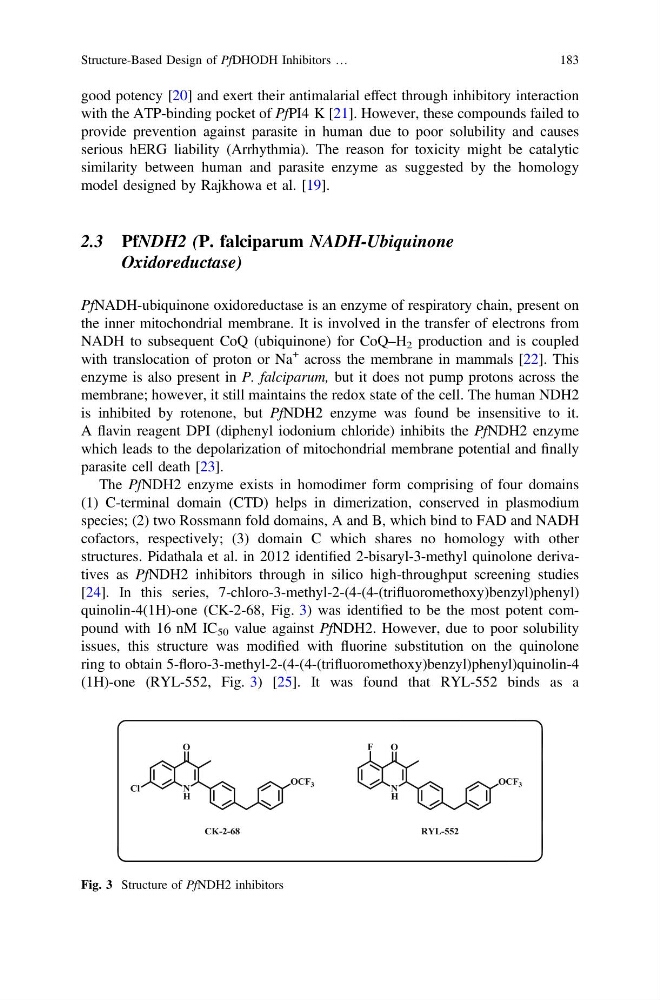
structures. Pidathala et al. in 2012 identified 2-bisaryl-3-methyl quinolone derivatives as PfNDH2 inhibitors through in silico high-throughput screening studies
[24]. In this series, 7-chloro-3-methyl-2-(4-(4-(trifluoromethoxy)benzyl)phenyl)
quinolin-4(1H)-one (CK-2-68, Fig. 3) was identified to be the most potent compound with 16 nM IC 50 value against PfNDH2. However, due to poor solubility
issues, this structure was modified with fluorine substitution on the quinolone
ring to obtain 5-floro-3-methyl-2-(4-(4-(trifluoromethoxy)benzyl)phenyl)quinolin-4
(1H)-one (RYL-552, Fig. 3) [25]. It was found that RYL-552 binds as a
Fig. 3 Structure of PfNDH2 inhibitors
Structure-Based Design of PfDHODH Inhibitors …
183
with the ATP-binding pocket of PfPI4 K [21]. However, these compounds failed to
provide prevention against parasite in human due to poor solubility and causes
serious hERG liability (Arrhythmia). The reason for toxicity might be catalytic
similarity between human and parasite enzyme as suggested by the homology
model designed by Rajkhowa et al. [19].
2.3 PfNDH2 (P. falciparum NADH-Ubiquinone
Oxidoreductase)
PfNADH-ubiquinone oxidoreductase is an enzyme of respiratory chain, present on
the inner mitochondrial membrane. It is involved in the transfer of electrons from
NADH to subsequent CoQ (ubiquinone) for CoQ–H 2 production and is coupled
with translocation of proton or Na
+ across the membrane in mammals [22]. This
enzyme is also present in P. falciparum, but it does not pump protons across the
membrane; however, it still maintains the redox state of the cell. The human NDH2
is inhibited by rotenone, but PfNDH2 enzyme was found be insensitive to it.
A flavin reagent DPI (diphenyl iodonium chloride) inhibits the PfNDH2 enzyme
which leads to the depolarization of mitochondrial membrane potential and finally
parasite cell death [23].
The PfNDH2 enzyme exists in homodimer form comprising of four domains
(1) C-terminal domain (CTD) helps in dimerization, conserved in plasmodium
species; (2) two Rossmann fold domains, A and B, which bind to FAD and NADH
cofactors, respectively; (3) domain C which shares no homology with other
structures. Pidathala et al. in 2012 identified 2-bisaryl-3-methyl quinolone derivatives as PfNDH2 inhibitors through in silico high-throughput screening studies
[24]. In this series, 7-chloro-3-methyl-2-(4-(4-(trifluoromethoxy)benzyl)phenyl)
quinolin-4(1H)-one (CK-2-68, Fig. 3) was identified to be the most potent compound with 16 nM IC 50 value against PfNDH2. However, due to poor solubility
issues, this structure was modified with fluorine substitution on the quinolone
ring to obtain 5-floro-3-methyl-2-(4-(4-(trifluoromethoxy)benzyl)phenyl)quinolin-4
(1H)-one (RYL-552, Fig. 3) [25]. It was found that RYL-552 binds as a
Fig. 3 Structure of PfNDH2 inhibitors
Structure-Based Design of PfDHODH Inhibitors …
183