

2.2 P. falciparum Phosphatidylinositol 4-kinase (PfPI4 K)
The phosphatidylinositol 4-kinase (PI4 K) enzyme catalyze the conversion of
phosphatidylinositol into two essential phospholipids, i.e., phosphatidylinositol
4,5-bisphosphate and phosphatidylinositol 3,4,5-triphosphate by phosphorylation at
one or more hydroxyl groups present in inositol moiety [18]. These phosphorylated
products regulate numerous biological events, including intracellular signaling,
vesicular transport, and cytoskeletal organization. Therefore, this biochemical
reaction is essential for mammals and for the parasite. The parasite has only this
enzyme to facilitate the phosphorylation of Phosphatidylinositol, but mammals
have four enzymes for this biochemical reaction [19]. Inhibition of PfPI4 K in
parasite cells lead to the deficiency of phospholipids in plasmodium leading to
disruption of plasma membrane around developing merozoites and finally causing
cell death. Also, lack of PI4 K in human erythrocytes ensure the unavailability of
phospholipids in the vicinity of the parasite cells [20].
Rajkhowa et al. in 2017 developed an acceptable homology model of the catalytic domain of PfPI(4) KIIIb, consisting of 327 amino acids [19]. They selected
X-ray crystal structure of HsPhosphatidylinositol 4-kinase III b(PDB ID-4D0L) as a
structural template with 44% sequence identity. Chain A was considered (with
ligand PIK93 involved in antimalarial activity) for model development. The model
was validated with the help of Ramachandran plot (favoured—90.5%, allowed—
7.7%, and outlier—1.8%). The virtual screening analysis started with 178 compounds selected from PubChem database. After hERG and toxicity screening, ten
compounds were selected for further molecular docking and molecular dynamics
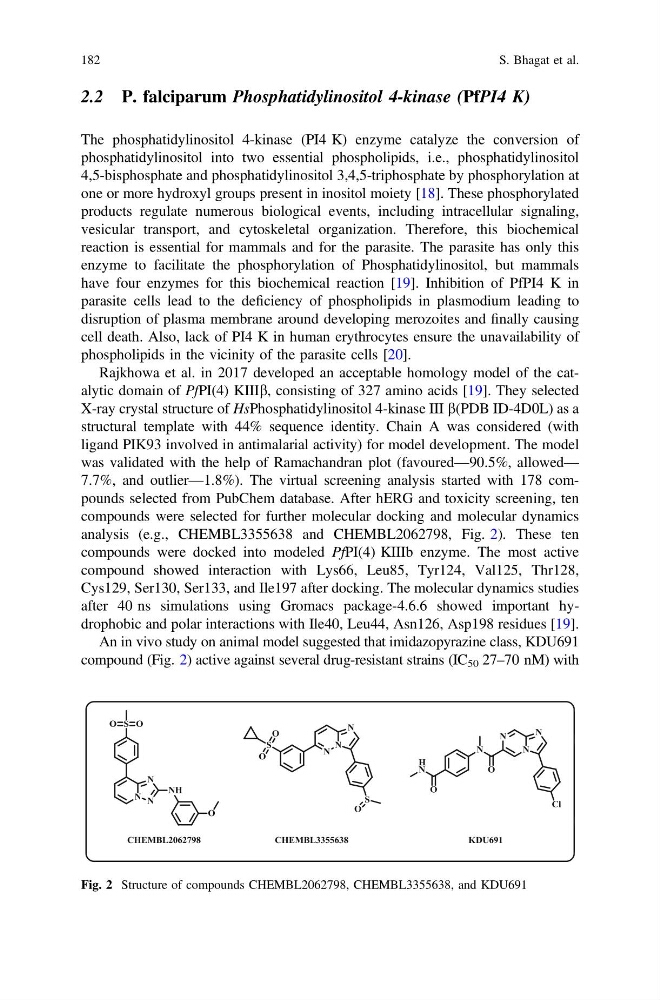
analysis (e.g., CHEMBL3355638 and CHEMBL2062798, Fig. 2). These ten
compounds were docked into modeled PfPI(4) KIIIb enzyme. The most active
compound showed interaction with Lys66, Leu85, Tyr124, Val125, Thr128,
Cys129, Ser130, Ser133, and Ile197 after docking. The molecular dynamics studies
after 40 ns simulations using Gromacs package-4.6.6 showed important hydrophobic and polar interactions with Ile40, Leu44, Asn126, Asp198 residues [19].
An in vivo study on animal model suggested that imidazopyrazine class, KDU691
compound (Fig. 2) active against several drug-resistant strains (IC 50 27–70 nM) with
Fig. 2 Structure of compounds CHEMBL2062798, CHEMBL3355638, and KDU691
182
S. Bhagat et al.
The phosphatidylinositol 4-kinase (PI4 K) enzyme catalyze the conversion of
phosphatidylinositol into two essential phospholipids, i.e., phosphatidylinositol
4,5-bisphosphate and phosphatidylinositol 3,4,5-triphosphate by phosphorylation at
one or more hydroxyl groups present in inositol moiety [18]. These phosphorylated
products regulate numerous biological events, including intracellular signaling,
vesicular transport, and cytoskeletal organization. Therefore, this biochemical
reaction is essential for mammals and for the parasite. The parasite has only this
enzyme to facilitate the phosphorylation of Phosphatidylinositol, but mammals
have four enzymes for this biochemical reaction [19]. Inhibition of PfPI4 K in
parasite cells lead to the deficiency of phospholipids in plasmodium leading to
disruption of plasma membrane around developing merozoites and finally causing
cell death. Also, lack of PI4 K in human erythrocytes ensure the unavailability of
phospholipids in the vicinity of the parasite cells [20].
Rajkhowa et al. in 2017 developed an acceptable homology model of the catalytic domain of PfPI(4) KIIIb, consisting of 327 amino acids [19]. They selected
X-ray crystal structure of HsPhosphatidylinositol 4-kinase III b(PDB ID-4D0L) as a
structural template with 44% sequence identity. Chain A was considered (with
ligand PIK93 involved in antimalarial activity) for model development. The model
was validated with the help of Ramachandran plot (favoured—90.5%, allowed—
7.7%, and outlier—1.8%). The virtual screening analysis started with 178 compounds selected from PubChem database. After hERG and toxicity screening, ten
compounds were selected for further molecular docking and molecular dynamics
analysis (e.g., CHEMBL3355638 and CHEMBL2062798, Fig. 2). These ten
compounds were docked into modeled PfPI(4) KIIIb enzyme. The most active
compound showed interaction with Lys66, Leu85, Tyr124, Val125, Thr128,
Cys129, Ser130, Ser133, and Ile197 after docking. The molecular dynamics studies
after 40 ns simulations using Gromacs package-4.6.6 showed important hydrophobic and polar interactions with Ile40, Leu44, Asn126, Asp198 residues [19].
An in vivo study on animal model suggested that imidazopyrazine class, KDU691
compound (Fig. 2) active against several drug-resistant strains (IC 50 27–70 nM) with
Fig. 2 Structure of compounds CHEMBL2062798, CHEMBL3355638, and KDU691
182
S. Bhagat et al.