

P
3
0.1
0.2
0.3
0.4
0.5
0.6
BMEP/MPa
ULSD
Blend-1
Blend-2
Blend-3
Blend-4
Biodiesel
80
70
60
50
40
30
20
10
0
M mass concentration/mg/m
0.7
76
Alternative Fuels for Transportation
and hence increases the temperature of the combustion chamber. Lapuerta,
Armas, and Jose (2008) reported that the U.S. EPA obtained the following
equation for NO x emissions,
NO
0 0009794 B
= e − .
% .
NOx diesel
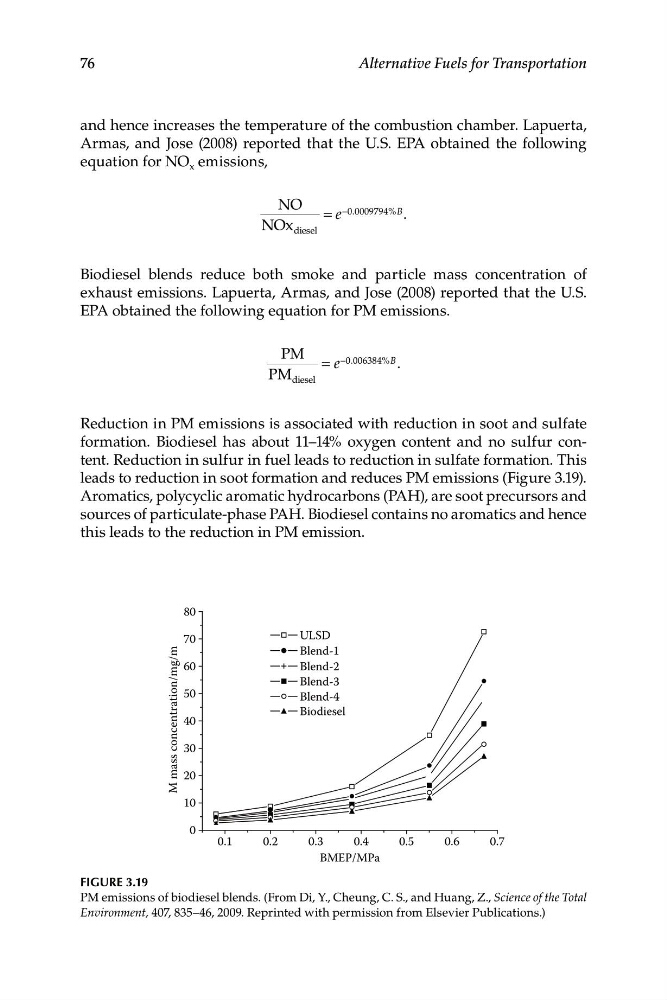
Biodiesel blends reduce both smoke and particle mass concentration of
exhaust emissions. Lapuerta, Armas, and Jose (2008) reported that the U.S.
EPA obtained the following equation for PM emissions.
PM
0 006384%B
.
= e −
.
PM diesel
Reduction in PM emissions is associated with reduction in soot and sulfate
formation. Biodiesel has about 11–14% oxygen content and no sulfur content. Reduction in sulfur in fuel leads to reduction in sulfate formation. This
leads to reduction in soot formation and reduces PM emissions (Figure 3.19).
Aromatics, polycyclic aromatic hydrocarbons (PAH), are soot precursors and
sources of particulate-phase PAH. Biodiesel contains no aromatics and hence
this leads to the reduction in PM emission.
Figure 3.19
PM emissions of biodiesel blends. (From Di, Y., Cheung, C. S., and Huang, Z., Science of the Total
Environment, 407, 835–46, 2009. Reprinted with permission from Elsevier Publications.)
3
0.1
0.2
0.3
0.4
0.5
0.6
BMEP/MPa
ULSD
Blend-1
Blend-2
Blend-3
Blend-4
Biodiesel
80
70
60
50
40
30
20
10
0
M mass concentration/mg/m
0.7
76
Alternative Fuels for Transportation
and hence increases the temperature of the combustion chamber. Lapuerta,
Armas, and Jose (2008) reported that the U.S. EPA obtained the following
equation for NO x emissions,
NO
0 0009794 B
= e − .
% .
NOx diesel
Biodiesel blends reduce both smoke and particle mass concentration of
exhaust emissions. Lapuerta, Armas, and Jose (2008) reported that the U.S.
EPA obtained the following equation for PM emissions.
PM
0 006384%B
.
= e −
.
PM diesel
Reduction in PM emissions is associated with reduction in soot and sulfate
formation. Biodiesel has about 11–14% oxygen content and no sulfur content. Reduction in sulfur in fuel leads to reduction in sulfate formation. This
leads to reduction in soot formation and reduces PM emissions (Figure 3.19).
Aromatics, polycyclic aromatic hydrocarbons (PAH), are soot precursors and
sources of particulate-phase PAH. Biodiesel contains no aromatics and hence
this leads to the reduction in PM emission.
Figure 3.19
PM emissions of biodiesel blends. (From Di, Y., Cheung, C. S., and Huang, Z., Science of the Total
Environment, 407, 835–46, 2009. Reprinted with permission from Elsevier Publications.)